Specialty Acquisition
Skylight Installation Leads
Skylight enquiries from Rent Roofing Sites come from homeowners and building owners who contact a local website, domain or tracking number the network owns and operates in a given market, and the word "skylight" covers three genuinely different jobs: cutting a brand-new opening into an existing roof, replacing an aging or damaged unit in an opening that already exists, and investigating a leak at or near a skylight that may or may not require a new unit at all.
These three paths call for different crew skills, different timelines, and in some cases a different trade partner entirely. A new installation changes the structure of the roof and typically involves interior finishing work — drywall, trim, sometimes a light well — that a pure roofing crew may not perform themselves. A replacement in an existing opening is closer to standard roofing and flashing work. A leak investigation may turn out to be a flashing failure unrelated to the skylight unit, or a problem with a nearby roof section rather than the skylight at all.
Not every roofing company that handles general repair and replacement work also installs or services skylights, and the intake is built around that reality: enquiries are routed only to roofing partners that have explicitly indicated they accept skylight-related work, so a lead doesn't land with a company that has no interest in or history with this scope. The intake also separates roofing-side questions from interior-finishing questions, since a caller's expectations about interior drywall or trim work can extend beyond what a roofing partner has agreed to perform.
Whether a skylight-focused territory is open in your market, and whether your company is flagged to receive this specific type of enquiry, depends on a Roofing Market Review, because specialty program inventory is reviewed per market and the live network is a small number of sites across PA, TX and IL. This page explains how the skylight lead program is built so you can evaluate the offer — it is not a claim that a territory is open right now.
Updated 2026-10-03. Terms, prices and availability are set by the written agreement for your market.
Separating a new opening from skylight replacement and leak repair
A caller who says "I want a skylight" might mean three very different things, and the intake's first job is figuring out which one, since the answer changes the entire scope of the project. The phrasing a homeowner uses isn't always a reliable signal on its own — someone describing a "skylight repair" may actually be asking for a full replacement, or may genuinely have a leak with no interest in a new unit.
New installation
The homeowner wants a skylight where none currently exists. This means cutting a new structural opening in the roof deck and framing, which is the most involved of the three paths and typically requires interior work to finish the resulting opening from inside the room.
Existing-unit replacement
An opening and unit already exist, and the homeowner wants the current skylight replaced — often because of age, fogging between glass panes, a cracked dome, or a desire to upgrade to a different style or glazing. This is closer to standard roofing and flashing work, since the structural opening doesn't need to change.
Leak investigation
The homeowner has noticed water intrusion at or near an existing skylight and isn't necessarily asking for a new unit — they want to know what's causing the leak and what it will take to fix it. The cause could be the skylight's own flashing, seals, or glazing, or it could be an unrelated roof issue nearby that only appears related because of where the water shows up inside.
- Record which of the three paths the caller is describing, in their own words, even if it changes after more questions.
- Note any mismatch between what the caller says they want and what they describe needing — flag it rather than resolving it yourself.
- Avoid assuming a leak report automatically means a new unit is needed, or that a stated interest in "installing a skylight" means a brand-new opening rather than a replacement.
Capturing existing unit information and the customer's desired change
For both replacement and leak-investigation enquiries, details about the current unit matter, even though most homeowners won't know manufacturer or model information off the top of their head. The intake captures what's reasonably available without requiring the caller to go find paperwork before the call can proceed.
- Approximate age of the existing skylight, if known, or how long the homeowner has owned the property with it in place.
- Visible condition: fogging between panes, visible cracks, staining, or a unit that no longer opens or seals properly if it's an operable model.
- Fixed versus operable (venting) unit, if the homeowner knows which type is currently installed.
- What the homeowner wants to change, if anything — same size and style, a larger opening, a different glazing type, or adding a shade or remote-open feature.
Photos help, but aren't required to proceed
Where a homeowner is comfortable sending a photo of the unit from inside the room, or of visible staining and damage, that can give your estimator useful context before a visit. The intake offers this as an option rather than a requirement, since not every caller is in a position to do this during the initial contact.
Desired-change details shape whether this stays a roofing-only job
A straight like-for-like replacement, same size and roughly the same style, usually stays within a roofing crew's normal scope. A homeowner wanting a larger unit, a different shape, or a switch from fixed to operable may be describing a project closer to a new installation in terms of structural and interior work, even though a unit technically already exists in that location.
TEACHING DIAGRAM
Three-path skylight scope graphic (illustrative example)
- 1Caller request
Homeowner describes wanting a skylight, a replacement, or a leak concern in their own words.
- 2Path identified
New installation, existing-unit replacement, or leak investigation — confirmed through follow-up questions.
- 3Roofing vs interior scope
Exterior roofing work separated from light-well, drywall and trim work the homeowner may expect.
- 4Eligibility check
Enquiry matched only to partners that have opted into the relevant skylight scope type.
- 5Scoped visit
Assessment confirms structural feasibility and the finish-work boundary before any quote.
Understanding roof work, interior work and coordination boundaries
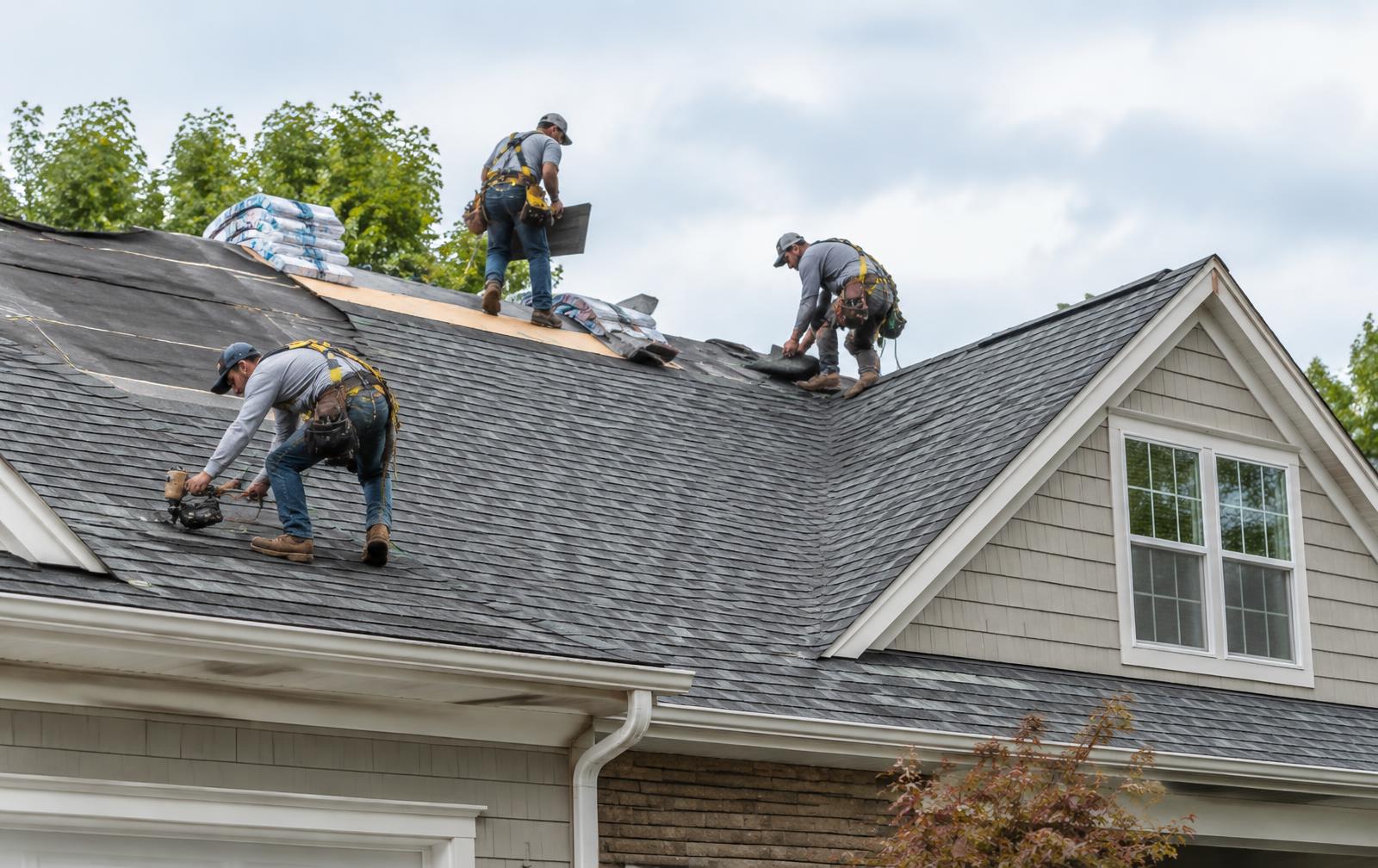
Skylight projects, especially new installations, sit at the boundary between roofing work and interior finishing work, and homeowners researching "skylight installation" often don't realize these are frequently handled as separate scopes, sometimes by separate trades. Setting this expectation clearly during intake avoids a mismatch discovered only after your estimator arrives.
What's typically roofing-side scope
- Cutting or modifying the roof opening and framing for a new installation.
- Setting and flashing the skylight unit itself, whether new or replacement.
- Weatherproofing the exterior roof surface around the unit.
What's typically interior-side scope
- Framing or finishing a light well between the roof opening and the ceiling, for a new installation.
- Drywall, trim, and paint finishing around the interior opening.
- Interior fixtures like blinds, shades, or remote-control hardware, depending on the unit chosen.
Some roofing companies handle interior finishing themselves, some subcontract it, and some only perform the roofing-side scope and expect the homeowner to arrange interior work separately. The intake does not assume which model your company uses — it records what the homeowner is expecting and leaves it to your team's first conversation to clarify what's actually included in a quote from your company.
Recording access and appointment information without guaranteeing feasibility
Before an assessment visit, the intake gathers practical access and scheduling details, while being careful not to promise that a requested skylight is feasible in the location the homeowner has in mind — feasibility depends on the roof framing, structural members, and interior layout, which can only be confirmed on site.
- Record the roof type and approximate pitch if the homeowner can describe it, since steep or complex roofs affect access and installation approach.
- Ask where in the home the homeowner wants a new skylight located, or where the existing unit sits, including which room and roof section.
- Note any known attic or roof access constraints the homeowner is aware of.
- Confirm who will be present for the assessment visit and whether they can make decisions about the project.
- Set a specific assessment window and explain what the visit will determine before a firm quote can be provided.
Why feasibility stays an open question until the visit
A homeowner may want a skylight directly above a specific room, but that location might sit above a structural beam, an HVAC chase, or wiring that makes the exact spot impractical without added cost or a nearby adjustment. None of this can be confirmed from a phone call, so the first conversation should frame the visit as the step that determines what's actually possible in the requested location, not a confirmation that the requested placement will work as described.
MODEL CALCULATOR
Illustrative Skylight Territory Cost Model
A simple model to frame costs against an assumed job mix of replacement and leak-investigation work. All numbers are inputs you set — not measured results.
- Month-1 cost (rental + setup) (US dollars)
- $1,494
- Modeled jobs won (leads x close rate) (count)
- 1
- Modeled revenue (jobs won x average job value) (US dollars)
- $2,200
Illustrative only. Skylight leads-per-month, close rate and average job value are not published figures and must be set by you based on your own market knowledge; actual results depend on territory, housing stock, and which skylight scope types your company has opted into.
Matching the enquiry to roofing partners that expressly offer skylight work
Because skylight work isn't universal across roofing companies, enquiries in this category are only routed to partners that have explicitly indicated they accept skylight-related jobs — new installation, replacement, or leak investigation, depending on which services a given partner has opted into. A company that performs general repair and replacement work but doesn't do skylight installations shouldn't receive a new-installation enquiry simply because it's assigned to the surrounding territory.
- Which skylight scope types a partner accepts: new installation, replacement, leak investigation, or some combination.
- Whether a partner performs interior finishing themselves, subcontracts it, or expects the homeowner to arrange it separately.
- Any brand or product-line preferences or restrictions a partner has indicated for skylight units.
This matching doesn't expand what a roofing partner is assumed to do. If your company hasn't indicated that you accept new-installation skylight work, this program doesn't route that type of enquiry to you by default, and your team's accepted services and territory choices remain the control point, consistent with how the broader lead program works across every category.
Confirming or updating accepted skylight services
If your company's accepted-services settings don't yet distinguish between skylight installation, replacement, and leak investigation, a Roofing Market Review is the place to confirm what's currently configured and request a change. Being specific about which of the three scope types you perform helps avoid enquiries outside what your team actually wants to take on.
Evaluating skylight opportunities within the roofer's service territory
Skylight work tends to be a smaller, more occasional category compared to general roof repair or replacement demand, and it's worth evaluating as a complement to broader territory coverage rather than a standalone volume driver. A company that already holds a residential or commercial territory in a market may see skylight enquiries as an incremental addition within existing coverage, rather than a separate program to budget for independently.
- Does your company currently accept new installation, replacement, leak investigation, or all three — and is that reflected accurately in your settings?
- What does the current local site content say about skylight services, and does it match what your team actually offers?
- How is a skylight enquiry distinguished from a general roof-repair enquiry in the lead record your team receives?
- What CRM delivery options exist for routing a skylight-specific lead type, and what status are they in (live, built, in testing)?
A worked illustrative model can frame the economics, even without published volumes for this category. If a skylight-eligible territory runs at the $997/month site rental list price plus a one-time $497 setup on the first plan, and your company completes even a handful of replacement or leak-investigation jobs alongside your existing repair and replacement work in a given month, the model can work out favorably — but this is a labeled assumption, not a projected result, and depends heavily on your market, your accepted scope types, and your close rate.
| Assumption | Value |
|---|---|
| Monthly site rental (list) | $997 |
| One-time setup (first plan) | $497 |
| Skylight jobs needed to cover month 1 cost | Varies by your average job value — model assumption only |
WORKSHEET
Skylight Scope Checklist
Work through this before a skylight enquiry reaches a proposal.
0 of 8 checked
EXPLAINER VIDEO · 49 SECONDS
Skylight Leads: New Installation, Replacement or Leak Investigation?
Narrated explainer with diagrams drawn for this page. No customer data or private screens are shown.
Video transcript
A skylight call can mean a new opening, a replacement of an existing unit, or a leak investigation. We confirm which before scheduling. For an existing unit we record approximate age and visible condition, and welcome a photo if the homeowner can send one. New installations often need interior finishing. We clarify whether your company handles that or the homeowner arranges it separately. We record the preferred location, but feasibility depends on what your team finds in the framing on site, not a phone promise. Enquiries route only to partners who've opted into that scope type. Skylight inventory is reviewed per market, so book a Roofing Market Review.
STRAIGHT ANSWERS
Questions roofers ask
Will skylight enquiries be separated from general roof-repair leads?
Yes. The intake identifies whether a caller wants a new installation, an existing-unit replacement, or a leak investigation, and records this distinctly from a general repair enquiry so it can be matched to partners that have opted into skylight work.
Can I accept replacements without accepting new roof openings?
Yes. Accepted skylight services can be set by scope type — new installation, replacement, and leak investigation are tracked separately, so your company can opt into some of these without being matched for all of them.
How are interior finishing expectations clarified before a visit?
The intake records what the homeowner expects regarding light wells, drywall, trim and fixtures, and leaves it to your team's first conversation to confirm whether your company performs that work directly, subcontracts it, or expects the homeowner to arrange it separately.
What happens if a leak-investigation call turns out not to be the skylight's fault?
That's a normal outcome. A reported leak near a skylight can originate from flashing, seals, or an unrelated roof section nearby. The intake records what the homeowner observed; your team's on-site assessment determines the actual cause.
Is a specific skylight location guaranteed to work once a homeowner requests it?
No. A requested location is recorded as a starting point for the visit, since structural members, attic layout, or interior obstructions can affect feasibility. This is confirmed on site, not promised during intake.
Do you guarantee a certain number of skylight leads?
No. Rent Roofing Sites does not guarantee lead counts, rankings, or results. Skylight-related demand is reviewed per market as part of the network's specialty program inventory, and availability varies.
Can skylight leads be delivered to my existing CRM?
Yes, through the same delivery options available on other programs: a generic webhook, a private Zapier app, native connections where actually connected and tested, or email/SMS fallback. Every delivery attempt has a status with retries and a fallback alert.
See what exists in your market
A Roofing Market Review is a short call. We check which ZIPs and services you want, whether a network asset or territory is open there, and which plan options would apply. No lead counts or results are promised.