
Specialty Acquisition
Flat Roofing Leads
Flat roofing leads from Rent Roofing Sites cover low-slope roofs on houses, additions, garages, small commercial buildings and multi-tenant properties, captured through the same network of owned local sites, domains and tracking numbers used across the program. A caller mentions a leak, a ponding spot, a membrane that's aged out, or a planned capital project, and the enquiry is recorded, matched to a territory, and routed to the one roofing company assigned there.
Low-slope roofing has its own set of qualification questions that a pitched-roof shingle lead doesn't need. What's the building used for — a home, a rental, a retail space, a warehouse? Who can authorize access and spending — an owner, a tenant, a property manager, a facilities contact? What system is currently on the roof, if the caller knows — TPO, EPDM, modified bitumen, built-up roofing, or something else? And is the caller describing a leak that needs triage now, a drainage concern that's been building for a while, or a planned recover or replacement they're starting to budget for?
Rent Roofing Sites does not decide whether your company treats a flat-roof leak call differently from a capital replacement enquiry, or whether you work on houses, commercial buildings, or both. During onboarding you set which low-slope services and property types you're equipped to serve, and that acceptance list, combined with the specialty inventory gate for this page, determines which enquiries reach your territory.
Whether a flat-roofing territory is open in your market depends on a Roofing Market Review, because the live network is a small number of sites across PA, TX and IL and specialty inventory is reviewed per market, never guaranteed nationally. This page explains how a low-slope enquiry is captured and matched so you can evaluate the offer against your own crew's capability, not a claim that a territory is open right now.
Updated 2026-10-03. Terms, prices and availability are set by the written agreement for your market.
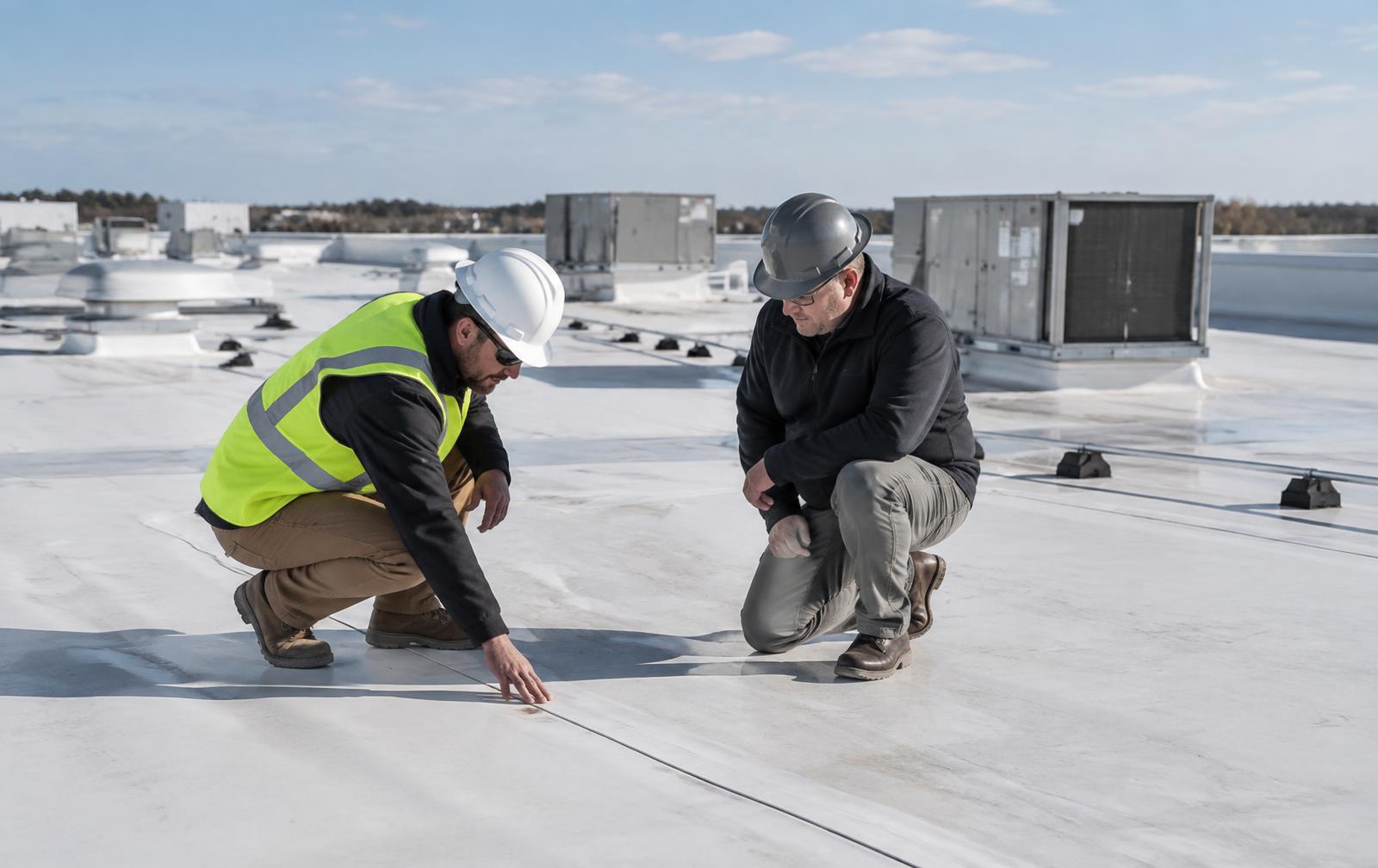
Understanding the building and its low-slope roof before qualification
A flat or low-slope roof enquiry can come from a residential homeowner with a flat-roofed addition or garage, a landlord with a small multi-unit building, a retail or office tenant noticing a ceiling stain, or a facilities contact managing a warehouse roof that's due for capital work. Each of these is a legitimate low-slope roofing lead, but they arrive with very different stakes, decision processes and timelines, and the intake has to capture which one it is before anything else is useful.
The first qualifying fact the lead record tries to establish is what the building is and how it's used — single-family residential, multi-tenant residential, small commercial, or industrial/warehouse — because that single fact changes almost everything downstream: who has authority to approve work, whether there's a property manager or facilities team involved, whether tenants need to be coordinated around, and what size of crew and equipment the job is likely to require.
Why low-slope buildings carry more variables than a pitched residential roof
A pitched shingle roof on a single-family home usually has one roof, one owner, and one straightforward access path. A low-slope roof frequently has rooftop HVAC units, vents, drains, parapet walls, and sometimes solar or communications equipment mounted on it — and the building beneath it may have multiple tenants, each with their own concerns about disruption, noise, or a crew walking through their space to reach a roof hatch.
| Building type | Typical decision authority | Common access complexity |
|---|---|---|
| Single-family home / garage | Homeowner, direct | Ladder or simple roof hatch |
| Small multi-unit residential | Owner or property manager | Shared access, tenant coordination |
| Retail / office commercial | Owner, property manager or tenant with limits | Interior hatch, business hours constraints |
| Warehouse / industrial | Facilities manager, capital budget process | Equipment-heavy rooftop, scheduled access |
The intake form records the building type and use as described by the caller. It does not verify square footage, roof age, or ownership structure, because none of that is confirmable through an online form — it's a starting point your team refines on the first call.
Separating leak service, drainage concerns and planned capital work
Low-slope roofing enquiries generally fall into three categories, and conflating them wastes time on both sides of the call. The first is an active leak — water actively entering the building, often visible as a ceiling stain, dripping, or a wet spot on a top-floor wall. The second is a drainage or ponding concern — water sitting on the roof after rain, a clogged or undersized drain, or a low spot that's been getting worse over seasons but isn't actively leaking indoors yet. The third is planned capital work — a property owner or facilities manager who knows the roof is aging out and is starting to budget for a recover or full replacement before it becomes an emergency.
Leak service
An active leak on a flat roof needs a fast response, similar to a residential pitched-roof leak, but flat-roof leak sources are often harder to trace because water can travel laterally under a membrane before showing up indoors far from the actual breach. The intake captures the caller's description of where the interior damage is appearing, but that location is not necessarily where the roof needs repair, and your team should set that expectation on the first call rather than assuming a quick patch job sight unseen.
Drainage and ponding
Ponding water is a maintenance issue that can become a structural one if ignored, but it's rarely an emergency on the day it's reported. A caller describing standing water after rain, without an active interior leak, usually has more flexibility on scheduling than an active-leak caller, which matters for how you prioritize your week's appointments.
Planned capital work
A facilities contact or property owner calling about a roof they know is near the end of its service life is in a different sales cycle entirely — closer to the commercial replacement conversation than a repair call. These enquiries often involve budget cycles, multiple bids, and a longer decision timeline, and your team's first call should establish where the caller is in that process rather than pushing for an immediate site visit.
- Active leak: confirm interior damage location and roof access, prioritize a fast callback.
- Drainage/ponding: confirm how long the condition has persisted and whether it's worsening, schedule within your normal window.
- Planned capital work: confirm budget timeline, decision process and whether other bids are being sought.
TEACHING DIAGRAM
Low-slope building intake diagram (illustrative sample record)
- 1Enquiry
Caller reports a concern on a network site via call, form or chat, mentioning a flat or low-slope roof.
- 2Building and use
Intake records building type — home, rental, commercial, industrial — and the caller's role.
- 3Concern type
Sorted into active leak, drainage/ponding, or planned capital work based on what's described.
- 4Membrane and access notes
Stated membrane, rooftop equipment and access details recorded as given, not confirmed.
- 5Site assessment
Your estimator confirms membrane, access, authority and the repair/recover/replace decision in person.
Recording the existing membrane without diagnosing roof condition online
Low-slope roofs are built from several distinct membrane systems — TPO, EPDM (rubber), modified bitumen, and built-up roofing (BUR, sometimes called tar-and-gravel) are the most common, and each has different repair methods, different expected service life, and in many cases, different crew expertise required. The intake form asks whether the caller knows their current roof system and records whatever answer is given, including "not sure," which is itself a common and legitimate response from a homeowner or a tenant who has never had reason to know.
A stated membrane type is useful context for your estimator to review before a visit, but it is not a confirmed specification and should never be treated as one. Property owners sometimes guess based on what a previous roofer told them years ago, what color the roof is, or what they assume "flat roof" material usually is in their area. Membrane systems can also have been added to or patched over the years, so what's currently visible on top may not match what the building was originally built with.
Why membrane-neutral intake matters
A flat-roof lead program that assumes every caller's roof is TPO, or auto-fills a membrane type based on building age, will mislead your team before the first call even happens. Keeping the intake question open and membrane-neutral — simply asking what the caller believes is on their roof, if anything — produces a more honest starting point than guessing on the caller's behalf.
- Caller states a known membrane ("I was told it's EPDM") — useful starting context, still unconfirmed.
- Caller doesn't know — common and expected, especially for tenants or newer owners; your team identifies it on site.
- Caller describes the roof by color or texture rather than material name — record as given, clarify in person.
Roof condition itself — how much life is left in the membrane, whether seams are failing, whether insulation underneath is wet — can only be assessed by someone on the roof, ideally with the ability to cut a test section or use moisture-detection equipment where appropriate. No online form, photo upload, or phone description substitutes for that inspection, and claiming otherwise to a caller sets up a disappointing first visit.
Where a caller supplies photos through chat or a form upload, those images can help your estimator get a general sense of the roof before arriving, but photo quality, lighting, and vantage point from the ground or a phone held up to a window are not reliable enough to replace a direct inspection.
Preparing for access, rooftop equipment and tenant coordination
Getting a crew or estimator safely and efficiently onto a low-slope roof is often more complicated than a pitched residential job, and planning for it before the visit saves a wasted trip. Commercial and multi-tenant low-slope roofs in particular tend to have real obstacles: locked roof hatches, ladders that require a key or an escort, HVAC units and ductwork that limit where equipment can be placed, and tenants below who need advance notice before a crew walks across a roof above their ceiling.
Access questions worth confirming before scheduling
- Is roof access through an interior hatch, an exterior ladder, or a lift, and who holds the key or can grant entry?
- Are there rooftop units — HVAC, exhaust fans, solar, communications equipment — that affect where crews can walk or stage materials?
- Does the building have tenants who need advance notice, and who is the point of contact for coordinating that?
- Are there business-hours restrictions, such as a retail tenant who doesn't want roof work noise during store hours?
- Is there safe fall protection or guardrail infrastructure already in place, or will the crew need to bring their own?
Tenant versus owner coordination
A tenant who reports a leak is usually the right person to coordinate interior access and describe the damage, but is rarely the person who can authorize roof work or approve its cost. A property manager may have delegated authority for routine repair spending but often needs the building owner's sign-off for a larger recover or replacement project. Confirming who has access authority and who has spending authority — they are not always the same person — on the first call avoids scheduling a visit that produces an inspection but no path to a signed agreement.
| Contact role | Can grant access | Can approve spending |
|---|---|---|
| Owner-occupant homeowner | Yes | Yes |
| Tenant (residential or commercial) | Often, with notice | Rarely |
| Property manager | Usually | Sometimes, up to a limit |
| Facilities manager | Usually | Often needs capital-budget approval |
MODEL CALCULATOR
Illustrative Flat-Roofing Territory Cost Model
A simple model to frame costs against an assumed close rate. All numbers are inputs you set — not measured results.
- Month-1 cost (rental + setup) (US dollars)
- $1,494
- Modeled jobs won (leads x close rate) (count)
- 1.4
- Modeled revenue (jobs won x average job value) (US dollars)
- $20,160
Illustrative only. Leads-per-month and close-rate are not published figures and must be set by you based on your own market and crew capability; actual results depend on territory, property mix, and your team's follow-up.
Leaving repair, recover or replacement decisions to a site assessment
Three outcomes are typically on the table for an aging or damaged low-slope roof: a targeted repair to address a specific leak or failed section, a recover where a new membrane is installed over the existing one where code and condition allow, or a full tear-off and replacement. Which of these makes sense depends on the membrane's remaining service life, the condition of the insulation and deck underneath, local code restrictions on recover layers, and the building owner's budget and timeline — none of which can be determined from an intake form.
The lead record should never suggest an outcome to the caller before an assessment has happened. A caller who was told on a sales call that their roof "probably just needs a recover" based on a phone description, and then learns on site that wet insulation requires a full tear-off, has a reasonable complaint about how that conversation was handled. The honest answer during intake and the first call is that repair, recover or replacement is a site-assessment decision, not a phone diagnosis.
What a site assessment typically evaluates
- Remaining membrane life and the extent of seam or flashing failure.
- Moisture presence in the insulation layer, often checked with a moisture meter or infrared scan.
- Deck condition underneath the membrane and insulation.
- Code restrictions on the number of roofing layers allowed before a tear-off is required.
- Drainage adequacy — whether existing drains or scuppers are sized correctly for current rainfall patterns.
For a planned capital project, the site assessment often becomes the basis for a written proposal that the facilities manager or owner takes into a broader budget or bid-comparison process. For an active leak, the assessment may lead to an immediate targeted repair with a separate, later conversation about whether a full recover or replacement makes more sense given the roof's overall condition.
Where the building owner is comparing your company against other bids — common for planned capital work — being direct about what still needs assessment, rather than offering a number before inspecting, tends to build more credibility than a fast guess that later has to be revised upward.
Matching low-slope demand to the roofer's service and property capabilities
Not every roofing company that handles pitched residential shingle work also handles low-slope commercial membrane systems, and the reverse is just as true — some companies specialize almost entirely in flat and low-slope work and have little residential shingle crew capacity. During onboarding, your company states which low-slope services it performs (leak repair, recover, full replacement) and which property types it's equipped for (residential flat sections, small commercial, larger commercial or industrial), and that acceptance list, combined with the specialty inventory gate for this page, is what determines which flat-roofing enquiries reach your territory.
A company set up for residential flat-roofed additions and garages may not have the crew size, insurance coverage, or equipment for a warehouse roof replacement, and shouldn't be routed those leads. A commercial-focused low-slope specialist may have no interest in a small residential patch job that doesn't justify mobilizing a crew. Keeping this distinction current in your onboarding profile is what keeps flat-roofing leads in your territory worth the rental.
Evaluating territory demand honestly
Rent Roofing Sites does not publish search volumes, conversion rates, or lead-count figures for flat and low-slope roofing in any market, because keyword data for a given area is unmeasured and the network does not guarantee lead counts. A Roofing Market Review is the venue to discuss what currently exists in a given territory: whether a site is already live there, what low-slope content and intake questions it runs, and what the written agreement says about exclusivity, term and exit.
- Is there an existing site in this territory, and does its intake already separate leak, drainage and planned-capital enquiries?
- What property types — residential, small commercial, industrial — does the current content and intake address?
- How does the specialty inventory gate apply my stated capability list to incoming flat-roofing enquiries?
- What does the written agreement say about exclusivity and reassignment if a rental pauses or ends?
- What CRM delivery options exist for my software, and what status are they in right now?
A worked illustrative model can frame the economics even without published demand data. If a flat-roofing territory runs at the $997 per month site-rental list price plus a one-time $497 setup on the first plan, and your company closes one mid-size recover or replacement project from that territory in a month, the revenue from that job will typically exceed the monthly cost by a wide margin — but this is a labeled model assumption about your own job value and close rate, not a projection of what any specific territory will produce.
| Assumption | Value |
|---|---|
| Monthly site rental (list) | $997 |
| One-time setup (first plan) | $497 |
| Low-slope projects needed to cover month-1 cost | Varies by your average job value — model assumption only |
WORKSHEET
Flat-Roof Enquiry Checklist
Work through this before scheduling a site visit on a flat or low-slope roofing lead.
0 of 9 checked
EXPLAINER VIDEO · 50 SECONDS
Flat Roofing Leads: TPO, EPDM and Who Decides
Narrated explainer with diagrams drawn for this page. No customer data or private screens are shown.
Video transcript
Flat roofs leak in their own ways: ponding water, open seams, and failed flashing at walls and drains. The membrane type changes the repair. On many flat roofs the caller is a tenant or manager. Confirm who can approve and pay for work before you schedule a visit. Good intake asks about the membrane if known, the building use, roof access, and where the leak shows inside. A flat roof job can be a patch, a maintenance plan, or a full replacement. Tell us which ones your crew wants. Flat roof enquiries vary by market and are reviewed one market at a time. Book a Roofing Market Review to check yours.
STRAIGHT ANSWERS
Questions roofers ask
Can flat-roof leads include both homes and commercial buildings?
Yes. The intake records building type and use as the caller describes it, covering residential flat sections, small commercial buildings and industrial properties. You set which property types your company is equipped to serve during onboarding, and that list affects which enquiries are routed to you.
Will the lead identify the membrane if the customer knows it?
If a caller states a membrane type — TPO, EPDM, modified bitumen or built-up roofing — it's recorded as given. Many callers don't know, which is recorded as well. Either way, the actual system and its condition are confirmed by your team on site, not from the intake record.
Does a flat-roof enquiry establish that coating or replacement is suitable?
No. The intake captures a reported concern and whatever the caller knows about their roof. Whether a repair, a recover, a coating, or a full replacement is appropriate is a site-assessment decision made by your team after inspecting the roof's condition.
How do you separate an urgent leak call from a planned capital project?
Intake asks whether water is actively entering the building, sitting on the roof without an interior leak, or whether the caller is budgeting ahead for a future recover or replacement. Those three categories carry different urgency and are flagged accordingly.
Can I accept flat-roof leak repairs without taking on full commercial replacement projects?
Yes. Your onboarding profile lets you separate accepted low-slope services — leak repair, recover, full replacement — and property types, and the specialty inventory gate for this page uses that list before routing an enquiry to your territory.
Is flat-roofing territory availability guaranteed in my market?
No. Flat-roofing specialty inventory is reviewed per market as part of a small live network across PA, TX and IL, and is never guaranteed nationally. A Roofing Market Review checks what currently exists before any agreement is discussed.
What if the tenant who reports a leak can't authorize the repair?
That's common and expected. The lead record shows who called and what they described, but your team still confirms who holds access authority and who holds spending authority — often different people — before scheduling a visit meant to produce a signed agreement.
See what exists in your market
A Roofing Market Review is a short call. We check which ZIPs and services you want, whether a network asset or territory is open there, and which plan options would apply. No lead counts or results are promised.