Specialty Acquisition
Roof Coating Leads
Roof coating leads from Rent Roofing Sites come from building owners and property managers who contact a local website, domain or tracking number the network owns and operates in a given market. They've typically heard that a coating or restoration system might extend a roof's life without a full tear-off, and they're calling to find out whether that applies to their building.
A coating enquiry is interest, not a confirmed fit. Whether a roof is actually a candidate for coating depends on substrate type, current condition, moisture content, prior repairs, and manufacturer requirements that can only be confirmed by a contractor on site. This page is built around that distinction: the intake captures what the owner reports and wants, and your team's assessment determines what's actually possible.
Commercial roof coating work also brings a decision-authority layer that residential leads usually don't: the person calling may be a facilities manager, a property manager, or a tenant representative rather than the building owner who can sign a contract. Capturing that distinction early changes how your team prepares for the first conversation and the eventual site visit.
Whether a coating-focused territory is open in your market depends on a Roofing Market Review, because specialty program inventory, including coating and restoration demand, is reviewed per market and the live network is a small number of sites across PA, TX and IL. This page explains how the lead program is built so you can evaluate the offer — it is not a claim that a territory is open right now.
Updated 2026-10-03. Terms, prices and availability are set by the written agreement for your market.
Identifying the building owner's reason for considering roof restoration
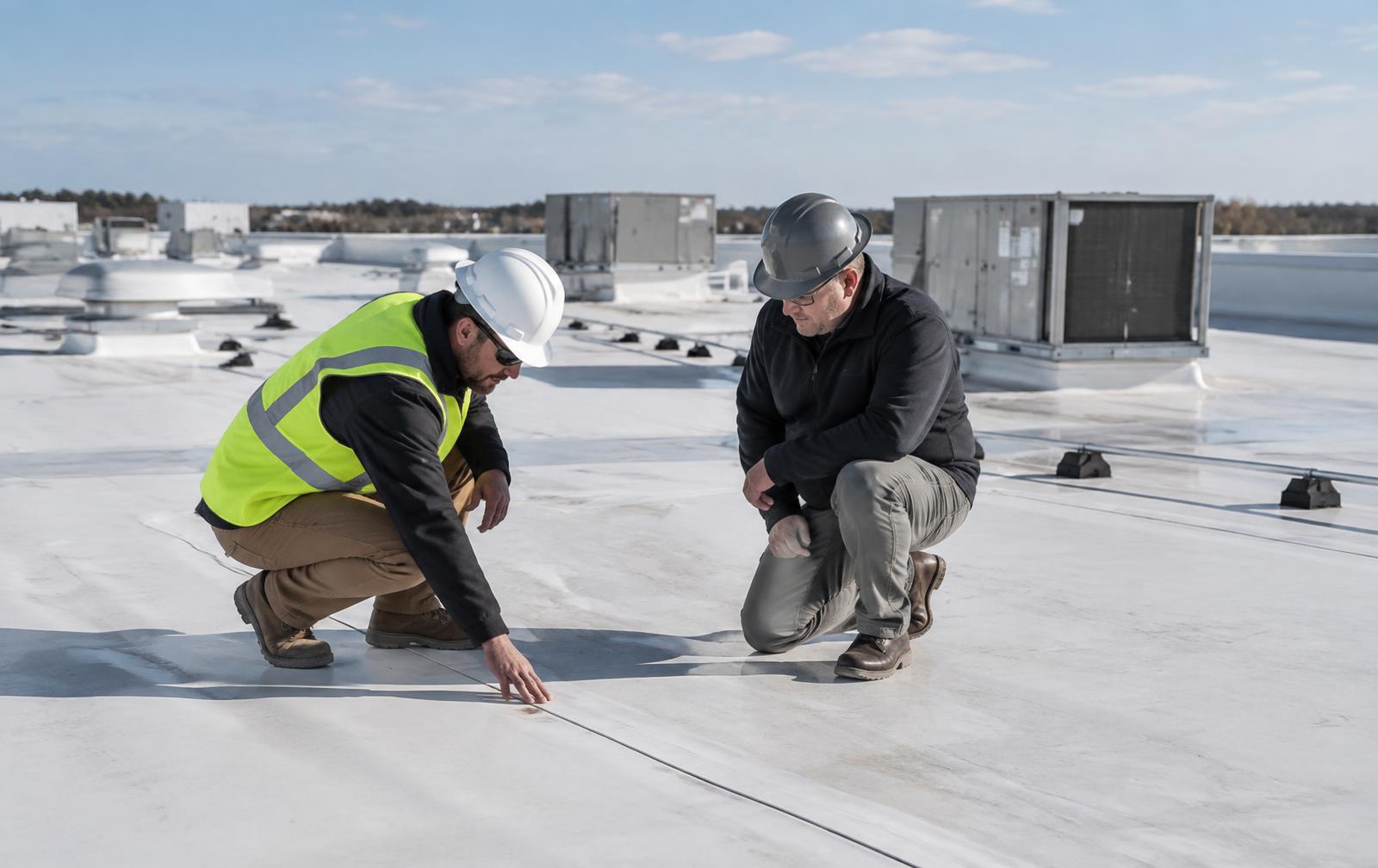
Owners and facilities contacts come to a coating enquiry from a handful of different starting points, and the reason behind the call shapes what they actually need from your company. Some have been told by a roofing contractor, an insurance inspector, or a property condition report that coating is an option worth exploring. Others are searching on their own after noticing ponding water, visible wear, or rising energy costs and have landed on "roof coating" as a possible answer without a professional recommendation behind it yet.
Cost-driven interest
A common driver is budget: a full roof replacement is a large capital expense, and a coating system is often positioned as a lower-cost way to extend service life. An owner calling for this reason wants to understand whether coating is realistic for their specific roof before they commit budget to either option.
Performance-driven interest
Some callers are after a specific performance outcome — reducing interior heat gain, addressing minor leaks without a full re-roof, or meeting a sustainability or reflectivity target for the property. These owners may already know which coating category interests them (reflective, silicone, acrylic) from research, even before a contractor has weighed in.
Maintenance-cycle interest
A property manager working through a scheduled maintenance plan may be calling simply because a coating or recoat is due per the building's roof management plan, not because of an active problem. This caller often has more documentation available — prior roof reports, warranty paperwork — than someone calling reactively.
- Record the owner's stated reason for considering coating in their own words.
- Note whether a professional (inspector, engineer, prior contractor) has already suggested coating, or whether the owner is exploring on their own.
- Capture any specific performance goal mentioned — energy cost, leak reduction, sustainability requirement.
Recording the existing substrate and previous roof treatments
Coating suitability depends heavily on what's already on the roof. A silicone coating over an existing EPDM membrane is a different conversation than a coating proposal for a built-up asphalt roof with multiple prior repairs, and an owner's description of their own roof is often incomplete or imprecise — "it's some kind of rubber roof" or "I think it's the flat kind" is common and expected from a non-roofer.
- Substrate type, if the owner knows it: TPO, EPDM, built-up/asphalt, modified bitumen, metal, or unknown.
- Approximate roof age or installation date, if available from paperwork or a prior contractor.
- Any prior coating, patch, or repair work the owner is aware of, including rough timing.
- Known leak history, even if resolved, since prior moisture intrusion affects coating eligibility.
Why "unknown" is still a usable answer
An owner who doesn't know their substrate type isn't a disqualified lead — it's the normal state for many property managers, especially on buildings they've managed for a short time or inherited from a previous management company. The intake record should capture "unknown" honestly rather than guessing, because a guessed substrate can set the wrong expectation before your estimator ever sees the roof.
Where paperwork exists — a prior roof report, a warranty document, or an as-built roofing plan — the owner may be able to send it ahead of the visit. The intake doesn't require this, but noting that it exists and offering to collect it before the site visit can save your estimator time.
TEACHING DIAGRAM
Coating-enquiry assessment ladder (illustrative example)
- 1Owner goal
Cost, performance, or maintenance-cycle reason given for considering coating.
- 2Known substrate
Owner reports substrate type and age where known, or confirms it's unknown.
- 3Unknown condition
Moisture, hidden damage and manufacturer eligibility remain unconfirmed until assessed.
- 4Assessment findings
Contractor checks substrate condition, moisture and drainage on site.
- 5Recommendation
Coating, repair, or replacement — determined by findings, not assumed at intake.
Separating coating interest from confirmed system suitability
This is the central distinction of a coating enquiry, and it's worth stating plainly to the property owner as part of your team's first response: expressing interest in a coating system does not mean the roof is a candidate for one. Coating manufacturers set moisture-content limits, substrate-condition requirements, and often require a core cut or moisture scan before any warranty is issued.
Conditions that commonly rule out or complicate coating
- Trapped moisture in the insulation or substrate, which coating will seal in rather than resolve.
- Membrane that's already failing structurally, where coating would mask rather than fix the underlying problem.
- Extensive ponding that a coating alone won't correct without underlying drainage work.
- A substrate incompatible with the coating system the owner is asking about, without a primer or different product.
None of these can be ruled in or out from a phone call or an online form. A roof that looks fine from the ground, or even from photos the owner sends, can have moisture trapped beneath the surface that only a moisture scan or core sample reveals. This is why the program treats every coating enquiry as a request for an assessment, not a request for a coating quote.
Setting this expectation early protects both sides
An owner who calls expecting a same-day coating price, and instead gets a conversation about moisture scans and site assessments, can feel like the process is slower than they wanted. Framing the assessment step clearly and early — as part of how any responsible coating contractor operates, not as a delay specific to your company — tends to set a more realistic expectation.
Preparing the contact for the roofer's condition assessment
Once an enquiry is routed to your company, how your team frames the first call affects whether the assessment visit actually produces a usable outcome. Because a coating recommendation depends on findings your team hasn't made yet, the first call is about setting up the assessment correctly, not about pre-selling a specific system.
- Confirm the substrate type and age information the owner has, noting where it's uncertain.
- Explain, in plain terms, that coating eligibility depends on a site assessment, including a visual check and possibly a moisture scan.
- Ask whether the owner has existing roof documentation (reports, warranties, as-built drawings) and offer to review it before the visit.
- Confirm who will be present for the visit and whether they can authorize next steps.
- Set a specific assessment window and clarify what the visit will and won't determine on the spot.
What the assessment visit typically needs to accomplish
A coating assessment usually needs to confirm substrate condition, check for trapped moisture, document existing damage or repairs, and determine whether the roof meets the manufacturer requirements for the coating system under consideration. Your estimator should be prepared to explain findings in terms the owner can act on — not just "yes" or "no" to coating, but what the findings mean for cost, timeline, and alternatives if coating isn't a fit.
| Confirmed during assessment | Why it matters |
|---|---|
| Substrate type and condition | Determines which coating systems, if any, apply |
| Moisture presence | Trapped moisture can disqualify coating or require remediation first |
| Existing repairs or patches | Affects surface prep and whether coating will hold evenly |
| Drainage and ponding | Coating alone rarely resolves a drainage problem |
MODEL CALCULATOR
Illustrative Coating Territory Cost Model
A simple model to frame costs against an assumed close rate for coating and restoration work. All numbers are inputs you set — not measured results.
- Month-1 cost (rental + setup) (US dollars)
- $1,494
- Modeled jobs won (leads x close rate) (count)
- 0.8
- Modeled revenue (jobs won x average job value) (US dollars)
- $11,250
Illustrative only. Coating leads-per-month and close-rate are not published figures and must be set by you based on your own market knowledge; actual results depend on territory, building stock, and your team's assessment-to-proposal conversion.
Evaluating coating enquiries without promising replacement avoidance
It's tempting to position a coating lead program around the idea that coating avoids a full roof replacement. That framing is accurate for some roofs and wrong for others, and promising avoidance of replacement before an assessment misrepresents what any contractor can actually know over the phone. This program avoids that promise in how enquiries are captured and how your team should frame the first conversation.
A more accurate frame, and the one your team's first call should use: coating is one possible outcome of an assessment, alongside repair, partial recoat, or a recommendation that replacement is the better option given the roof's actual condition. An owner calling about coating should leave the first conversation understanding that the assessment will determine which of those applies to their building.
Evaluating territory fit for coating demand
As with other specialty programs, Rent Roofing Sites does not publish search volumes, keyword difficulty, or lead-count figures for coating and restoration demand in any market — that SEO data is unmeasured, and the network does not guarantee lead counts or project volume. What's worth evaluating on a Roofing Market Review call is whether a coating-capable territory exists, what services the current site content and intake cover, and what the written agreement says about exclusivity and term.
- Is there an existing site in this territory, or would this be a new build?
- Does the current site content distinguish coating interest from confirmed suitability, consistent with how your estimators actually operate?
- What does the written agreement say about exclusivity and reassignment if the rental ends?
- What CRM delivery options are available for your software, and what status are they in (live, built, in testing)?
- How is coating-specific intent flagged versus general commercial roofing interest in the lead record?
A worked illustrative model can frame the economics, even without published volumes. If a coating-eligible commercial territory runs at the $997/month site rental list price plus a one-time $497 setup on the first plan, and your company completes even one mid-size coating project in a given month, the model can work out favorably — but this is a labeled assumption, not a projected result, and depends on your market, your close rate, and your assessment-to-proposal conversion.
| Assumption | Value |
|---|---|
| Monthly site rental (list) | $997 |
| One-time setup (first plan) | $497 |
| Coating or restoration jobs needed to cover month 1 cost | Varies by your average job value — model assumption only |
WORKSHEET
Coating Prospect Checklist
Work through this before a roof coating enquiry reaches a proposal.
0 of 8 checked
EXPLAINER VIDEO · 41 SECONDS
Is This Roof Eligible for a Coating?
Narrated explainer with diagrams drawn for this page. No customer data or private screens are shown.
Video transcript
A roof coating can extend the life of a sound roof. It will not save a roof that has already failed. Eligibility starts with the existing roof type and condition: rust, open seams, ponding water, and surface wear. Coating over wet insulation traps moisture. A moisture check comes before any coating decision. Coating warranties have rules. Match the system to the roof and be clear about what is and is not covered. Coating enquiries vary by market. Book a Roofing Market Review to check yours.
STRAIGHT ANSWERS
Questions roofers ask
Does a roof-coating enquiry mean the building is suitable for coating?
No. The enquiry reflects the owner's interest and stated goal, not a confirmed fit. Coating suitability depends on substrate type, condition and moisture content, which can only be confirmed by a contractor during an on-site assessment.
What information should be collected about an existing roof system?
Substrate type if known, approximate age, any prior coating or repair work, and known leak history, even if resolved. Where this information is unknown, the intake records that honestly rather than guessing.
Can coating leads include projects that ultimately need another solution?
Yes. An assessment can lead to a coating recommendation, a repair, a partial recoat, or in some cases a recommendation that replacement is the better option. The enquiry starts the assessment process; it doesn't commit the outcome to coating.
Who typically calls about roof coating — the owner or someone else?
Both. A facilities or property manager often makes the initial call, while the budget decision may sit with a building owner, a regional real estate contact, or a board. Confirming purchasing authority is part of qualifying the enquiry.
Do you guarantee my company will receive a certain number of coating leads?
No. Rent Roofing Sites does not guarantee lead counts, rankings, or results. Coating and restoration demand is reviewed per market as part of the network's specialty program inventory, and availability varies.
Can coating leads be delivered to my existing CRM?
Yes, through the same delivery options available on other programs: a generic webhook, a private Zapier app, or email/SMS fallback. Native connections for some CRMs are built and ready to confirm during onboarding, while others are still in testing — ask about your specific CRM's status.
What if the building's substrate type is completely unknown?
That's common, especially on buildings under newer management, and it doesn't disqualify the enquiry. The intake records "unknown" honestly, and substrate confirmation becomes part of the on-site assessment your team performs.
See what exists in your market
A Roofing Market Review is a short call. We check which ZIPs and services you want, whether a network asset or territory is open there, and which plan options would apply. No lead counts or results are promised.