
Specialty Acquisition
Multifamily Roofing Leads
Multifamily roofing leads from Rent Roofing Sites come from property managers, owners and maintenance staff at apartment communities and rental portfolios who reach a local website, domain or tracking number the network owns and operates in a given market. They're typically calling about a roof problem, a planned project, or a maintenance question affecting one or more occupied residential buildings, not a single-family home.
A multifamily enquiry carries a layer of complexity that single-building residential leads usually don't: multiple stakeholders, occupied units that limit access, and a scope that might cover one roof or an entire portfolio phased over several years. This page is built around that complexity: the intake captures who's calling, how many buildings are involved, and what access constraints exist, so your team isn't discovering those details for the first time on site.
Property management structures vary enough that the person who reports a problem, the person who approves a repair, and the person who signs a contract for a larger project can be three different people, sometimes at three different companies. Confirming those roles early changes how your team prepares for the first call and for the eventual proposal, and it keeps a completed assessment from sitting unanswered because it reached someone without authority to act on it.
Whether a multifamily-focused territory is open in your market depends on a Roofing Market Review, because specialty program inventory, including multifamily and portfolio demand, is reviewed per market and the live network is a small number of sites across PA, TX and IL. This page explains how the lead program is built so you can evaluate the offer — it is not a claim that a territory is open right now.
Updated 2026-10-03. Terms, prices and availability are set by the written agreement for your market.
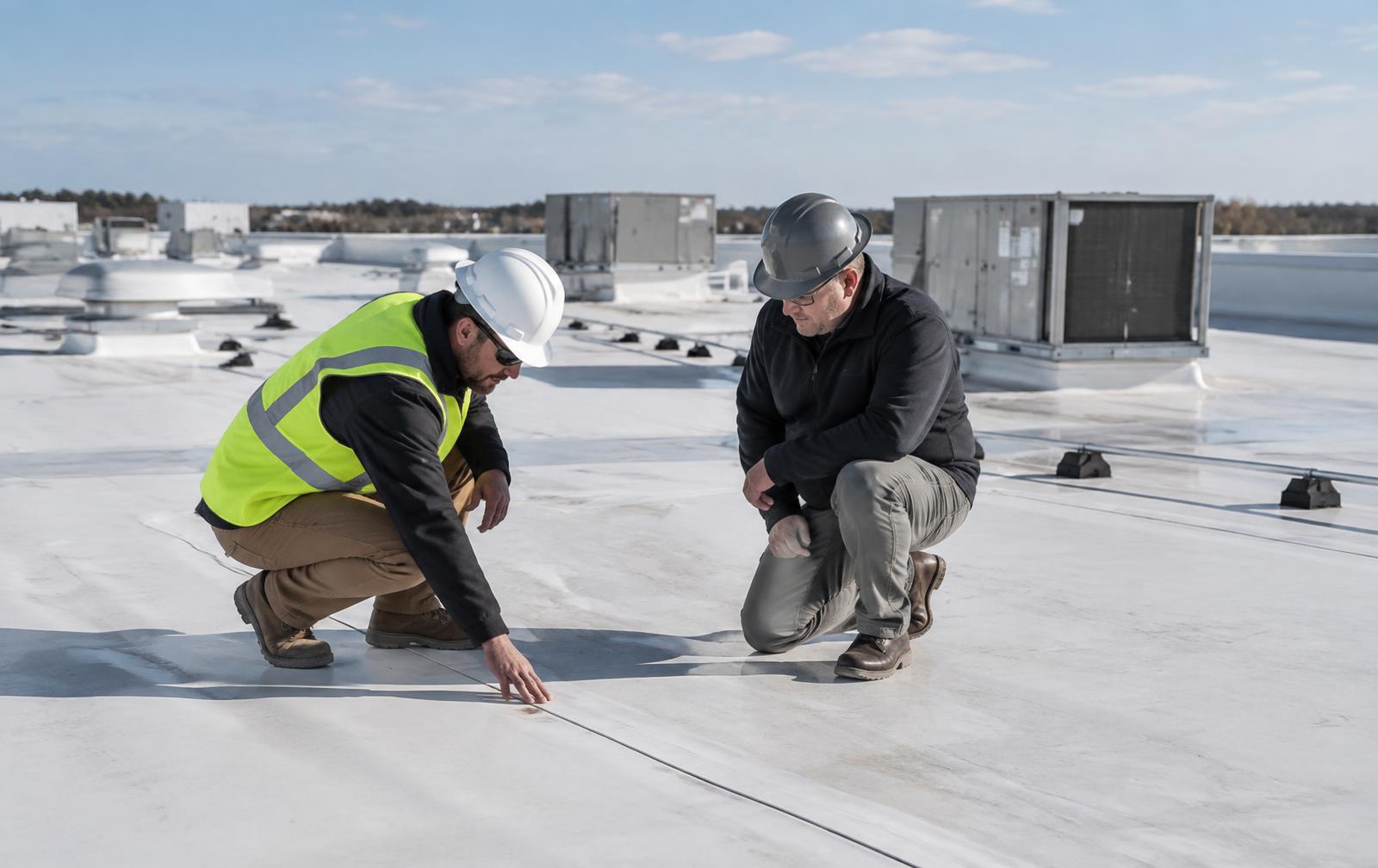
Understanding the owner-manager-resident roles in a multifamily enquiry
A call or form submission from a multifamily property rarely comes from the person who ultimately approves and pays for roofing work. Sorting out who's who early is one of the most useful things an intake can do, because the right next step depends entirely on which role is actually on the line.
Resident or tenant
A resident reporting a leak in their unit is reporting a symptom, not authorizing a project. They typically have no authority over building-level roofing decisions, but their report is often the first signal that something needs attention, and it should be passed to the right property contact rather than treated as a standalone lead to pursue directly.
On-site property manager
An on-site manager usually handles day-to-day maintenance requests and can often authorize smaller repairs within a set budget. Larger projects, like a full building re-roof, typically need approval above the on-site manager's authority.
Regional or portfolio manager
At larger ownership groups, a regional manager or asset manager oversees several properties and controls capital-project budgets. This is often the right contact for anything beyond a routine repair, and the on-site manager may need to route the conversation there.
Owner or ownership group
On smaller or independently owned properties, the owner may be directly reachable and may handle both day-to-day decisions and larger capital approvals personally.
- Record the caller's actual role: resident, on-site manager, regional manager, or owner.
- Note whether the caller can authorize the requested work, or whether approval sits elsewhere.
- Ask directly who else needs to be involved before a proposal can move forward.
Qualifying the number of buildings and the scope under discussion
Multifamily properties range from a single small building to sprawling communities with dozens of structures, and the roofing scope under discussion can be just as varied — one roof with a leak, several buildings due for replacement on a staggered schedule, or an entire portfolio being evaluated at once. The intake should capture this range honestly rather than assuming a single-building scope by default.
- Total number of buildings at the property, and how many are part of the current enquiry.
- Unit count per building or for the property overall, if the caller has it readily available.
- Roof type and approximate age, if known, especially where it differs across buildings.
- Whether the enquiry covers one isolated problem or a broader portfolio-level question.
When the caller doesn't have exact numbers
A caller may know roughly how many buildings are affected without having exact unit counts or roof ages on hand, particularly if they're relatively new to managing the property. Recording approximate figures, clearly marked as approximate, is more useful to your estimator than waiting for exact numbers that may take days to track down.
Where portfolio-level documentation exists — a roof inventory, prior inspection reports, or a capital-reserve study — noting that it's available and offering to review it before a site visit can save real time during the assessment stage.
TEACHING DIAGRAM
Multifamily opportunity map (illustrative example)
| Building | Reported issue | Access/occupancy note | Decision contact |
|---|---|---|---|
| Building A | Active leak, unit 204 | Resident notice required before visit | On-site manager |
| Buildings B-D | Age-related wear, no active leak | Routine access, no resident notice needed | Regional manager |
| Building E | Flagged in prior reserve study | Vacant unit available for inspection | Ownership group |
Capturing occupied-property access and resident coordination needs
Working on an occupied apartment building is different from working on a single-family home or a closed commercial site. Residents are living underneath and around the work area, parking and walkways need to stay usable, and access windows often depend on building management's own notice requirements to tenants, not just your crew's availability.
- Whether the buildings are currently occupied, and at what approximate occupancy level.
- Any resident-notice requirements the property management company needs met before work begins.
- Parking, walkway or amenity-area constraints the crew will need to work around.
- Noise or work-hour restrictions tied to lease terms or local ordinances.
Coordinating with on-site staff
On-site maintenance staff often serve as the day-to-day point of contact during a project, even when a regional manager made the purchasing decision. Confirming who handles access, key coordination and day-of questions prevents a crew from showing up to a building with no one available to grant access or answer resident questions.
- Confirm occupancy status and any required resident notice before scheduling an assessment visit.
- Identify the on-site contact who will coordinate access during the actual visit.
- Ask about parking, walkway and amenity-area constraints affecting equipment staging.
- Note any time-of-day or day-of-week restrictions tied to the property's own policies.
Separating an isolated repair from a phased portfolio project
Not every multifamily enquiry is the start of a large capital project, and treating a single-building leak call as a sign of imminent portfolio-wide work overstates the opportunity. Equally, a call that starts with one leaking building can turn out to be the first conversation in a multi-year replacement plan once the roof's age and the rest of the portfolio come into view.
- Is the reported issue isolated to one roof, or has the caller mentioned similar issues elsewhere on the property?
- Does the property have a capital-reserve plan or replacement schedule that this enquiry might connect to?
- Has the caller mentioned phasing — replacing buildings over several years rather than all at once — as a management approach?
- Is this the first contact about roofing, or does the caller reference prior inspections, bids or contractors?
Why phased projects need their own tracking
A phased portfolio project might involve one building this year and three more over the following two years, with separate approvals at each stage. Counting the whole multi-year phased plan as a single closed opportunity the moment the first building is approved overstates what's actually been decided; each phase typically needs its own confirmation before it should be counted as committed work.
A single-building repair enquiry, by contrast, should be scoped and proposed on its own terms. If the conversation naturally expands to cover other buildings on the property, that expansion gets recorded as new information, not assumed from the start.
MODEL CALCULATOR
Illustrative Multifamily Territory Cost Model
A simple model to frame costs against an assumed close rate for multifamily and portfolio work. All numbers are inputs you set — not measured results.
- Quarter-1 cost (3 months rental + setup) (US dollars)
- $3,488
- Modeled projects won (opportunities x close rate) (count)
- 0.7
- Modeled project revenue (projects won x average value) (US dollars)
- $43,200
Illustrative only. Opportunities per quarter and close rate are not published figures and must be set by you based on your own market knowledge; actual results depend on territory, property stock, and your assessment-to-proposal conversion.
Preparing management for the roofer's assessment and proposal
Once a multifamily enquiry reaches your company, the first call should set up a useful assessment visit rather than attempt to price the work sight unseen. Multifamily roofs can have different ages, systems or repair histories across the same property, and a thorough assessment often needs to account for that building by building, even when the overall request sounds simple at first.
- Confirm the buildings, roof types and any known age or history differences across the property.
- Explain what the assessment visit will cover: roof-by-roof condition, access logistics, and documentation needed for a proposal.
- Confirm who will coordinate access on the day of the visit, and whether resident notice needs to go out first.
- Ask whether a reserve study, prior inspection report or capital plan exists that could inform the proposal.
- Set expectations for how the proposal will address multiple buildings or a phased approach, if relevant.
What a multifamily proposal typically needs to reflect
A proposal for a single building looks different from one addressing several buildings at different points in their service life. Your estimator should be prepared to present findings and options per building where conditions differ, rather than a single blended number that obscures which roofs actually need near-term attention.
| Scope under discussion | What the assessment should address |
|---|---|
| Single building, single issue | Condition at the reported location and overall roof age/history |
| Multiple buildings, similar age | Condition variance across buildings even when built at the same time |
| Portfolio with phased plan | Which buildings need near-term action versus later-phase monitoring |
Evaluating multifamily opportunities across buildings and project stages
Measuring a multifamily pipeline by enquiry count alone can be misleading, since one enquiry might represent a single small repair and another might represent a dozen buildings under one ownership group. A more useful view tracks opportunities by building count and project stage — isolated repair, single-building project, or multi-building/phased project — so your team can see where the real capacity demand sits.
As with other specialty programs, Rent Roofing Sites does not publish search volumes, keyword difficulty, or lead-count figures for multifamily demand in any market — that SEO data is unmeasured, and the network does not guarantee lead counts or project volume. What's worth evaluating on a Roofing Market Review call is whether a multifamily-capable territory exists, whether the current site content distinguishes single-building and portfolio-level enquiries, and what the written agreement says about exclusivity and term.
- Is there an existing site in this territory, or would this be a new build?
- Does the current site intake separate single-building repairs from multi-building or portfolio enquiries?
- What does the written agreement say about exclusivity and reassignment if the rental ends?
- What CRM delivery options are available for your software, and what status are they in (live, built, in testing)?
- How are occupied-property access details and management-role information captured in the lead record?
A worked illustrative model can frame the economics, even without published volumes. If a multifamily-capable territory runs at the $997/month site rental list price plus a one-time $497 setup on the first plan, and your company closes even one multi-building project in a given quarter, the model can work out favorably — but this is a labeled assumption, not a projected result, and depends on your market, your close rate, and the size of properties in your service area.
| Assumption | Value |
|---|---|
| Monthly site rental (list) | $997 |
| One-time setup (first plan) | $497 |
| Multifamily projects needed to cover one quarter's cost | Varies by your average project value — model assumption only |
WORKSHEET
Multifamily Opportunity Brief
Work through this before a multifamily enquiry reaches a proposal.
0 of 8 checked
EXPLAINER VIDEO · 53 SECONDS
Multifamily Roofing Leads: Qualify the Property, the People and the Phases
Narrated explainer with diagrams drawn for this page. No customer data or private screens are shown.
Video transcript
A resident's leak report isn't an approved project. On-site managers often handle small repairs, while owners or regional managers approve larger work. Multifamily enquiries can cover one roof or a dozen buildings. Record counts and ages as given, even when they're only approximate. These are occupied buildings. Resident notice, parking limits and access coordination all need to be captured before a crew shows up. A single leak call isn't automatically a portfolio project, and a phased multi-year plan shouldn't be counted as won all at once. Hand off a building-by-building picture with the next approval step clear, and book a Roofing Market Review to check multifamily demand in your market.
STRAIGHT ANSWERS
Questions roofers ask
Can one multifamily enquiry include multiple buildings?
Yes. The intake records the total number of buildings and units involved where the caller has that information, or approximate figures clearly marked as approximate, so the enquiry isn't assumed to be a single building by default.
How do you distinguish resident complaints from an authorized project request?
The intake records the caller's actual role — resident, on-site manager, regional manager, or owner — and whether they can authorize the requested work. A resident's leak report is passed along as a reported issue, not treated as an approved project.
Will the handoff include occupancy and access considerations?
Yes. Occupancy status, resident-notice requirements, and any parking, walkway or work-hour constraints mentioned by the caller are included in the handoff so your crew isn't discovering them on-site.
Do you guarantee my company will receive a certain number of multifamily leads?
No. Rent Roofing Sites does not guarantee lead counts, rankings, or results. Multifamily and portfolio demand is reviewed per market as part of the network's specialty program inventory, and availability varies.
How is a single-building repair different from a phased portfolio project in your tracking?
They're tracked separately. A single-building repair is scoped and proposed on its own terms, while a phased portfolio project has each phase confirmed individually rather than counting the full multi-year plan as committed the moment the first phase is approved.
What if the property manager doesn't have exact unit or building counts?
That's common, especially for managers newer to a property. Approximate figures are recorded as approximate, and exact details can be confirmed during the on-site assessment rather than delaying the intake.
Can multifamily leads be delivered to my existing CRM?
Yes, through the same delivery options available on other programs: a generic webhook, a private Zapier app, or email/SMS fallback. Native connections for some CRMs are built and ready to confirm during onboarding, while others are still in testing — ask about your specific CRM's status.
See what exists in your market
A Roofing Market Review is a short call. We check which ZIPs and services you want, whether a network asset or territory is open there, and which plan options would apply. No lead counts or results are promised.