
Organic Discovery & Conversion
Roofing Content Marketing
Content marketing under this program means producing and maintaining pages on the roofing websites the network owns and operates — not writing for a roofer's existing company site, and not publishing generic homeowner blog posts unrelated to a buying decision. Every page is built around a real service the assigned contractor can deliver and a real question a homeowner or property owner is actually asking.
This is a B2B service page describing that production and maintenance work, including how topics get selected, how we avoid repeating the same article with a different town name swapped in, what evidence content needs before it publishes, and how the finished pages connect to intake and lead delivery.
A worked example runs through this page: a content brief for a single service-area topic, from the homeowner question through the finished page and its internal links. A content brief template and a topical coverage tool are included so you can see what a complete brief looks like before reviewing live content on a territory's asset.
Whether a content build is active for a given territory, and how much of the asset's coverage is already written versus planned, depends on a Roofing Market Review. Asset status and content inventory are reviewed per market and vary by site.
Updated 2026-10-03. Terms, prices and availability are set by the written agreement for your market.
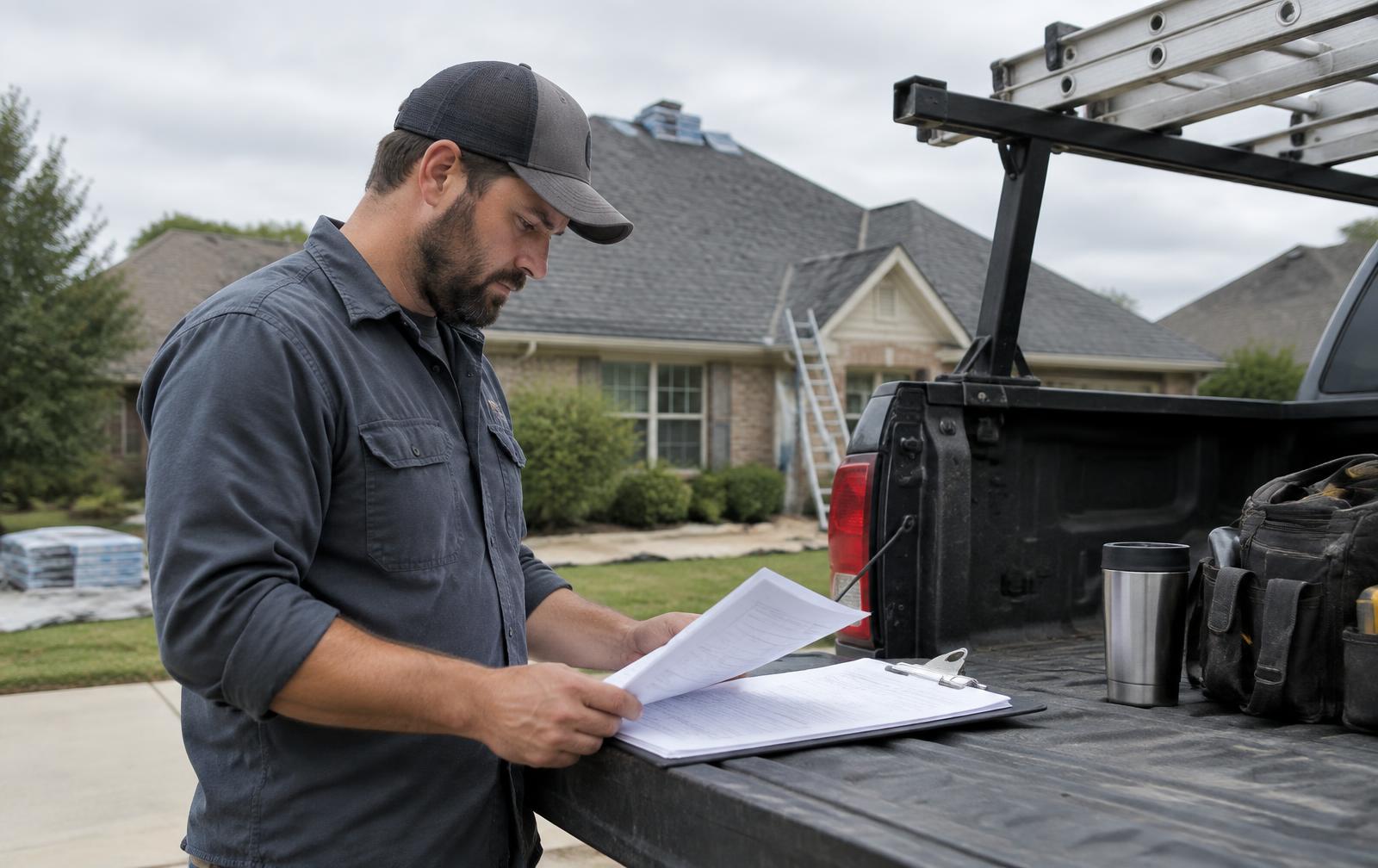
Choose roofing content around buying decisions and service demand
Start with the questions your office already hears on the phone. Homeowners ask whether a few missing shingles mean the whole roof has to go, why a ceiling stain appeared months after a storm, how long a replacement takes, whether metal is loud in the rain, and what happens if rain comes during the job. Each of those questions sits close to a buying decision, and each deserves a clear, honest answer written by someone who understands roofing. A topic list built this way tends to attract visitors who are already thinking about calling someone, which matters more than raw traffic. Because keyword volumes for this program are unmeasured, the list is treated as a set of editorial hypotheses that are checked later against real enquiries.
Topic selection starts from a real decision a homeowner or property owner is making — whether to repair or replace, what a storm inspection involves, what a coating system can and can't fix — not from a generic list of roofing keywords assembled without regard to actual service demand in that territory.
A topic qualifies for the content plan when it connects to a service the assigned contractor actually offers and a question real enquiries in that market have raised. Topics that don't map to an offered service, or that exist only to pad a site's page count, don't make the cut.
Where topics come from
- Patterns in actual call and form enquiries for that territory, where that data is available.
- Services the assigned contractor has confirmed they perform.
- Seasonal and regional context specific to that market, such as storm patterns or common roof types in the area.
- Follow-up questions the contractor's team reports hearing often on first calls.
We do not assume keyword search volumes when selecting topics — Semrush data is currently unavailable, so topic prioritization relies on service relevance and enquiry patterns rather than published search-volume figures.
Assign one useful purpose to each page in the acquisition asset
Each page on a network-owned asset serves one clear purpose: answering a specific service question, explaining a specific problem, or supporting a service page with background detail. A page trying to do all three at once tends to do none of them well and makes the site harder for a visitor — or a search engine — to understand.
Common page purposes
| Purpose | Example |
|---|---|
| Service page | Roof repair in [territory], covering what the service includes |
| Problem explainer | What causes ceiling stains after a storm |
| Process page | What happens during a roof inspection |
| Supporting resource | Materials or roof-type background relevant to the territory |
Service pages carry the primary call-to-action and link directly to the contact path. Problem explainers and process pages build understanding and link into the relevant service page rather than duplicating its contact mechanics.
TEACHING DIAGRAM
Content brief to published page sequence (illustrative example)
- 1Homeowner question
Real question tied to a service the assigned contractor actually offers.
- 2Evidence gathering
Real photos, confirmed process detail and local context collected.
- 3Draft and link
Page written with one purpose and linked to the service it supports.
- 4Accuracy review
Checked against current services, territory and seasonal relevance.
- 5Ongoing evaluation
Reviewed against qualified enquiries, not traffic alone.
Gather real roofing knowledge, photos and local context
The best source material is usually sitting in your own company. Estimators know which questions homeowners ask on the driveway. Crew leads know what decking damage looks like once old shingles come off and why a valley leak often starts higher up the slope. Office staff know which explanations calm a nervous caller. Capturing that knowledge in short interviews, with photos taken on real jobs where the homeowner agreed, gives content a level of detail that generic articles cannot match. When a photo or example is not from a real job, it is labeled clearly as an illustration rather than presented as proof.
Content is only as good as the real information behind it. Before a brief moves to a draft, we gather what's actually true about the service and the territory: real project photos where the assigned contractor has supplied them, genuine local context (climate, common roof ages, typical materials in that area), and details confirmed by the contractor's own team about how they handle a given job.
- Real project photos, captioned accurately and not relabeled from a different market.
- Local weather and roofing-material context specific to the territory, not generic regional filler.
- Process details confirmed by the assigned contractor — what an inspection actually covers, what a typical repair timeline looks like.
- Known local considerations: HOA rules, permit requirements, or common roof types that affect the service.
What we don't fabricate
We do not invent statistics, testimonials, client names, or review counts to fill out a page. Where real proof isn't yet available for a territory, the content is written without that proof rather than with an invented substitute, and the page is flagged for a later update once evidence exists.
Connect service pages, problem explanations and supporting resources
Picture a homeowner who lands on an article about ice dams in late winter. The article explains why ice forms at the eaves, which signs inside the house point to a problem, and what a roofer would check. At the natural point where the reader wonders who can look at their own roof, a link leads to the repair service page for that area, and from there to the call or form. That simple path, from a helpful explanation to the matching service to a contact option, is how content turns into enquiries. Without it, a good article can attract readers who never find the next step.
Pages on an asset link to each other the way a homeowner would actually move through a decision: from noticing a problem, to understanding what it means, to the service that resolves it, to the contact action. A problem explainer about ceiling stains links into the relevant repair or inspection service page; a service page links back to supporting detail a hesitant visitor might still want before contacting the business.
Avoiding repeated city-swap pages
A common thin-content pattern in local service sites is publishing the same article dozens of times with only the town name changed. This program avoids that pattern: where a territory covers multiple towns, the content plan looks for genuinely distinct angles — different common roof types, different storm history, different service radius notes — rather than duplicating one article under many URLs.
- Map each planned page to a specific service and, where relevant, a specific sub-area with a real distinguishing detail.
- Check draft topics against existing pages on the same asset before publishing to avoid near-duplicate coverage.
- Link supporting pages into the service page that converts, not into an unrelated page purely for link count.
- Review the full site's internal link map periodically so new pages don't end up orphaned or looping only among themselves.
MODEL CALCULATOR
Content Brief Template
Use this as a working structure for a single content brief. Values here are placeholders for your own planning, not measured data.
- Modeled hours this cycle (count)
- 24
- Modeled pages per review-cycle week (count)
- 0.5
Illustrative planning structure only. Actual page counts, review cadence, and territory-specific content inventory are set per market and reviewed on a Roofing Market Review, not fixed by this template.
Review accuracy, originality and outdated information
Roofing information goes stale in specific ways. Material lines are discontinued, local permit rules change, manufacturer warranty terms are revised, and seasonal advice that made sense one year can mislead the next. Set a review date on every page, and when a page mentions anything that can change, such as a code requirement or a product, note where that fact came from. During review, check that photos still match the text, that links still work, and that no page has drifted into promising outcomes the network cannot control, such as insurance approvals or specific timelines.
Published content is reviewed on an ongoing basis, not written once and left untouched. Pricing references, service descriptions, and seasonal claims can go stale, and a page describing a service the assigned contractor no longer offers — or a territory boundary that's since changed — needs to be corrected or retired.
- Check service descriptions against what the currently assigned contractor has confirmed they offer.
- Flag seasonal content (storm-season guidance, winter roof-prep content) for a review pass before the relevant season each year.
- Watch for pages referencing a contractor, territory boundary, or program detail that's changed since publication.
- Check for near-duplicate pages created over time and consolidate where they overlap.
- Confirm outbound and internal links still point to live, correct pages.
Maintenance triggers include a territory reassignment, a change in accepted services, a correction requested by the assigned contractor, or a scheduled seasonal review. None of these reviews are automatic word-count refreshes for their own sake — the goal is accuracy, not churn.
Evaluate content through search visibility and qualified enquiries
The measure of a content page under this program is whether it contributes to qualified enquiries reaching the assigned contractor, not page views or time-on-page alone. A page that draws traffic but produces no relevant calls or forms is reviewed and revised or retired, the same as a page that draws no traffic at all.
We do not publish keyword search volumes or difficulty scores for content topics — that data is currently unmeasured — so content prioritization and evaluation rely on actual enquiry patterns and service relevance rather than projected search demand.
Illustrative example: a single-topic content brief
Suppose a territory's asset needs a page addressing 'what to do after storm damage to a roof.' The brief would start from a homeowner question (do I need a tarp, who do I call first, does insurance need to see it before repairs), specify the real service it connects to (storm roof inspection and repair, if the assigned contractor offers it), call for real local storm context if available, and plan internal links to the storm-damage service page and the contact action. The finished page is then reviewed for accuracy, published, and tracked for whether it produces qualified storm-related enquiries in that territory over the following weeks. This is a labeled example of the brief-to-review sequence, not a report on a specific live page's performance.
| Signal | What it suggests |
|---|---|
| Qualified enquiries attributed to the page | Page is contributing to the acquisition goal |
| Traffic with no enquiries | Topic or call-to-action may need revision |
| No measurable traffic after a reasonable period | Topic, structure, or internal linking may need review |
WORKSHEET
Content Brief Checklist
Work through this before a new roofing content page is drafted for a territory's asset.
0 of 8 checked
EXPLAINER VIDEO · 44 SECONDS
What Useful Roofing Content Looks Like in a Lead Asset
Narrated explainer with diagrams drawn for this page. No customer data or private screens are shown.
Video transcript
Topics start from a real homeowner question connected to a service the assigned contractor actually offers. We collect real proof before writing, and write around a gap honestly rather than inventing a stat or testimonial. Each page has a single purpose and links the way a homeowner actually moves through a decision. Where a territory spans towns, pages need a real distinguishing detail, not a swapped town name on a repeated article. Content is reviewed on an ongoing basis and evaluated by qualified enquiries, not traffic alone. Book a Roofing Market Review.
STRAIGHT ANSWERS
Questions roofers ask
Do you write content for our current website or for the rented lead asset?
Content under this program is written and maintained on the network-owned lead asset for your territory. We do not write or edit content on your company's own website.
How do you avoid repeating the same article across different towns?
Where a territory covers multiple towns, we look for genuinely distinct angles — roof types, storm history, service radius notes — and merge near-identical topics into one page rather than publishing repeated city-swap pages.
What roofing information and project proof would you need from our team?
Real project photos where available, confirmation of which services you actually offer, and any process detail specific to how your team handles a given job, such as what an inspection typically covers.
Do you use keyword search volume to decide what to write about?
No. Search-volume data is currently unmeasured, so topics are chosen based on service relevance and actual enquiry patterns in that territory rather than projected search demand.
How often is published content reviewed or updated?
On an ongoing basis, triggered by things like a territory reassignment, a change in accepted services, a correction from the assigned contractor, or a scheduled seasonal review, not on a fixed republish-everything schedule.
Is this content page itself an example of a homeowner-facing blog post?
No. This page describes a B2B production and maintenance service for roofing contractor buyers. The content it describes is published separately, on the network's owned consumer-facing roofing sites.
Does more content guarantee higher rankings or more leads in our territory?
No. Rent Roofing Sites does not guarantee rankings or lead counts. Content inventory and territory availability are reviewed per market as part of a Roofing Market Review.
See what exists in your market
A Roofing Market Review is a short call. We check which ZIPs and services you want, whether a network asset or territory is open there, and which plan options would apply. No lead counts or results are promised.