
Organic Discovery
Roofing Video Marketing
Roofing video marketing on an owned lead asset works when one video answers one homeowner or property manager question and sits directly on the service page where that enquiry starts. The organic video production covered here is built for the network-owned site, not for a paid YouTube ad campaign, and the two should never be described as the same thing.
A useful roofing video is not a highlight reel. It takes a specific question a caller already has — how a flat roof leak gets found, what a storm inspection actually checks, how a coating assessment differs from a quote — and answers it with real footage, real explanation, and a visible path to contact. The goal is a visitor who understands the service well enough to call or fill out a form with the right expectations already set.
This page covers what an original video needs to do its job inside the lead-asset system Rent Roofing Sites operates: a clear topic tied to a service page, a transcript for accessibility and search, an on-screen contact action, and attribution that only claims what the available tracking can actually show. It does not promise a channel strategy, a subscriber count, or any video-attributed lead volume, because none of those are measured or guaranteed.
Whether video production is part of your program, and what original footage or technical input your company can contribute, is something a Roofing Market Review confirms for your specific market and territory — production scope and availability are reviewed per account, not assumed from this page.
Updated 2026-10-03. Terms, prices and availability are set by the written agreement for your market.
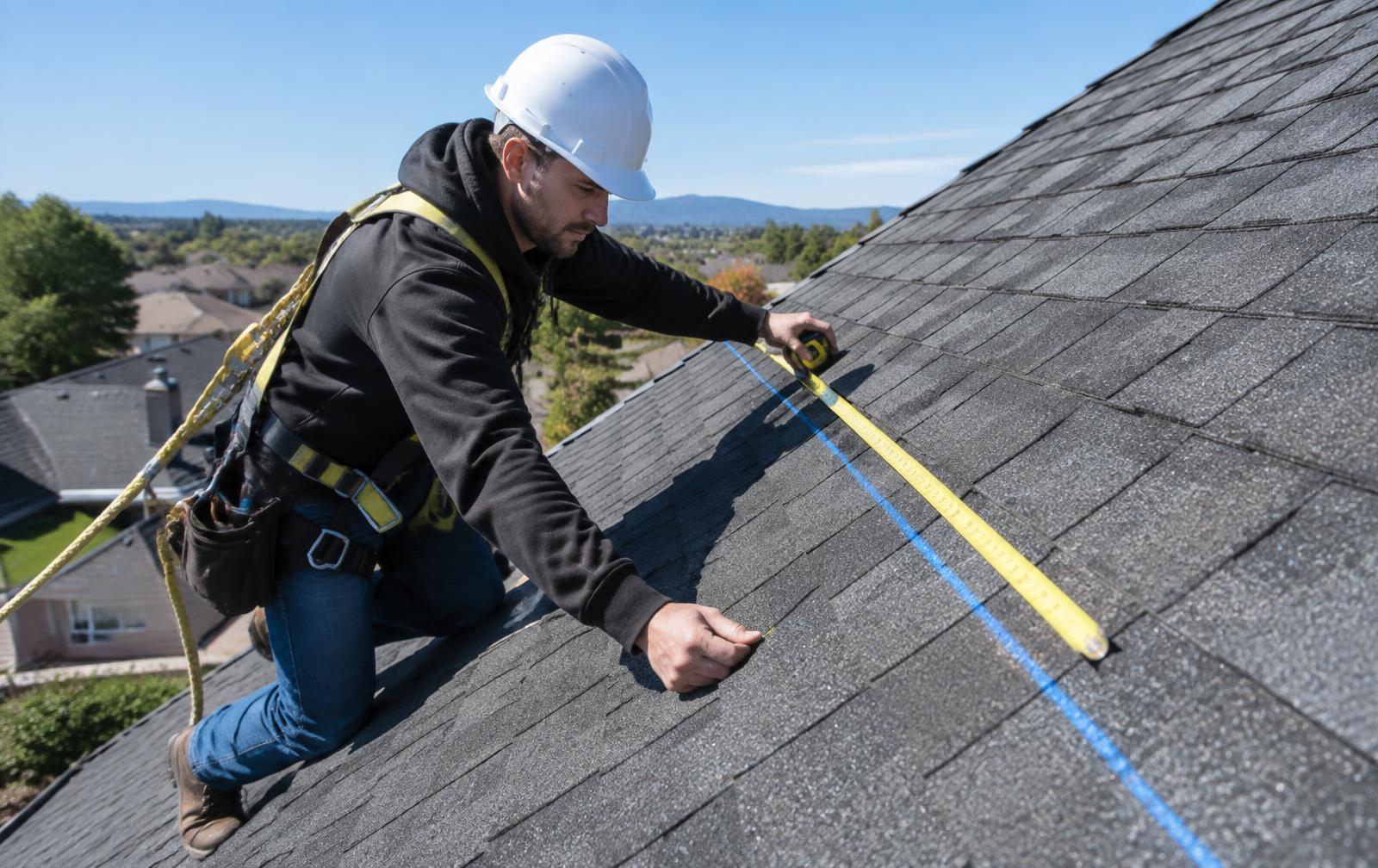
Choose a roofing video topic with a clear job in the lead journey
Good topics come from moments when a homeowner is unsure what they are looking at. A short clip that shows the difference between normal granule loss and hail bruising, filmed on a real roof with the owner's permission, answers a question people genuinely search for. So does a walkthrough of what happens on replacement day, from tear-off to cleanup, or an explanation of why a stain on the ceiling may be far from the actual leak. Each of these videos has one job: help the viewer understand their situation well enough to take the next step. A video that tries to cover every service at once usually helps no one.
A video topic earns its place on a lead asset only if it does a specific job: answering a question a visitor already has at a specific point in their decision, right before they'd otherwise call or fill out a form.
The starting point isn't a list of interesting roofing subjects — it's the service pages that already receive enquiries. A video works best attached to a page where visitors frequently have a predictable, answerable question before contacting anyone.
- What a roof inspection after a storm actually checks, for a storm-damage service page
- How a flat roof leak is located before any repair estimate, for a commercial repair page
- What a coating assessment evaluates before a system is recommended, for a coating or restoration page
- What happens between a form submission and a scheduled visit, for a general lead-capture page
Topics that don't belong on a lead-asset video
General roofing education with no tie to a specific service page, company culture content with no useful decision information, or anything that reads as a sales pitch rather than an answer tends to underperform and adds little to the site. If a topic can't be matched to one service page and one point in the enquiry journey, it's not ready to produce.
Plan a video around authentic expertise and useful proof
The most convincing person on camera is usually someone who does the work. An estimator explaining what they look for in the attic, or a crew lead pointing out soft decking after the shingles come off, carries authority that a scripted voice cannot. Keep the language plain, avoid promises about cost or insurance outcomes, and let the footage do the teaching. When real footage is not available for a topic, a clearly labeled illustrated explainer is an honest substitute. What should never appear is staged customer praise or reviews that were not given by real customers.
A roofing video's credibility comes from showing real expertise and real conditions, not from production polish. Footage of an actual inspection, a real material close-up, or a genuine explanation from someone who does the work carries more weight than a scripted actor reading lines.
Proof in a video follows the same rule as proof anywhere else on a lead asset: it has to be real. No invented testimonials, no stock footage presented as a specific company's work, and no claims about results the video can't actually support.
- Use real project footage where the roofing company can provide it, labeled honestly as an example rather than a guaranteed outcome.
- Let a real technician or estimator explain a process in their own words rather than scripting an unnatural read.
- Show actual tools or materials relevant to the topic — a moisture meter, a specific shingle type, a flashing detail — rather than generic roofing stock imagery.
- Avoid claims about speed, price, or promised outcomes that the video can't substantiate.
When footage isn't available yet
Not every video needs original job-site footage on day one. A clearly labeled storyboard or illustrative walkthrough can explain a process honestly while real footage is gathered over time. The key is the label: a storyboard presented as if it were a live job site misleads the viewer, while a storyboard presented as a storyboard does not.
TEACHING DIAGRAM
Storyboard-to-conversion map (illustrative example)
- 1Homeowner question
A specific question tied to one service page, like what a storm inspection checks.
- 2Original footage or labeled storyboard
Real job-site footage where available, or a clearly labeled illustrative walkthrough.
- 3Embedded on service page
Placed after core service content, with the call button and form still visible.
- 4Transcript published
Full written transcript near the video for accessibility and skimming.
- 5Verifiable enquiry events
Page-level call, form and chat counts compared; no unverifiable video-attributed lead count claimed.
Connect the video to its service page and contact path
A video that lives on its own, disconnected from a contact action, is a media asset without a job. Every video on a lead-asset page needs an on-screen or adjacent path to the same call button, form, or chat that the rest of the page uses.
The placement matters as much as the content. A video embedded above the fold, ahead of the explanation it illustrates, can actually slow a visitor down if they came specifically to find a phone number. A video placed after the core service information, with the contact action still visible nearby, tends to support rather than compete with the primary conversion path.
- Place the video on the one service page its topic matches most directly.
- Keep the page's existing call button and form visible near the video, not replaced by it.
- Add a short on-screen prompt at the video's close that matches the page's actual next step.
- Avoid auto-play with sound, which can frustrate a mobile visitor who arrived to find a phone number quickly.
Publish accessible transcripts and useful supporting content
Every video on a lead-asset page should ship with a written transcript, published alongside it, so visitors who can't or don't want to watch video still get the same information.
A transcript also supports visitors in noisy environments, on data-limited connections, or with accessibility needs that make video playback impractical. Publishing it as readable text on the page, not just as a downloadable caption file, makes the content usable to the widest set of visitors.
- Publish a full transcript near the video, not only a caption track inside the player.
- Keep the transcript's language plain and close to how the speaker actually explained the topic.
- Pair the transcript with any supporting checklist or summary points the video covers, so a skimming visitor can get the gist quickly.
- Review transcripts for accuracy before publishing, especially technical terms specific to roofing systems.
What a transcript does not replace
A transcript supports accessibility and skimming; it doesn't substitute for the page's own service description, FAQ, or proof sections. The video and its transcript are one component of a page that needs to work for every visitor, including the many who never interact with the video at all.
MODEL CALCULATOR
Illustrative Video-Supported Page Comparison Model
A simple model for comparing a video-supported page's enquiries to a similar page without video. All numbers are inputs you set from your own data — not measured or published figures.
- Enquiry difference (video page minus baseline) (count)
- 3
- Modeled additional jobs (difference x close rate) (count)
- 0.8
- Modeled additional revenue (jobs x average job value) (US dollars)
- $4,500
Illustrative only. This model compares page-level enquiry counts you enter yourself; it does not claim that a specific lead was caused by the video, and results depend on traffic volume, topic fit, and your own close rate.
Track the enquiries that supported video paths can reveal
Video rarely works alone, so measure it as part of a path. Record which page the video sits on, how many visitors start playback, and how many of those visitors go on to call or submit the form during the same visit. Because the network saves each enquiry with its source page, it is possible to see whether pages carrying a helpful video produce enquiries for the services the video covers. Treat small numbers with caution. A handful of enquiries over one month is a signal to keep watching, not proof that the video caused them.
Video-supported pages can be compared against similar pages without video using the same enquiry events already tracked on the lead asset — calls, form submissions, and chat starts — but only where those events are actually instrumented and distinguishable.
It's important to separate what's measurable from what isn't. A video play count is measurable where video analytics exist. Whether a specific call or form came because a visitor watched the video, as opposed to reading the surrounding page content, is usually not something that can be attributed with confidence unless a dedicated event — like a click on a video-adjacent call button — is specifically tracked.
- Page-level enquiry counts (calls, forms, chat starts) for a video-supported page versus a comparable page without one.
- Video play and completion counts, where the hosting setup actually records them.
- A specific on-screen call-to-action click, if a distinct tracked element exists for it.
- Time-on-page differences, as a weak and indirect signal, not a conversion proof.
What not to claim
Avoid stating a specific number or percentage of leads "came from" a video unless a dedicated, tested tracking event supports that exact claim. A page-level before-and-after comparison is reasonable to discuss; a precise video-attributed lead count usually is not, given how enquiry paths actually work on a public site.
Define production, publishing rights and maintenance responsibilities
Before any video gets produced, it's worth settling who shoots it, who owns the footage, where it's allowed to be published, and who's responsible for updating or removing it if a service or claim changes.
Original video production scope — whether the network, the roofing company, or a combination produces the footage — is part of what a Roofing Market Review confirms for your account. This page explains how video fits the lead-asset system; it isn't a claim that a specific production package is included for every account.
- Confirm who owns the raw footage and the final edited video, and where else it can be published if at all.
- Agree who provides narration, on-camera explanation, or technical review of script accuracy.
- Set a review step so claims in the video match what the roofing company can actually deliver.
- Establish a process for updating or removing a video if a service, price reference, or claim changes.
- Clarify whether the video can be reused on the roofer's own website or social channels, separate from the lead-asset page.
| Responsibility | Typically confirmed with |
|---|---|
| Topic selection tied to a service page | Joint — reviewed against actual enquiry patterns |
| On-camera technical explanation or footage access | Roofing company, where available |
| Editing, captions, transcript, and page placement | Production side, confirmed per account |
| Accuracy review of claims made in the script | Roofing company, before publishing |
WORKSHEET
Roofing Video Brief Checklist
Work through this before a roofing video goes into production for a lead-asset page.
0 of 8 checked
EXPLAINER VIDEO · 54 SECONDS
How a Roofing Video Supports an Owned Lead Asset
Narrated explainer with diagrams drawn for this page. No customer data or private screens are shown.
Video transcript
A useful roofing video answers one question a visitor already has, right on the service page where that question comes up. We use real project footage where it is available, or a clearly labeled storyboard when it is not. Either way, the viewer knows what they are watching. The video sits on its matching service page, after the main content, with the call button and form still visible nearby. Every video ships with a published transcript, so a visitor who cannot watch still gets the same information. We compare enquiry counts on the page with and without video. We do not claim a specific lead came from a video unless a tested event actually proves it. Review production scope on a Roofing Market Review.
STRAIGHT ANSWERS
Questions roofers ask
Where will videos created for the roofing lead asset be published?
On the specific service page on the network-owned site that matches the video's topic, alongside the page's existing call button, form, and a published transcript. These are organic assets for the lead asset, not a paid YouTube ad campaign.
Can we provide our own project footage and technical expertise?
Where available, yes — real footage and a technician's or estimator's explanation can strengthen a video's credibility. Production scope and who contributes what is confirmed per account on a Roofing Market Review, not assumed from this page.
How do you distinguish video views from leads attributable to a video path?
Video play counts and page-level enquiry counts (calls, forms, chat starts) are tracked where instrumented. A specific lead is attributed to a video only if a dedicated, tested tracking event — like a distinct click on a video-adjacent action — actually supports that claim; otherwise, pages are compared at the page level, not claimed as video-caused.
Does every lead-asset service page get a video?
No. A video is built for a page where visitors predictably have one answerable question before contacting anyone. Pages without that pattern may not get a dedicated video, and that's a reasonable outcome, not a gap.
Will the video include customer testimonials?
No invented or bulk testimonials are used anywhere on the network's sites, including in video. Any real customer reference would need to be genuine, consented, and verifiable, and is not a standard or promised component of video production.
Can we reuse a video produced for the lead asset on our own company website or social accounts?
That depends on the publishing rights agreed for the specific video, which should be settled before production. Ask about reuse rights during your Roofing Market Review rather than assuming they're included.
Do keyword or search volume figures factor into video topic selection?
Keyword and search volume data for video-related terms is currently unmeasured, since Semrush access is unavailable. Topic selection is based on matching real enquiry questions to service pages, not on published search-volume figures.
See what exists in your market
A Roofing Market Review is a short call. We check which ZIPs and services you want, whether a network asset or territory is open there, and which plan options would apply. No lead counts or results are promised.