
Specialty Acquisition
New Construction Roofing Leads
New construction roofing leads from Rent Roofing Sites come from builders, developers and general contractors who reach a local website, domain or tracking number the network owns and operates in a given market. They've typically searched because they need a roofing trade partner for a project that's somewhere between early planning and an active bid package, not because they're comparing finished-roof repair quotes.
A builder enquiry is a request for a roofing trade conversation, not a confirmed subcontract. Whether your company is a realistic fit depends on the project's actual procurement stage, the plans and specifications available, the build schedule, and whether the bid process matches how your estimating team actually works. This page is built around that distinction: the intake captures what the requester reports about their project, and your team's own review determines whether it's worth pursuing.
Builder and developer work also runs on a different clock than residential or storm leads. A project in early concept stage might not reach a roof-ready milestone for a year or more, while a project already holding approved plans and a bid deadline needs a fast, accurate response. Capturing which kind of enquiry you're looking at — and tracking it honestly as it moves, or doesn't move, toward an award — changes how your team should spend its time.
Whether a new-construction-focused territory is open in your market depends on a Roofing Market Review, because specialty program inventory, including builder and developer demand, is reviewed per market and the live network is a small number of sites across PA, TX and IL. This page explains how the lead program is built so you can evaluate the offer — it is not a claim that a territory is open right now.
Updated 2026-10-03. Terms, prices and availability are set by the written agreement for your market.
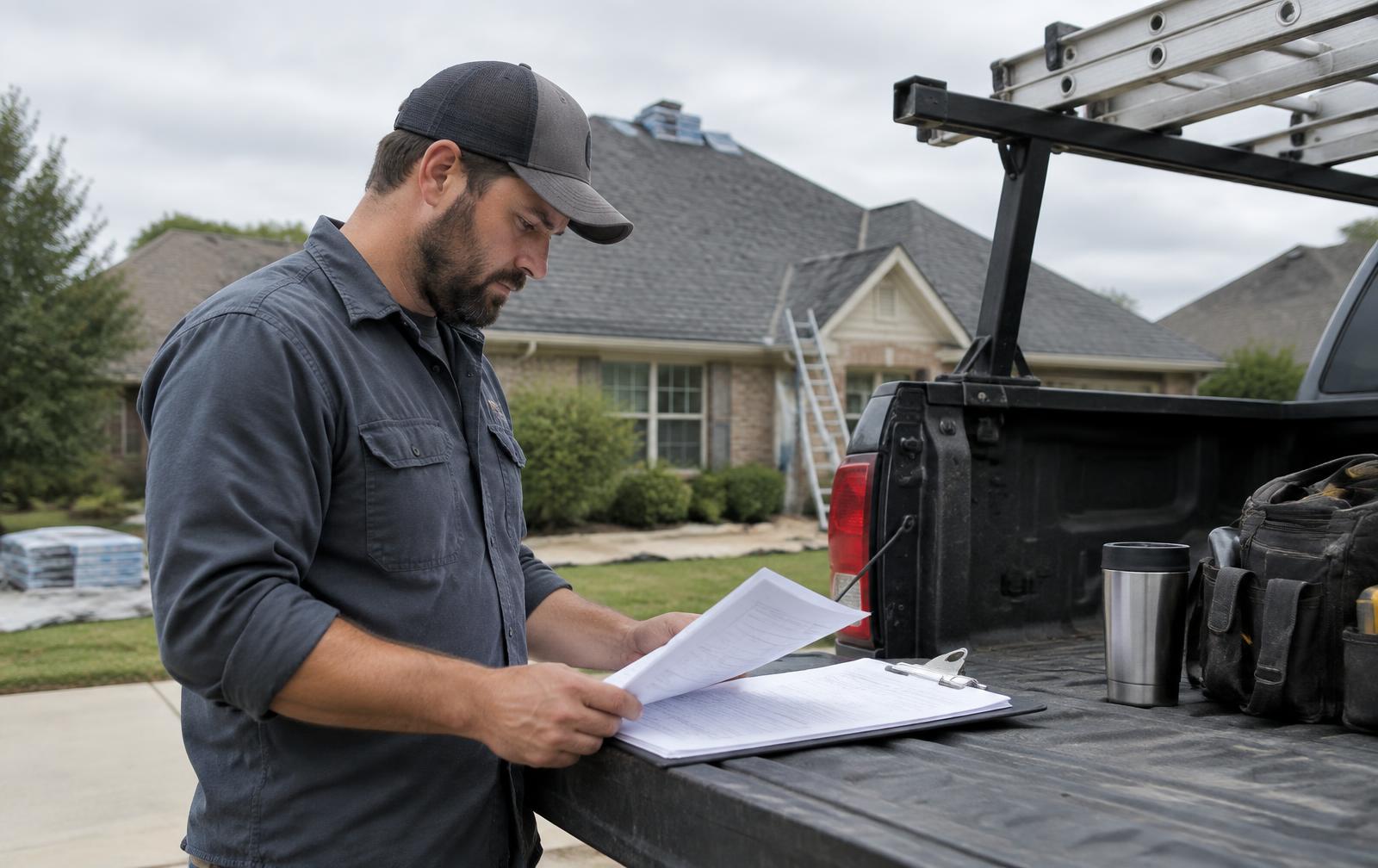
Identifying the builder or developer's roofing procurement stage
A request that mentions "new construction roofing" can sit anywhere from a developer thinking out loud about a future phase to a general contractor with a signed bid deadline three weeks out. Treating every enquiry as if it's at the same stage wastes your estimator's time on projects that won't move for months, and risks missing one that needs an answer this week.
Early planning
A developer or owner's rep exploring roofing options before architectural plans are finalized. They may be comparing roof systems in concept, gathering budget-level pricing, or deciding whether a project is financially viable at all. There's often no scope to bid yet — only a general description of the building and its intended use.
Plans in progress
Architectural and engineering drawings exist but may still be revised. A general contractor might be assembling a preliminary trade list and wants roofing contractors aware of the project before formal bidding opens, so they can plan their own subcontractor outreach timeline.
Active bid
Plans are issued for bid, a scope and submission date exist, and the requester wants qualified roofing contractors to price the work. This is the stage where your estimator's time is best spent, assuming the project and schedule fit your business.
- Record what the requester says about plan status: concept, in progress, or issued for bid.
- Note whether a specific bid deadline or submission date was mentioned.
- Capture the requester's role: developer, general contractor, architect, or owner's representative.
Qualifying plans, specifications and the scope available for bidding
A roofing bid is only as good as the information it's based on. Builders vary widely in what they can share at first contact: some have a complete architectural and roofing specification ready to send, while others only have a general building description and a rough square footage. Both are legitimate starting points for a conversation, but your team needs to know which one it's getting.
- Whether architectural plans exist and, if so, their revision status (preliminary, for-review, issued-for-bid).
- Whether a roofing-specific specification section has been written, or whether the system is still open to recommendation.
- Approximate roof area or building footprint, if known, even as a rough estimate.
- Roof system type under consideration, if specified: single-ply membrane, metal, built-up, or another system named in the project description.
When the scope is still open
Not every project arrives with the roof system already decided. On some, the general contractor or developer is open to a roofing contractor's recommendation based on budget, climate and building use. The intake should record this honestly as "system open" rather than guessing a system that was never actually specified, since presenting an invented spec to your estimator can send the wrong system quote back to the requester.
Where a specification document, drawing set or addendum exists, the requester may be able to send it directly or point to a plan room. The intake doesn't require this document to exist before the enquiry is passed along, but noting where it can be found saves your estimator a step.
TEACHING DIAGRAM
New construction project-readiness strip (illustrative example)
- 1Concept
Developer exploring roofing options before architectural plans are final.
- 2Plans available
Drawings exist, possibly still in revision; roofing spec may or may not be written.
- 3Bid issued
Scope, documents and submission date confirmed for pricing.
- 4Award decision
Verbal selection given, subject to contract execution — not yet signed.
- 5Roof-ready
Construction reaches the milestone where the roofing scope can actually begin.
Understanding build schedules and roof-ready milestones
A new construction roofing opportunity isn't ready for installation the day the enquiry arrives — it's ready when the building reaches a roof-ready milestone, which depends on framing, sheathing or deck completion, and often on other trades finishing work that has to happen first. A builder who contacts a roofing contractor six months before that milestone isn't wasting anyone's time; they're planning ahead, which is normal in construction procurement.
- Current construction phase: site work, foundation, framing, dry-in, or later.
- Estimated roof-ready date, if the builder has one, even as a rough range.
- Whether the project has experienced schedule delays that might move that date.
- Number of buildings or phases involved, if the project is a multi-building development.
Reading a schedule honestly
Construction schedules slip more often than they accelerate. A roof-ready date given at first contact is a planning estimate, not a commitment, and your team should treat it that way when allocating crew capacity. Checking in periodically on a project with a distant roof-ready date, rather than assuming it will happen exactly on schedule, keeps your pipeline realistic.
Matching the builder's timeline to your own capacity
A project with a roof-ready date eight months out and a project with one three weeks out require different internal handling even if both come through the same intake. The eight-month project needs periodic follow-up and schedule-change tracking; the three-week project needs a prompt estimating response and, often, a faster decision about whether the project fits your crew's near-term calendar.
- Record the builder's stated construction phase and estimated roof-ready date.
- Flag projects with imminent roof-ready dates for prompt estimator review.
- Set a follow-up cadence for projects with distant roof-ready dates rather than letting them go cold.
Confirming bid recipients, selection criteria and decision authority
Knowing who actually selects the roofing subcontractor matters as much as knowing the project's schedule. On some projects, the general contractor controls subcontractor selection outright. On others, the developer or owner has a say, particularly on larger projects or ones with a preferred-vendor list the general contractor has to work within.
- General contractor: typically manages the bid process and makes the final trade-contractor selection on most projects.
- Developer or owner: may have final approval on larger projects, or a list of pre-qualified trades the general contractor must use.
- Architect or engineer: may specify an acceptable roof system or manufacturer but rarely selects the installing contractor directly.
- Construction manager: on some delivery models, manages bidding on the owner's behalf rather than the general contractor's.
Understanding how the bid will be evaluated
Builders select subcontractors on more than price: bonding capacity, insurance limits, prior project references, crew size and prequalification paperwork all factor in on many commercial and multifamily projects. Asking what the selection process actually requires — rather than assuming the lowest number wins — helps your estimator decide whether it's worth the time to prepare a full submission.
- What documentation does the bid process require: bonding, insurance certificates, references, prequalification forms?
- Is the project open-bid or invitation-only, and how was your company identified as a potential bidder?
- What is the actual submission deadline and format (sealed bid, online portal, email)?
MODEL CALCULATOR
Illustrative New Construction Territory Cost Model
A simple model to frame costs against an assumed award rate for builder and developer work. All numbers are inputs you set — not measured results.
- Quarter-1 cost (3 months rental + setup) (US dollars)
- $3,488
- Modeled contracts won (bids x award rate) (count)
- 0.6
- Modeled contract revenue (contracts won x average value) (US dollars)
- $27,000
Illustrative only. Bid opportunities per quarter and award rate are not published figures and must be set by you based on your own market knowledge; actual results depend on territory, builder activity and your bid-to-award conversion.
Matching project demands to the roofer's production capabilities
Not every new construction enquiry fits every roofing company, and treating all of them as pursuable regardless of size or system can quietly erode margins. A project calling for a large standing-seam metal roof on a multi-building development is a poor match for a company set up for residential asphalt work, no matter how promising the lead volume looks on paper.
- Roof system experience: does your crew have verifiable experience with the specified or likely system?
- Project size relative to current crew and schedule capacity, including other committed work during the likely install window.
- Bonding capacity and insurance limits relative to what the project requires.
- Geographic fit: is the project within a realistic service radius for crew travel and supervision?
Lost-margin traps on builder work
Builder and developer projects carry their own ways to lose margin that a residential crew may not expect: retainage held until substantial completion, change-order processes that differ from a homeowner conversation, payment terms tied to draw schedules rather than job completion, and liquidated-damages clauses tied to schedule delays outside your control. None of these can be assumed from the intake alone, and all of them belong in your estimator's review before a number goes out.
- Confirm retainage percentage and when it's released.
- Understand the change-order approval process before work starts, not after a change arises.
- Check payment terms against your own cash-flow needs for a project of this size.
- Ask about liquidated-damages or schedule-penalty clauses tied to the roofing scope specifically.
Tracking an inbound construction opportunity from invitation to award
New construction opportunities move through several stages before an award decision, and conflating any single stage with a signed subcontract overstates your pipeline. An invitation to bid is not a bid submitted. A bid submitted is not a bid under review. A verbal "you're our pick" from a project manager is not a signed subcontract — construction awards can and do change before contracts are executed, particularly when financing or ownership changes.
- Invitation or first contact: the builder reaches out or responds to outreach about the project.
- Qualification: plans, schedule, bid process and decision authority are confirmed as described above.
- Bid preparation and submission: your estimator prices the scope against the confirmed requirements.
- Bid under review: the builder is comparing submissions; no decision has been made yet.
- Verbal selection: the builder indicates intent to award, subject to contract execution.
- Signed subcontract: the only stage that should be counted as closed-won revenue.
Qualified demand that reaches your team through this intake is handed off with the project's current stage clearly marked, not inflated to the next stage up. A builder enquiry still in early planning is handed off as early planning, with a note on when to check back — not framed as an active bid because that would be a more exciting number to report internally.
A worked illustrative model can frame the economics without claiming a guaranteed outcome. If a new-construction-capable territory runs at the $997 monthly site rental list price plus a one-time $497 setup on the first plan, and your company wins even one mid-size commercial roof package in a quarter, the model can work out favorably — but this is a labeled assumption tied to your own close rate and average contract value, not a projection of results.
| Assumption | Value |
|---|---|
| Monthly site rental (list) | $997 |
| One-time setup (first plan) | $497 |
| New-construction awards needed to cover one quarter's cost | Varies by your average contract value — model assumption only |
WORKSHEET
Bid-Readiness Checklist
Work through this before committing estimator hours to a new construction enquiry.
0 of 8 checked
EXPLAINER VIDEO · 60 SECONDS
Is This New Construction Roofing Lead Ready for a Bid?
Narrated explainer with diagrams drawn for this page. No customer data or private screens are shown.
Video transcript
A builder, developer or general contractor reaches out about a new project. That is not a repair call, and the first step is understanding who requested help and why. Projects sit at different stages: early concept, plans still being drawn, or an active bid with a real deadline. The stage changes how your team should respond. Check whether plans exist and whether a roofing spec is written or still open to recommendation. Missing documents get flagged honestly, not guessed. Compare the builder's roof-ready date to your own crew capacity. Construction schedules shift, so treat any date as a planning estimate. A submitted bid is not an award, and a verbal nod is not a signed subcontract. Track the real stage, and book a Roofing Market Review to check builder demand in your market.
STRAIGHT ANSWERS
Questions roofers ask
Are these interested builder enquiries or purchased builder contact lists?
These are inbound enquiries from builders, developers and general contractors who contact a network-owned site or tracking number, not a purchased or scraped contact list. An enquiry reflects interest in a roofing-trade conversation, not a confirmed subcontract.
Will I receive plans and specifications when the requester provides them?
Where a requester shares plans, specifications or a plan-room link, that information is passed along as part of the handoff. Many enquiries arrive before formal documents exist, in which case the record is marked accordingly rather than guessing at a scope.
How can I distinguish early planning from an active roofing bid?
The intake records the builder's stated procurement stage — concept, plans in progress, or active bid — along with any submission deadline mentioned. Early-planning enquiries are handed off as planning-stage, not inflated into active bids.
Do you guarantee my company will be selected for a new construction project?
No. Rent Roofing Sites does not guarantee awards, contracts, rankings or results. New construction and builder demand is reviewed per market as part of the network's specialty program inventory, and availability varies.
What if the roofing system hasn't been specified yet?
That's common on earlier-stage projects. The intake records the system as open to recommendation rather than inventing a specification, so your estimator can decide whether to propose a system as part of the bid.
How are multi-building or phased developments handled in the intake?
The record notes the number of buildings or phases involved, along with any difference in schedule between phases, so your team can evaluate the project as a whole rather than a single structure.
Can new construction leads be delivered to my existing CRM?
Yes, through the same delivery options available on other programs: a generic webhook, a private Zapier app, or email/SMS fallback. Native connections for some CRMs are built and ready to confirm during onboarding, while others are still in testing — ask about your specific CRM's status.
See what exists in your market
A Roofing Market Review is a short call. We check which ZIPs and services you want, whether a network asset or territory is open there, and which plan options would apply. No lead counts or results are promised.