THE PROBLEMThe problem nobody puts in the demo
Search 'hail tracker' and you will find a wall of tools: live radar maps, NOAA storm report viewers, swath trackers by address or ZIP, and apps that ping you when hail crosses your county. The category is crowded because the need is real — storm roofers live and die by knowing where hail fell.
But here is what nobody in the category advertises: nearly all of these tools drink from the same well. The core data — NOAA storm reports, dual-polarization radar estimates, spotter networks — is public. Whether you use a free tracker or a paid one, the underlying picture of the storm is substantially the same picture every other roofer sees.
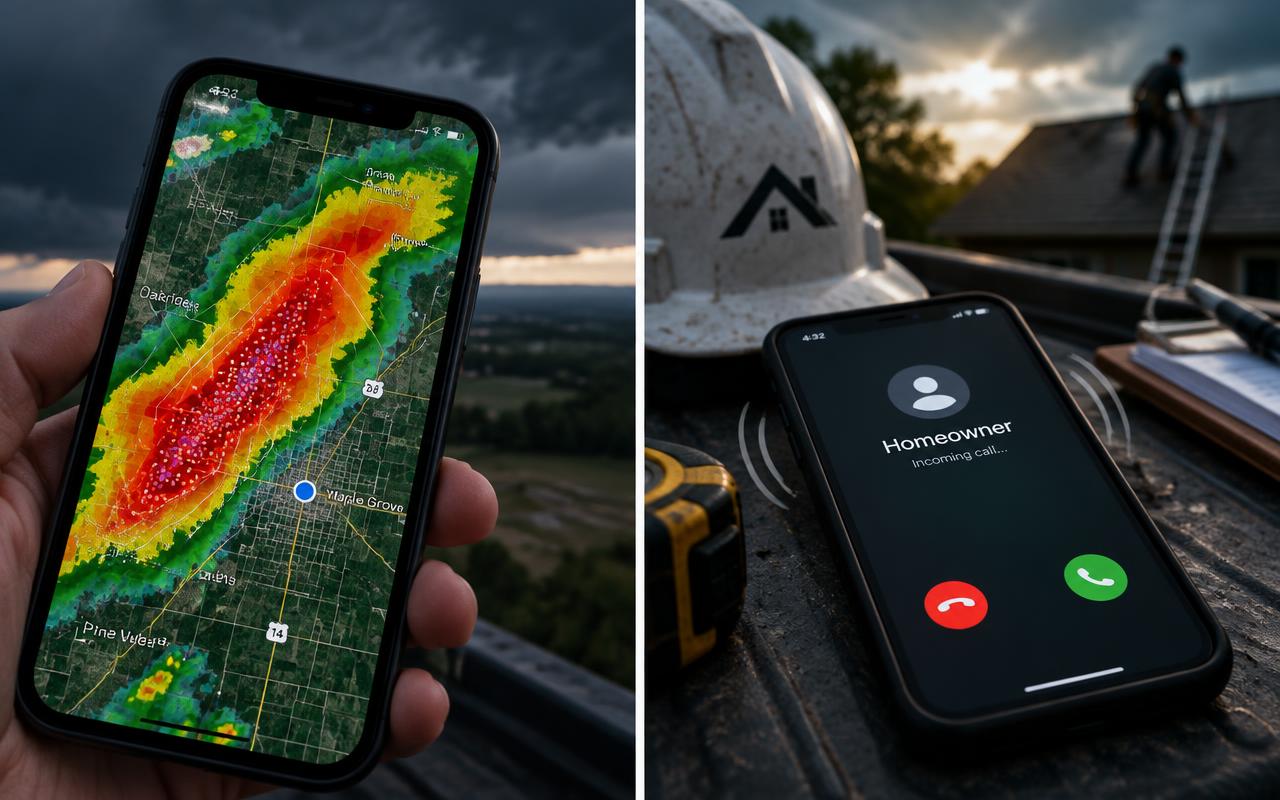
So the tracker answers one question well — where did hail fall — and leaves the money question wide open: of the thousands of homeowners under that swath, which ones will call you? On that question, every hail tracker in America is silent.
LET'S BE HONESTWhat it is really costing you
Watch what happens in a market the hour after a tracker fires. Alerts go off across the region. Every storm roofer with the app sees the same notification. By morning, the affected neighborhoods are carpeted in door hangers, and the homeowners who answer are on their fourth pitch of the day.
You know the math from living it. A day of canvassing costs fuel, labor, and your best selling hours. The conversion rate on cold storm doors is brutal, and it gets worse every season as more companies pile into the same data. You are working harder each year for a thinner slice of the same swath.
And while the pack knocks, the best homeowners — real damage, real insurance, ready to move — are doing what every modern homeowner does: searching online for a local roofer and calling the one they find. The tracker told you where the storm went. It said nothing about where the homeowners went. They went to search.
THE FAILED FIXWhy more data never fixed it
The standard answer is more tracking. Add the live layer. Add the address-level reports. Add the historical swath database. Each feature is real, and each one sharpens the same half of the picture — the weather half — while the sales half stays blank.
Some roofers pair the tracker with bought lead lists or dialers, turning storm data into a cold-calling machine. Now the overhead is higher and the homeowner experience is worse: interrupted dinners, shared lists, and prospects who have already told five companies to stop calling.
Trackers are not the enemy. They are genuinely useful for verification and planning. The failure is expecting a weather tool to do a sales job. No radar upgrade, at any price, makes a homeowner pick up the phone and call you.
THE REAL FIXOwn the call, not just the map
The fix is to own the other half. When hail hits your town, motivated homeowners search: 'hail damage roof repair' plus their town, 'roof leak after storm,' 'hail damage roof inspection.' That search is the highest-intent moment in storm roofing, and it belongs to whoever operates the local site that answers it.
Rent Roofing Sites builds and operates those local sites, each with a real local phone number, one per territory. Every inbound call and form request routes to exactly one roofer. Keep your tracker for planning — when it fires, you will already own the channel the homeowners are about to use.
And you can start free. The Free Exclusive Territory Pilot lets a qualified roofer lock an open territory and receive its inbound inquiries at zero cost and zero risk. The tracker tells you where the storm hit. The territory makes sure the calls from that storm come to you.
01Where hail tracker data actually comes from
Nearly every hail tracker is built on the same public foundation: NOAA and Storm Prediction Center storm reports, plus dual-polarization radar that can distinguish hail from rain and estimate size. Paid tools add polish — better maps, alerts, address lookups — but the raw picture of the storm is public data anyone can access.
That matters for strategy. If your competitive edge is a data feed, and that feed is available to every competitor, your edge has an expiration date measured in minutes. Durable advantage comes from owning something the feed cannot sell twice: the inbound channel.
02Live trackers, address lookups, and history tools: what each is for
Live trackers are for awareness — knowing a storm is producing hail now. Address and ZIP lookups are for verification — checking whether a specific property sits in a past swath, useful in claim conversations. Historical databases are for market research — understanding which towns hail most often.
Notice what none of them is for: getting a homeowner to choose you. Each tool serves the planning side of the business. The selling side needs a different asset entirely.
03The two halves of a storm business
Every storm roofing operation has two halves: knowing where the work is, and getting chosen to do it. The industry has built endless tools for the first half and left the second half to door-knocking — the most expensive, lowest-converting sales method still in common use.
An exclusive inbound territory is the missing second-half tool. The homeowner searches, finds the local site, and calls. Your planning tools tell you a storm is coming; the territory converts it.
04How the Free Exclusive Territory Pilot works
Apply for your territory. If it is open and you are a fit, we route the inbound calls and form requests from our local site to you — exclusively. You answer, book, and close with your own process and CRM. We do not manage jobs, estimates, or crews.
The pilot is free. If you continue, pricing is set in a written agreement — published site rent is $997 per month per site, with setup and per-call terms documented in writing. If the market does not produce, you risked nothing.
05Who should apply — and who should not
Apply if you already understand storm data and want the missing half: a steady flow of homeowners who contact you first. The territory model rewards roofers who answer fast and close warm inquiries.
Do not apply expecting guaranteed lead counts. Storm demand depends on weather and market, and we never invent numbers. What we promise is exclusivity, honest routing, and a free way to prove your market.
06A week in the life: the tracker vs the territory
Two roofers get the same tracker alert. The first spends the week converting that alert into a canvassing plan — routes, hangers, knocks, and stiff competition at every door. The second holds the territory: the alert simply tells her to keep the phone close, because the homeowners in her town are about to search, and the local site they find routes to her.
The tracker did its job for both of them. The difference is what happened next. One turned information into a week of chasing. The other turned it into a week of answering.
07The alert paradox
A hail alert feels like an edge, but an alert sent to every subscriber is the opposite of an edge — it is a starting gun for a race you did not choose to enter. The faster and more accurate alerts get, the faster the crowd forms. Better alerts make the swarm quicker, not your business stronger.
The only alert that matters is the one your phone makes when a homeowner calls. That alert does not go to your competitors. It goes to the one roofer who holds the territory.
08Verification vs demand: two different jobs
Trackers earn their keep in verification: confirming an event, checking an address, supporting a claim conversation with storm history. That is real value, and territory holders use it too. But verification happens after a homeowner contacts you. It cannot cause the contact.
Keep the two jobs straight and your spending gets rational fast: pay for verification tools that serve your pipeline, and build the demand channel that fills it. Confusing the two is how roofers end up with great data and an empty schedule.
09Your next step
If your storm strategy starts and ends with a tracker, you are playing half the game. Apply for the Free Exclusive Territory Pilot with your target ZIP and we will tell you honestly whether it is open.
If it is, you will see real inbound inquiries from your market before you pay anything. Keep the tracker. Add the half that pays. Proof first, zero risk.
10The questions smart roofers ask before switching
Roofers who have been burned by lead sellers ask the right questions, and you should too. Is the lead shared? No — one roofer per territory, full stop. Is the homeowner expecting the call? Yes — they initiated it. Can I see it work before I pay? Yes — that is the entire point of the free pilot.
Ask the same questions of your current lead sources. If the answers come back shared, cold, and pay-first, you already know why the margins feel thin. The model is the margin.
11What happens after the pilot
If the pilot produces real inquiries and you want to keep the territory, the terms are simple and written down before you commit: $997 per site per month, with setup and per-call terms spelled out in the agreement. No surprise fees, no long lock-in invented after the fact.
If the pilot does not convince you, you walk away having spent nothing. That is what zero risk means, and it is why the offer is structured this way — we would rather prove the channel than pitch it.
12The real cost of doing nothing
Every storm alert you chase alongside the swarm is a week of labor spent at the thinnest margins in the business. Meanwhile, the roofer who owns the inbound channel in your town collects the same storm's demand without leaving the office. Position compounds, and so does the cost of waiting.
The free pilot removes every excuse for waiting. No money, no lock-in, no risk — just an honest look at what inbound demand in your market actually looks like. The only expensive option left is standing still.