THE PROBLEMThe problem nobody puts in the demo
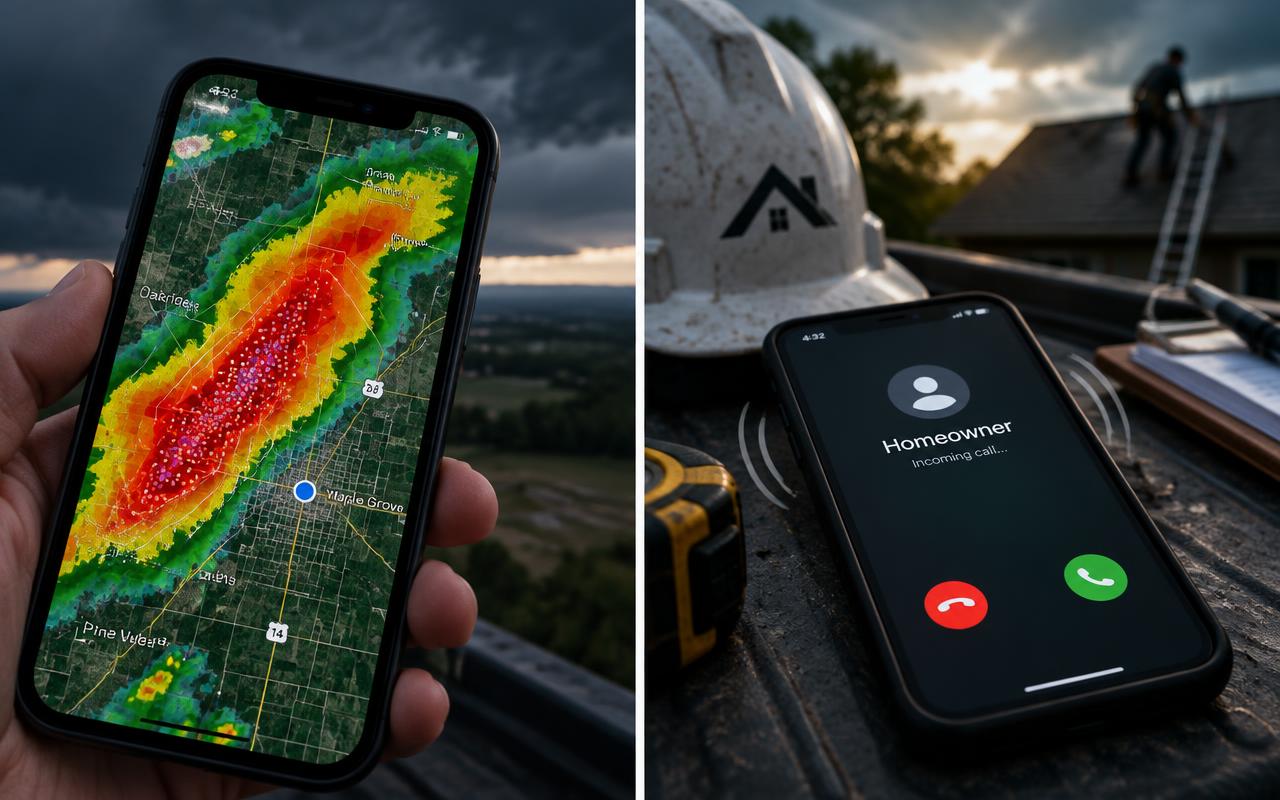
A hailstorm rolls through town on a Tuesday night. By Wednesday morning you pull up a free hail map, find the red swath, and drive out there ready to work. So does every other roofer in three counties. The same free map you used is sitting open on twenty other dashboards, and the homeowners on that street are about to get their doors knocked so many times they stop answering.
That is the real problem with free hail maps and free hail trackers. They are weather tools. They tell you where ice fell from the sky. They do not tell you which homeowner has a bruised roof, which one has insurance, which one owns the home, or which one is ready to sign. You get a colored blob on a screen and a tank of gas.
And the blob is the same blob everyone else gets. Free tools are free because everyone has them. NOAA hail reports, free radar overlays, the free tier of the big hail apps — it is all public data. Public data means public competition. When your whole storm strategy starts with the same information every storm chaser in America can pull up in ten seconds, you are not finding opportunity. You are finding a crowd.
LET'S BE HONESTWhat it is really costing you
Think about what a storm day actually costs you. Gas. A crew member riding along. Hours of knocking on doors where the roof is fine, the homeowner is a renter, or the guy three houses down already signed with a company that got there at 7 a.m. You can burn two full days working a swath and come home with nothing but door hanger receipts.
It gets worse. The homeowners who do answer have already talked to four other roofers. Now you are not selling a roof — you are in a price war against strangers, on a doorstep, with a homeowner who is annoyed and confused. Your close rate on cold storm knocking is a fraction of what it is on a real inbound call, and every hour you spend knocking is an hour you are not on a roof earning.
Meanwhile the clock is ticking. Storm work has a shelf life. The money is made in the first weeks after the event, and every day you spend guessing which street to work is a day the organized companies spend sitting in kitchens with signed paperwork. The map did not lie to you. It just did not do the part that matters.
THE FAILED FIXWhy more data never fixed it
So what do most roofers do? They upgrade the map. They pay for a hail tracker subscription, get sharper swaths, tighter polygons, wind overlays, and address-level reports. The data gets better. The result stays the same, because the data was never the bottleneck. Knowing exactly which roof got hit by 1.75-inch hail does not put you in that homeowner's living room.
Some roofers buy lead lists to go with the map. Now they have addresses and phone numbers — shared with five other buyers, scraped, aged, and full of renters and wrong numbers. The list seller made money. The map company made money. You made phone calls to people who already told three other roofers to stop calling.
None of these tools are bad. Maps are useful. Data is useful. But they all solve the same first half of the problem — where is the damage — and leave the second half, the half that pays, completely untouched: who is the homeowner going to call, and will it be you?
THE REAL FIXOwn the call, not just the map
Here is the fix. Instead of chasing the storm to the homeowner, you own the place the homeowner goes after the storm. When hail hits a town, the first thing a homeowner does is not answer the door — it is pick up a phone and search. 'Hail damage roof repair' plus their town. 'Roof leak after storm.' That search happens within hours, and it goes to whoever owns the local site that shows up.
That is what we build. Rent Roofing Sites owns and operates local roofing websites with real local phone numbers, town by town. When a homeowner in your territory searches or calls, that call goes to one roofer. Not five. One. If that is you, the storm chasers can knock all they want — the homeowner already called you before the first door hanger hit the porch.
And right now, the way in costs nothing. Our Free Exclusive Territory Pilot lets a qualified roofer lock a territory and start receiving its inbound calls and form requests with zero risk. No shared leads. No bidding. No racing twenty trucks to the same street. The map tells you where the storm hit. The territory makes sure the calls from that storm come to you.
01What a free hail map actually is (and is not)
A free hail map is a picture of a past weather event. The data behind most of them comes from the same public sources: NOAA storm reports, radar-estimated hail size, and spotter reports. That data is real and useful. It is also free to everyone, delayed, and often wrong at the address level. Radar can estimate that hail fell over a neighborhood. It cannot tell you which roofs are bruised, which shingles are cracked, or which homeowner is motivated.
Treat the map as a planning tool and it serves you well. Treat it as a sales strategy and it fails you, because a sales strategy has to end with a signed contract, and a map never gets you past the driveway.
02The math of the door-knocking war
Run your own numbers. How many doors does your crew knock in a day after a storm? How many answer? How many own the home, have damage, have insurance, and have not already signed? For most storm roofers the honest answer is a small single-digit percentage of knocks turning into signed work, spread across days of labor.
Now compare that to an inbound call. The homeowner searched, found a local company, and picked up the phone. They already want the roof looked at. The close rate on that call is not a small single-digit number. One channel spends your day hunting. The other spends your day estimating.
03Why the first hours after a storm decide everything
Homeowner behavior after hail is predictable. The storm passes, the homeowner hears ice on the roof or sees granules in the driveway, and within hours they search. The companies that capture that search win the job before the door-knockers finish their coffee. By the time the fifth storm chaser knocks, the homeowner is not comparing bids — they are waiting for the company they already called.
This is why owning the inbound channel beats owning better data. Better data tells you where to hurry. The inbound channel means the homeowner hurries to you.
04What the Free Exclusive Territory Pilot includes
The pilot is simple. You apply for your territory. If it is open and you are a fit, we connect you to the inbound calls and form requests our local site produces in that area. You answer, you book, you close — using your own process and your own CRM. We do not manage your jobs, your estimates, or your crews. We create the demand and hand it to one roofer.
There is no lead list to share, no auction, and no per-lead bidding war. Exclusivity is the whole point: one territory, one roofer. Regular pricing after the pilot is set in a written agreement — our published site rent is $997 per month per site, with setup and per-call terms in writing — but the pilot itself costs you nothing to find out what your market can do.
05Who this is for — and who it is not
This is for roofers who can answer the phone, show up fast, and close work they did not have to chase. If you have crews ready and your bottleneck is finding homeowners instead of serving them, an exclusive inbound territory is the highest-leverage move in your storm season.
It is not for roofers who want a magic map, a shared list, or a guarantee. We do not promise lead counts, job counts, or revenue. Storms are weather, not a vending machine. What we promise is structure: when homeowners in your territory look for help, they find you first, and nobody else gets that call.
06A week in the life: map-chasing vs call-answering
Follow two roofers through the same storm week. Roofer A checks the free hail map Monday night, loads the truck Tuesday morning, and spends Tuesday through Friday knocking doors in the swath. By Friday he has talked to dozens of homeowners, most of them cold, and signed a small number of jobs at margins shaved by doorstep competition.
Roofer B holds the territory. Monday night the same storm hits. Tuesday morning her phone rings with homeowners who searched and found the local site. She spends the week doing inspections and writing estimates for people who asked for them. Same storm, same town, completely different week — and the difference is not effort. It is position.
07The trust gap after a storm
Storm-damaged homeowners have been burned before, and they know the storm-chaser script. A stranger at the door starts at a trust deficit that takes real skill to overcome. Most knocks fail before the pitch even starts, because the homeowner has already decided not to buy from the door.
An inbound call starts at the opposite end of the trust scale. The homeowner found you, read about you, and chose to dial. You are not interrupting their day — you are answering their question. Everything about the conversation that follows is easier, from the inspection to the signature.
08What 'free' really costs in storm roofing
Free tools are never the whole cost. The free hail map is free; the week of fuel, labor, and door-knocking it sends you on is not. When you add the true cost of working a free map — your hours, your crew's hours, your close rate on cold doors — free data often turns out to be the most expensive lead source you use.
The honest comparison is never 'free vs paid.' It is 'cost per signed job.' Run that number on your last storm campaign, then run it on any inbound work you have done. The gap between those two numbers is the argument for owning the inbound channel.
09Your next step
Keep using free hail maps for what they are good at: awareness and planning. Then fix the half of the business they ignore. Apply for the Free Exclusive Territory Pilot, tell us the ZIP you want to work, and we will tell you honestly whether it is open.
If it is, you will see real inbound inquiries from real homeowners in your market — before you pay anything. That is the whole offer: proof first, paperwork second, and zero risk in between.
10The questions smart roofers ask before switching
Roofers who have been burned by lead sellers ask the right questions, and you should too. Is the lead shared? No — one roofer per territory, full stop. Is the homeowner expecting the call? Yes — they initiated it. Can I see it work before I pay? Yes — that is the entire point of the free pilot.
Ask the same questions of any lead source you currently pay for. If the answers come back shared, cold, and pay-first, you already know why the margins feel thin. The model is the margin.
11What happens after the pilot
If the pilot produces real inquiries and you want to keep the territory, the terms are simple and written down before you commit: $997 per site per month, with setup and per-call terms spelled out in the agreement. No surprise fees, no long lock-in invented after the fact.
If the pilot does not convince you, you walk away having spent nothing. That is what zero risk means, and it is why the offer is structured this way — we would rather prove the channel than pitch it.