THE PROBLEMThe problem nobody puts in the demo
HailStrike built its name on doppler radar hail reports: detailed swaths, estimated hail sizes, and storm histories you can pull by address or area. If you have ever worked a storm, you know the appeal. Instead of guessing, you drive straight to the neighborhoods that got hit hardest.
But here is what the report cannot do. It cannot tell a homeowner from a renter. It cannot tell a motivated buyer from a tire-kicker. It cannot tell a bruised roof from a cosmetic scuff, or an insured loss from a denied claim. The report knows everything about the storm and nothing about the sale.
So you end up doing the filtering yourself, the old way: door to door, house to house, spending skilled selling hours on people who were never going to buy. The data narrowed your search from a city to a neighborhood. You still have to knock the neighborhood.
LET'S BE HONESTWhat it is really costing you
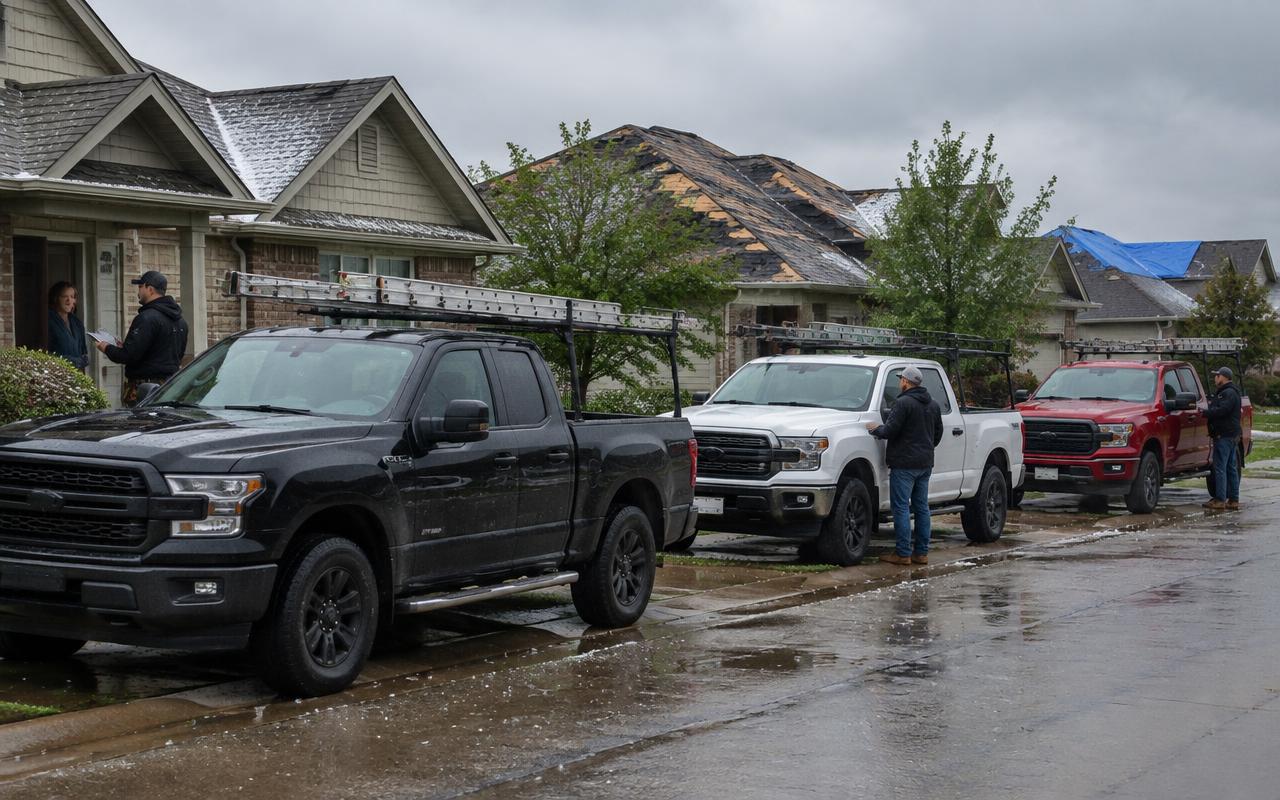
Picture the day after a big hail event in a market like Dallas or Denver. The swath maps light up. By noon, the affected streets look like a roofing convention — trucks parked bumper to bumper, door hangers on every knob, homeowners hiding behind closed blinds. You are one of twenty companies working the same blocks with the same data.
Every hour in that crowd costs you. Fuel, labor, materials, and the opportunity cost of not being on a roof. And the homeowners you do reach have already been pitched so many times that the conversation starts with suspicion. You are not a trusted local expert on that doorstep. You are the sixth stranger today.
The worst part? While you are knocking, the motivated homeowners — the ones with real damage and real insurance — are inside, on their phones, searching for a roofer. They are raising their hands right now. And the company that owns the local search presence in that town is catching every one of them without knocking a single door.
THE FAILED FIXWhy more data never fixed it
The usual response is to upgrade the data. Buy more detailed reports. Add wind data. Pull more addresses. Maybe add a canvassing app to track which doors you hit. Each tool adds cost, and each tool still leaves you doing the same thing: interrupting people who did not ask for you.
Some roofers try to beat the crowd by being faster — getting to the swath at dawn, working twelve-hour days. That wins a few jobs and burns out a lot of crews. Speed does not fix the structural problem: you are still an uninvited stranger competing on a doorstep.
None of this means HailStrike is a bad product. It means the product category has a ceiling. Radar reports answer 'where did hail fall?' The question that pays your crew is 'who is going to call me?' Those are different questions, and no data subscription answers the second one.
THE REAL FIXOwn the call, not just the map
The fix is to stop chasing and start owning. After a hailstorm, the homeowners most likely to buy do not wait for a knock — they search. 'Hail damage roof repair near me.' 'Roof inspection after hail' plus their town. That search is the highest-intent moment in the entire storm economy, and it belongs to whoever owns the local site that shows up.
Rent Roofing Sites builds and operates those local sites, one per territory, each with a real local phone number. Every inbound call and form request from a territory routes to exactly one roofer. The homeowner pre-qualifies themselves: they own the home, they have a problem, and they picked up the phone. No renter filter needed. No tire-kicker list. Motivation is built in.
And you can prove it in your own market for free. The Free Exclusive Territory Pilot puts a qualified roofer on the receiving end of an open territory's inbound inquiries at zero cost and zero risk. Keep your radar reports for planning if you like them. Let the pilot handle the part radar never could.
01What doppler hail reports genuinely do well
Doppler-based hail estimation is real meteorology. Modern dual-polarization radar can distinguish hail from rain and estimate size along a storm's path, and report products package that into maps and address histories that are legitimately useful for planning. If your goal is to know which part of a metro took the hardest hit, these tools deliver.
Our argument is not with the science. It is with the business model built on top of it: that better storm data automatically turns into signed roofs. It does not. Between the swath and the signature sits the entire sales process, and the data does none of it.
02The renter and tire-kicker problem
Canvassing a hail swath means knocking every door, and a meaningful share of those doors are dead ends: renters who cannot authorize work, homeowners with no damage, homeowners with no insurance, and people who collect three bids with no intention to buy. You pay for every one of those knocks in time and fuel.
Inbound leads filter themselves. A renter does not search for roof repair. A tire-kicker does not call and describe their roof problem. The act of searching and calling is the qualification step — and it happens before you spend a minute.
03Why speed-to-door is a losing arms race
When everyone has the same swath data, the only edge left is speed, and speed does not scale. There are only so many doors a crew can knock in a day, and every competitor's crew is knocking the same ones. You end up in an arms race where the prize is a doorstep conversation with an annoyed homeowner.
The inbound channel has no arms race. One site, one number, one roofer. While the pack fights over doorsteps, the territory holder answers calls from homeowners who already decided to reach out.
04How the Free Exclusive Territory Pilot works
You apply for your territory. If it is open and you are a fit, we route the inbound calls and form requests from our local site to you. You answer, book, and close with your own process. We do not manage your jobs, write your estimates, or run your crews — we create the demand and hand it to one roofer.
The pilot is free. If the market produces and you continue, pricing is set in a written agreement — published site rent is $997 per month per site, with setup and per-call terms documented in writing. If it does not produce, you risked nothing.
05Who this fits — and who it does not
This fits storm roofers who are great at closing and tired of hunting. If your bottleneck is finding motivated homeowners rather than serving them, an exclusive inbound territory is the strongest structural advantage available in storm work.
It does not fit anyone looking for guaranteed lead counts or a magic data feed. Storm demand depends on weather and market, and we never invent numbers. What we promise is exclusivity and honest routing — and a free way to see the proof yourself.
06A week in the life: the report reader vs the call answerer
Two roofers pull the same doppler report after the same storm. The first builds a canvassing route, prints door hangers, and spends the week working doors — filtered by nobody, competing with everyone. The second holds the territory: the week is spent answering calls from homeowners who searched, found the local site, and asked for help.
The report was equal. The weeks were not. One roofer spent the week hunting for motivation; the other spent it serving motivation that arrived on its own. That gap is the entire argument.
07Why self-selected homeowners close at a different rate
Sales math is brutal about intent. A cold knock converts at a low single-digit rate on a good day, because most people you interrupt were never going to buy. An inbound caller has already cleared the three biggest hurdles: they own the home, they believe they have damage, and they want to talk to a roofer now.
You do not need a better pitch when the prospect arrives pre-qualified. You need a calendar. That is what the inbound channel changes: it replaces persuasion of the uninterested with service for the already-motivated.
08The crew morale factor nobody counts
Canvassing burns out good people. Knocking a hundred doors to find three conversations wears down your best salespeople, and turnover in storm canvassing roles is brutal for a reason. Every roofer who has lost a good canvasser to burnout knows the hidden cost of the chase.
Inbound work retains people. Answering calls from homeowners who want help is the work your best people actually signed up for. The territory model is not just better economics — it is a better job.
09Your next step
If your storm strategy is a radar report plus hustle, you already know the ceiling. Apply for the Free Exclusive Territory Pilot with your target ZIP and we will tell you honestly whether it is open.
If it is, you will see real inbound inquiries from your market before you pay anything. Keep the reports for planning. Let the territory do the part they never could. Proof first, zero risk.
10The questions smart roofers ask before switching
Roofers who have been burned by lead sellers ask the right questions, and you should too. Is the lead shared? No — one roofer per territory, full stop. Is the homeowner expecting the call? Yes — they initiated it. Can I see it work before I pay? Yes — that is the entire point of the free pilot.
Ask the same questions of your current lead sources. If the answers come back shared, cold, and pay-first, you already know why the margins feel thin. The model is the margin.
11What happens after the pilot
If the pilot produces real inquiries and you want to keep the territory, the terms are simple and written down before you commit: $997 per site per month, with setup and per-call terms spelled out in the agreement. No surprise fees, no long lock-in invented after the fact.
If the pilot does not convince you, you walk away having spent nothing. That is what zero risk means, and it is why the offer is structured this way — we would rather prove the channel than pitch it.
12The real cost of doing nothing
Every storm season you spend on shared maps and cold doors is a season your competitors use to build local position. The roofer who owns the inbound channel in your town next year is the one who moved this year. Position compounds, and so does the cost of waiting.
The free pilot removes every excuse for waiting. No money, no lock-in, no risk — just an honest look at what inbound demand in your market actually looks like. The only expensive option left is standing still.