PHASE 1Legal setup: entity, license and bond
Start by choosing a business structure. Many roofers form an LLC to separate business and personal assets; talk to an accountant or attorney about what fits you. Then register with your state and get a tax ID.
Licensing rules vary widely. Some states license roofing contractors at the state level, some leave it to cities or counties, and some have home-improvement registrations instead. Check your state licensing board and your local building department before you sign a single job. Many places also require a contractor or license bond.
Budget for application fees, exam fees if your state tests, the bond premium, and any local business license. Put each one in the calculator as you get the real number.
- Business entity filing
- State and local license or registration
- Contractor bond
- Local business license
PHASE 2Insurance: usually your biggest early bill
Roofing is a high-risk trade, and insurers price it that way. General liability protects you if you damage a property or someone gets hurt. Workers' compensation covers your employees and is required in most states once you have staff. Commercial auto covers your truck.
Rates depend on your state, payroll, claims history, and whether you do steep-slope, low-slope or commercial work. Get quotes from at least two agents who write roofing policies. Ask about paying monthly versus yearly, because it changes how much cash you need on day one.
Many homeowners and almost all general contractors and property managers will ask for a certificate of insurance before they hire you. Without it, you cannot bid much of the best work.
PHASE 3Truck, trailer and tools
You need a reliable way to get crew, ladders and material to jobs and haul tear-off away. Some roofers start with a used pickup and a dump trailer. Others rent dumpsters per job. Leasing keeps cash free but costs more over time.
Your tool list will grow, but the core is ladders, roofing nailers, a compressor and hoses, hand tools, tarps, a magnetic sweeper and safety gear. Fall protection is not optional. OSHA has specific fall-protection rules for construction, and fines plus injury costs can sink a new company.
- Truck (buy, lease or use your own)
- Dump trailer or dumpster budget
- Extension and step ladders
- Nailers, compressor, hoses
- Harnesses, anchors, ropes, helmets
PHASE 4Marketing and lead flow
A new roofing company has no reviews, no referrals and no repeat customers. Your first leads have to come from somewhere. Common options are a simple website, a Google Business Profile, door knocking after storms, referral deals with realtors and insurance agents, paid ads, and buying or renting leads.
Budget for at least your first three months of marketing. Track the source of every lead from day one so you know what to keep. The cheapest lead is not always the best one; a shared lead sold to five roofers is very different from an exclusive call from a homeowner in your area.
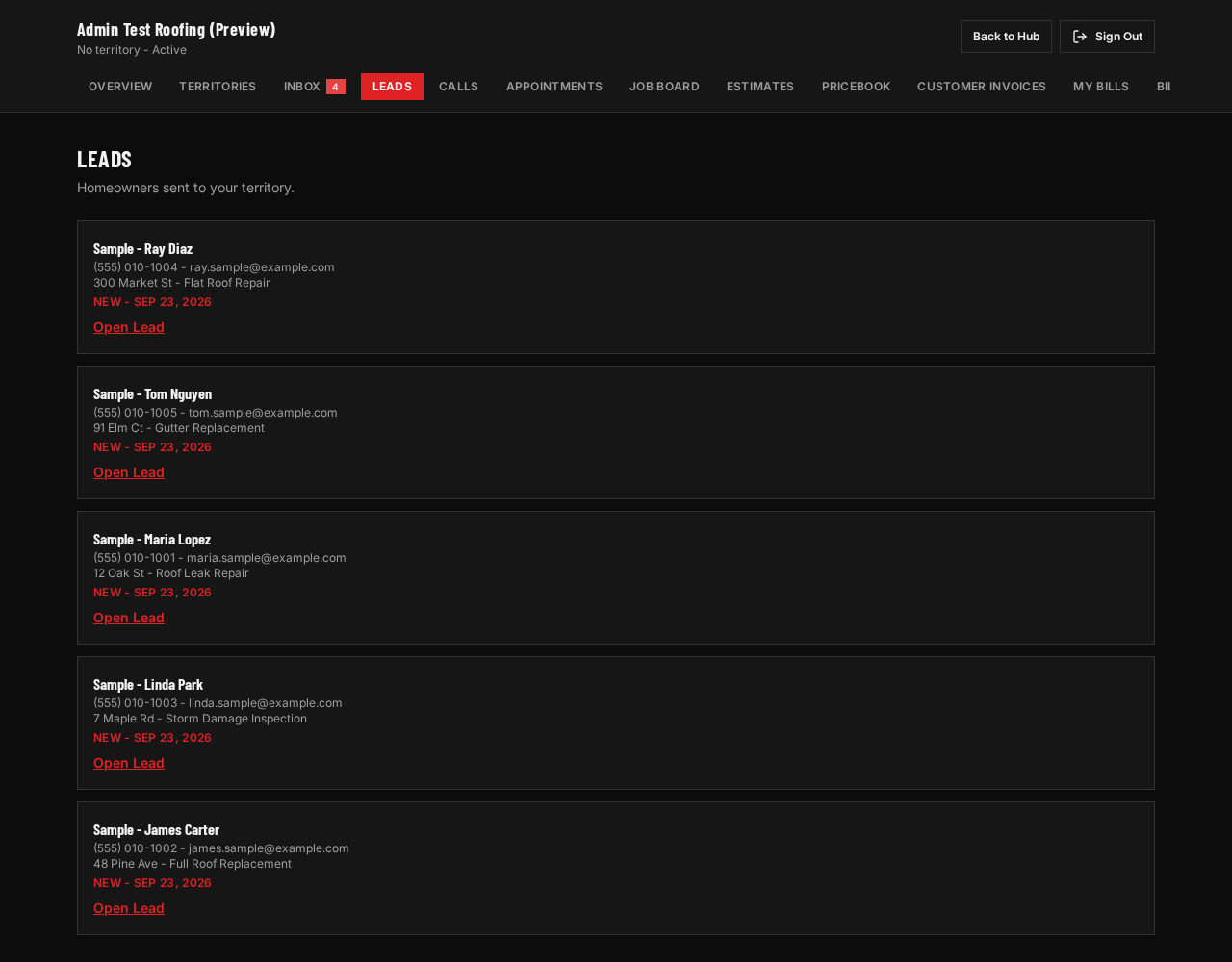
Renting a territory is one option. You pay a monthly fee for the calls and forms from a local site we own, and that territory goes to one roofer. It is not free and it does not guarantee jobs, but it can give a new company steady inbound calls while its own brand grows.
PHASE 5Software and office
You need a phone number that rings the right person, a way to track leads, a way to send estimates and a way to get paid. On day one, that can be a spreadsheet and your phone. As you add salespeople and crews, a CRM starts to pay for itself.
Do not overbuy. Many roofing CRMs price by user and add setup or training fees. Ask for a written quote for your real team size before you commit.
PHASE 6Cash cushion
Roofing has a cash gap. You buy material and pay crew before you collect, and insurance jobs can take weeks to pay out. Many new roofers run out of cash even while they are busy.
Plan for at least three months of fixed bills: insurance, truck payment, phone, software, marketing and your own pay. Some suppliers offer credit accounts, which help, but they still need to be paid on time.
PHASE 7A simple break-even example you can copy
Here is how the math works, using numbers you replace with your own. Suppose your fixed monthly costs, meaning insurance, truck, phone, software, marketing and your own minimum pay, add up to a number we will call F. Suppose your average job brings in a gross profit, after materials, labor and dumpster, that we will call G. Your break-even is F divided by G jobs per month.
Now work backwards to leads. If you close one in five homeowners you actually meet, you need five real appointments for every job. If half your leads turn into appointments, you need ten leads per job. Multiply that by your break-even jobs and you know how many leads a month your business needs just to stay alive. That is the number your marketing plan must deliver.
This exercise is sobering for most new owners, and that is the point. It tells you whether your price is high enough, whether your fixed costs are too heavy, and how much lead flow you must buy, rent or build before you quit your day job.
PHASE 8Mistakes that drain startup cash
Buying a brand new truck before you have steady work is the classic one. A reliable used truck or a lease keeps cash in the bank for the slow first months. Another is underpricing to win early jobs. Low prices feel safe, but they make your break-even impossible and train customers to expect discounts.
Skipping insurance or licensing to save money is the most dangerous mistake. One injury, one damaged home or one complaint to the state can end the business. Finally, many new roofers spread marketing money across too many channels without tracking any of them. Pick a few sources, track every lead, and double down on what produces booked inspections.
Keep a separate business bank account from day one, set aside money for taxes every time you get paid, and keep receipts organized. Your accountant will thank you, and you will always know if the business is actually making money.
PHASE 9Where your first ten jobs usually come from
For most new roofers, the first jobs come from people who already know them: friends, family, former coworkers and neighbors. Tell everyone you have started, hand out cards, and ask for introductions. Do great work on those first jobs, take before and after photos, and ask every happy customer for a review and a referral.
Next, set up the basics that help strangers find and trust you: a Google Business Profile with real photos, a simple website with your service area and phone number, and proof of license and insurance. After that, add one or two paid or rented lead sources and track them closely.
Your goal in year one is not to be everywhere. It is to find two or three sources that reliably book inspections at a cost your margins can carry.
PHASE 10What a missed lead really costs
A missed call is not just one lost job. It is the marketing money you spent to make the phone ring, the referral that job would have produced, and the review that would have helped you win the next one. When owners add those up, the true cost of a slow callback is usually much higher than they expected.
Use the calculator on this page with your own numbers. Enter how many calls and forms you get, how many slip through, your close rate and your average job. The result shows sales you never got the chance to quote. Then pick one change, like a shared lead list or an after-hours text, and measure the difference next month.
PHASE 11Subcontracting versus building your own crew
Many new roofing owners start by selling jobs and hiring subcontracted crews to install them. This keeps fixed costs lower, because you are not carrying payroll and workers' compensation for a full crew on slow weeks. It also means less control over schedule and quality, and you still need to check that subs carry proper insurance.
Others start as installers and build their own crew from day one. That gives more control and can mean better margins per job, but it raises insurance, payroll and equipment costs and makes slow weeks painful.
There is no single right answer. Some owners start with subs and bring crews in-house once work is steady. Whatever you choose, put the arrangement in writing, collect certificates of insurance from every sub, and include the true cost of each model in your startup calculator. Talk with your insurance agent and accountant, because the choice affects your policies, taxes and paperwork.
PHASE 12Write a one-page roofing business plan
A business plan does not need to be fifty pages. One page you actually use beats a binder on a shelf. Write down who you serve, what you sell, where you work, how you will get leads, what you charge, what it costs to run, and how many jobs a month you need to break even.
Break-even is the key number. Divide your monthly fixed costs by the average profit per job. If your fixed costs are high and your profit per job is low, you need a lot of jobs, which means you need a lot of leads. That math tells you how much marketing you really need.
- Service area (ZIPs and towns)
- Services: repair, replacement, storm, commercial
- Lead sources and monthly budget
- Pricing method and target margin
- Monthly fixed costs
- Jobs per month to break even