THE PROBLEMThe problem nobody puts in the demo
Interactive Hail Maps — and its recon-style tools — are the polished end of storm data. Zoomable swaths, address-level hail estimates, historical storms, exportable lists. If you are going to chase storms with data, this is the good stuff, and its popularity among storm roofers is earned.
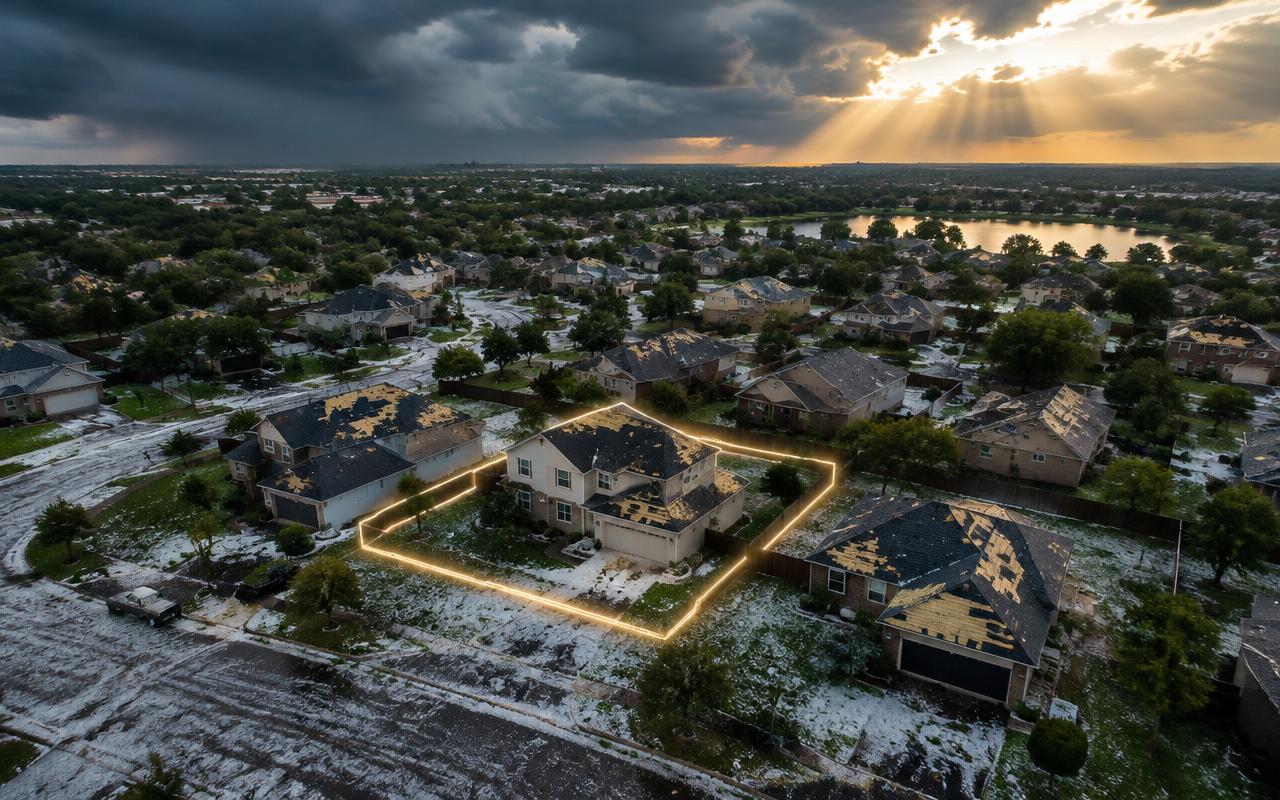
But popularity is exactly the problem. The word 'interactive' cuts both ways: you are not the only one interacting. When a hail event lights up the map, every subscriber in the region zooms into the same neighborhoods at the same time. The map does not just show you where the damage is. It shows everyone.
What follows is predictable to any roofer who has lived it: a territory war. Trucks converge on the same subdivisions. Door hangers stack up. Homeowners get pitched six times in two days. The better the map gets, the faster the crowd arrives — and the thinner the pickings get for everyone in it.
LET'S BE HONESTWhat it is really costing you
Territory wars are expensive in ways that never show up on the subscription invoice. You burn crew hours canvassing streets that three other companies canvassed that morning. You drop prices on the doorstep because the homeowner is holding four other bids. You win jobs at margins that barely cover the chase.
And the war never ends, because the map refreshes with every storm. Each new event resets the scramble. Your 'territory' is only yours until the next swath drops and the next wave of trucks rolls in. You never build anything durable — no local brand, no referral base, no compounding advantage. Just an endless series of land rushes.
Worst of all, the war is fought on the weakest ground: the cold doorstep. While twenty roofers fight over knocks, the motivated homeowners — real damage, real insurance, ready to move — are searching online for a roofer they can call. In a territory war, the company that owns that search wins without fighting.
THE FAILED FIXWhy more data never fixed it
Most roofers respond to the war by escalating it. Better map tier. Faster response. Bigger canvassing crew. Earlier mornings. Each escalation costs money or sanity, and each one is matched by competitors within weeks. It is an arms race where the only guaranteed winner is the company selling the maps.
Some try to carve out informal turf — 'we work this side of town' — but nothing enforces it. The map is public to every subscriber, the doors belong to homeowners, and there is no mechanism that keeps a competitor off your street. Handshake territories dissolve with the next big swath.
The hard truth: you cannot win a territory war with better data, because the data is the thing everyone shares. The only way out of the war is to own something the crowd cannot see on any map — the inbound channel itself.
THE REAL FIXOwn the call, not just the map
Here is what ending the war looks like. You hold an exclusive territory: a defined town or area where the local roofing site — the one homeowners find when they search after a storm — routes every call and form request to you and only you. Not a handshake. A structure. One territory, one roofer, enforced by the routing itself.
Rent Roofing Sites builds and operates those local sites with real local phone numbers. When hail hits your territory, the homeowners who search find the local site, call the local number, and reach you. The map-chasers can zoom in all they want — by the time their trucks roll, the motivated homeowners are already on your schedule.
And the entry is free. The Free Exclusive Territory Pilot lets a qualified roofer lock an open territory and receive its inbound inquiries at zero cost and zero risk. No subscription arms race. No doorstep bidding war. You find out what your market produces before you pay a dollar.
01What Interactive Hail Maps and Hail Recon do well
Credit where due: interactive swath mapping is the most usable storm data in the industry. Zoomable maps, address-level estimates, and storm history exports are genuinely well-built tools for understanding where hail fell. For market research and storm verification, they have real value.
The limitation is not quality — it is exclusivity. A tool sold to every roofer cannot give any roofer an edge that lasts. The better the tool, the faster the crowd, and the shorter your head start.
02The economics of a territory war
Run the true cost of working a contested swath: subscription, fuel, labor hours, materials, and a close rate depressed by doorstep competition. Many storm roofers discover their cost per signed job in a territory war rivals or exceeds the cost of premium lead sources — with none of the predictability.
Exclusive inbound flips the equation. The homeowner is motivated, local, and calling you. Your selling hours go to people who asked for them, and your margin is not shredded by a four-bid doorstep fight.
03Why exclusivity must be structural, not social
Informal turf agreements fail because nothing enforces them. Structural exclusivity is different: the local site's phone number and forms route to one roofer by configuration. A competitor can knock every door in your town and still never receive a single one of its inbound calls.
That is the difference between claiming a territory and holding one. Claiming is a hope. Holding is a system.
04How the Free Exclusive Territory Pilot works
Apply for your territory. If it is open and you are a fit, we connect you to the inbound calls and form requests our local site produces there. You answer, book, and close with your own process and your own CRM. We do not manage jobs, estimates, or crews — we create demand and route it to one roofer.
The pilot costs nothing. If you continue, pricing is set in a written agreement — published site rent is $997 per month per site, with setup and per-call terms documented in writing. If the market does not produce, you risked nothing.
05Who should apply — and who should not
Apply if you are done with the scramble: you can answer fast, show up fast, and close homeowners who already want help. The territory model rewards operators, not chasers.
Do not apply expecting guaranteed lead counts. Storm demand depends on weather and market, and we never invent numbers. What we guarantee is exclusivity, honest routing, and a free way to prove your market before you pay.
06A week in the life: the zoomer vs the owner
Two roofers open the same interactive map after the same storm. The first zooms, exports, routes, and spends the week canvassing a neighborhood that three other subscribers exported the same morning. The second holds the territory: the week is spent answering calls from homeowners who searched and found the local site before the first truck arrived.
Same map, same storm, same town. The difference is not the data — it is who owns the channel the homeowners use. The zoomer competes. The owner answers.
07Why every storm resets the war
Notice the pattern in map-driven storm work: nothing carries over. Each new swath triggers a new scramble, and last storm's effort buys you nothing in the next one. You are permanently starting over, because the asset you are working from — the shared map — resets to zero every time.
An inbound territory accumulates. The local site gains authority, the brand gains recognition, and each storm season starts from a stronger position than the last. One model is a treadmill. The other is a staircase.
08The margin math of exclusivity
Doorstep competition destroys margin in two directions: you cut price to beat the other bids, and you spend more labor per signed job. Exclusive inbound removes both pressures. The homeowner is not holding four bids — they called you. The conversation is about the roof, not the auction.
Roofers who switch from contested storm chasing to exclusive inbound consistently describe the same shift: fewer conversations, better conversations, and margins that survive the sale. That is what structural exclusivity buys.
09Your next step
If you are done fighting territory wars with shared maps, the exit is simple. Apply for the Free Exclusive Territory Pilot with your target ZIP and we will tell you honestly whether it is open.
If it is, you will see real inbound inquiries from your market before you pay anything. The war continues for everyone still on the map. You will not be in it. Proof first, zero risk.
10The questions smart roofers ask before switching
Roofers who have been burned by lead sellers ask the right questions, and you should too. Is the lead shared? No — one roofer per territory, full stop. Is the homeowner expecting the call? Yes — they initiated it. Can I see it work before I pay? Yes — that is the entire point of the free pilot.
Ask the same questions of your current lead sources. If the answers come back shared, cold, and pay-first, you already know why the margins feel thin. The model is the margin.
11What happens after the pilot
If the pilot produces real inquiries and you want to keep the territory, the terms are simple and written down before you commit: $997 per site per month, with setup and per-call terms spelled out in the agreement. No surprise fees, no long lock-in invented after the fact.
If the pilot does not convince you, you walk away having spent nothing. That is what zero risk means, and it is why the offer is structured this way — we would rather prove the channel than pitch it.
12The real cost of doing nothing
Every storm season spent in territory wars is a season someone else uses to build an unassailable local position. The roofer who owns your town's inbound channel next year is the one who moved this year. Exclusivity compounds, and so does the cost of waiting.
The free pilot removes every excuse for waiting. No money, no lock-in, no risk — just an honest look at what exclusive inbound demand in your market actually looks like. The only expensive option left is standing still.