THE PROBLEMThe problem nobody puts in the demo
If you roof in Oklahoma, storms are part of the job description. Spring brings line after line of severe weather across Oklahoma City, Tulsa, Norman, Edmond, Moore, Broken Arrow and the towns in between. Hail maps of the state can look like a patchwork quilt by June.
Every one of those swaths draws attention. Local roofers see them. So do storm restoration companies from Texas, Kansas, Missouri and far beyond. Oklahoma is close to several big roofing markets, so trucks can reach a fresh swath in hours.
That turns every good storm into a crowded storm. The neighborhoods under the swath fill with door knockers and signs before many local companies have finished their first inspections. Homeowners get pitched over and over, and the trust a local roofer has built gets lumped in with everyone else.
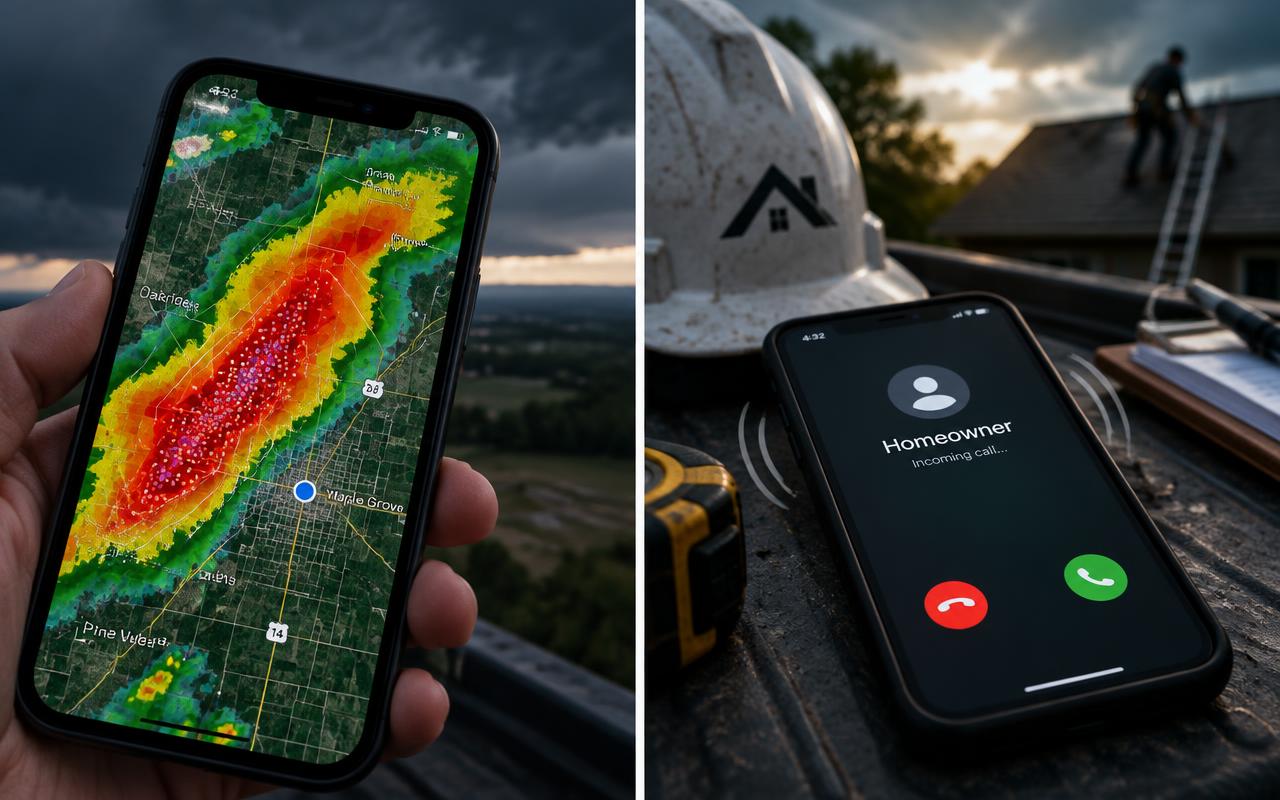
The deeper problem is that a hail map only shows weather. It cannot show which homeowner wants help, which one already signed, or which house is a rental where the tenant cannot approve anything.
LET'S BE HONESTWhat it is really costing you
You probably know the cycle by heart. Storm hits. Map updates. Crews flood the swath. Homeowners stop opening doors. Prices get pushed down by companies that will not be around for warranty work. The local roofer works harder for thinner margins.
Oklahoma homeowners have seen a lot of storm seasons. Many have had at least one bad experience with a contractor who took a deposit and disappeared, or who did fast, sloppy work and left. That history makes them cautious with anyone who knocks, including honest local companies.
Meanwhile your costs keep running: fuel, canvassers, signs, map subscriptions, hours spent on doors that never open. When the season winds down, the swaths are worked over and the pipeline thins out. You are back to waiting for the next storm.
This is not a failure of effort. It is a failure of position. When your lead source is the same map everyone else uses, you are always one runner in a crowded race.
THE FAILED FIXWhy more data never fixed it
Many Oklahoma roofers respond by stacking more tools: paid hail trackers, instant alerts, address lists, canvassing apps. Each promises a step ahead of the competition.
But the competition buys the same tools. Faster data makes the swath crowd up faster. It does not give you the homeowner's permission to help, and it does not keep the next truck from knocking on the same door five minutes later.
More storm data is a better weather report. It is not a better lead source. That distinction is why so many roofers spend more on maps every year and still feel stuck.
THE REAL FIXOwn the call, not just the map
The better path is to be where homeowners look on their own. After a storm, plenty of Oklahoma homeowners search before anyone knocks: roof repair near me, hail damage roof, roofer in Edmond. The roofer who answers that search gets the call.
Rent Roofing Sites builds local roofing sites for specific Oklahoma towns and works to rank them. Calls and requests from each site route to one roofer, the company holding that territory. We do not split the homeowner among several buyers.
When a homeowner calls you first, you start with trust. They chose you. The swarm outside does not change that conversation.
01Why Oklahoma hail markets get crowded fast
Oklahoma's location matters. It sits in the path of spring storms, and it sits close to major roofing hubs in Texas, Kansas and Missouri. A crew in Dallas or Wichita can reach Oklahoma City or Tulsa in a few hours. That makes even mid-sized storms worth the trip for chasers.
For a local roofer, it means you rarely get a storm to yourself. Being local used to be a big advantage. Now it only helps if homeowners can find you before the trucks arrive.
02What Oklahoma hail maps are built on
Hail maps usually combine NOAA NEXRAD radar data, dual-polarization hail detection, hail size estimates and public storm reports. Oklahoma has excellent radar coverage, so the maps can be detailed.
Detailed is not the same as exact. Radar estimates where hail likely fell. It does not inspect a roof. It does not know who owns the house, whether they want help, or whether another roofer signed them yesterday.
- Use hail maps for storm timing and general area.
- Do not treat a swath as a list of willing homeowners.
- Remember every competitor sees the same swath at the same time.
03Adding up the real cost of a storm push
Most roofers never total up a storm campaign. Map tools sit on one card, canvassers in payroll, fuel in the truck budget, and the discounts you gave to beat low bids never show up anywhere. Add them together, then divide by signed jobs from that push.
Compare that cost per job to jobs that began with a homeowner calling you. The inbound jobs usually win on cost, speed and margin. That is the case for owning the inbound channel in your town.
04How the territory model works in Oklahoma
We build a local roofing site for a town like Moore, Yukon, Owasso or Stillwater. We work to rank it for the searches homeowners use. It gets a local number and a short form asking for name, phone, ZIP and roofing problem.
Each lead is saved in our system first, then routed to the roofer who holds the town. You see it in your portal and can receive it in your CRM. We never sell that homeowner to anyone else.
05What we will not promise
We will not promise a set number of calls. Search rankings take time and storms vary. We promise exclusivity in your territory during the pilot, tracking for every routed lead, and written terms before any paid plan.
You see the results with your own eyes. If they are not worth it, you leave.
06Who is a good fit
Oklahoma roofing companies with a real local presence, proper licensing and insurance, and a team that answers the phone. Companies that want to keep their own process and CRM and simply want more homeowners calling them directly.
- Serves the town you want to hold.
- Answers or returns calls quickly.
- Plans to stand behind work for years.
07The months between storms
Oklahoma's storm season is intense, but it does not last all year. When the maps go quiet, homeowners still search for leak repair, wind damage help, and roof replacements. A ranked local site keeps answering.
That steadier flow helps you keep crews busy and plan ahead instead of riding the storm roller coaster.
08A quick test
Search roof repair plus your town. Count how many results are truly local roofers and how many are lead sellers who share homeowners with several companies. Imagine every caller from that search reaching only you. If that is worth testing, apply.
09Use the map as background
Keep your hail tracker if you like it. It helps you know when storms hit and talk with homeowners and adjusters. Just stop making it your main lead source. Let homeowners who searched and called become your pipeline.
10Two Oklahoma roofers, one spring storm
A May storm crosses Edmond and north Oklahoma City. Roofer A pulls up the hail map, prints routes and sends a crew of canvassers into the swath. By the second day they are sharing every street with trucks from Texas and Kansas. Homeowners keep their doors shut. A small number of inspections get booked, and several of those homeowners are also talking to two other companies.
Roofer B holds the Edmond territory. That same morning, homeowners who searched roof repair Edmond and roof inspection after hail reach the local site and call. Each call goes to Roofer B's office. No other roofer receives those calls from us. Her team books inspections with homeowners who are expecting them.
Both roofers are good at their jobs. One spends the week racing. The other spends it serving people who asked. That is the gap an exclusive territory is built to close.
11Building a reputation that outlasts storm season
Oklahoma homeowners remember who helped them and who disappeared. A roofer who answers calls all year, does honest inspections, and stands behind repairs builds the kind of name that neighbors pass along.
An exclusive territory supports that long game. Every caller you serve well in your town makes the next referral easier. Storm crews who leave after the season never build that local trust. You can.
12Questions to ask any lead source
Before you pay for any Oklahoma roofing leads, ask a few simple questions. Who else receives this homeowner? Can I hear the call? What happens if the homeowner was never in my service area? What are the terms in writing?
We answer those questions plainly. Routed leads from your territory go only to you. Recordings show in your portal when available. Terms after the pilot are written before they start.
13How an Oklahoma territory call flows
A homeowner in your territory searches for help and finds our local site. They call the local number or fill out the short form. The lead is saved in our system the moment it arrives, so it cannot be lost. Then it routes to your company. You get an alert, see the details in your portal, and call back.
If you use a CRM, we can send the lead there too, where supported. If a delivery fails, the lead stays safe in our system and you still see it in your portal. That way a busy storm week never costs you a homeowner who already reached out.
From there it is your process. You inspect, explain, and earn the job the way a good local roofer always has. The difference is that you start with a homeowner who chose to call, not a stranger behind a closed door.
14Three Oklahoma storm myths
Myth one: the first truck in the swath wins. In crowded Oklahoma markets, the first truck often just meets the second, third and fourth trucks on the same street. Speed matters less than whether the homeowner already chose you.
Myth two: more door knocks means more jobs. Past a certain point, more knocks mean more tired homeowners and lower trust for everyone. A smaller number of homeowners who called you usually beats a big pile of cold doors.
Myth three: storm work is the only work worth chasing. Repair calls, leak calls and aging-roof replacements keep coming all year. A territory that answers those searches gives you steady work between storms, and storm calls on top when hail hits your town.