THE PROBLEMThe problem nobody puts in the demo
If you have ever looked at a hail map, you have looked at NOAA data, whether you knew it or not. The National Oceanic and Atmospheric Administration runs the National Weather Service and the NEXRAD radar network that scans the skies across the United States. Public storm reports collected by the NWS and the Storm Prediction Center add ground truth from spotters and the public.
Many private hail maps and trackers take that public data, process it, and wrap it in a nicer interface. Some add their own algorithms. But the foundation is often the same: radar plus reports.
That means a few things for roofers. First, the core weather data is widely available. Second, every competitor is looking at versions of the same picture. Third, none of that data was built to find customers. It was built to understand and warn about weather.
So when roofers use NOAA live hail radar as a lead source, they are using a weather tool for a sales job. It can tell you where storms went. It cannot tell you who wants a roofer.
LET'S BE HONESTWhat it is really costing you
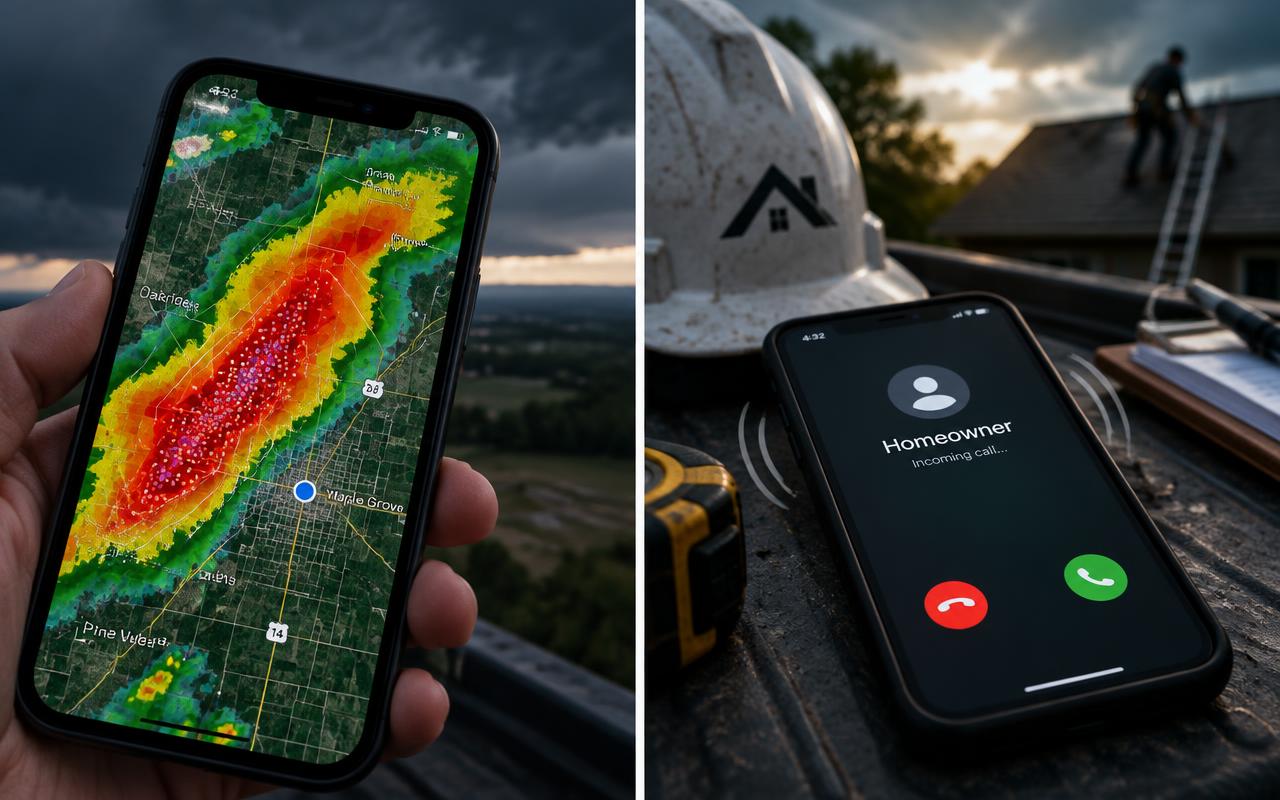
Watching live hail radar during a storm can be exciting. You see the cores light up and know that roofs are getting hit. But by the time the storm passes, every storm company in the region has watched the same radar loop.
Then comes the familiar race: crews heading to the swath, door knockers in every neighborhood, homeowners pitched again and again. The data was free. The race it started is expensive.
Radar can also mislead. It measures the storm high above the ground. Hail can melt on the way down, blow sideways in strong wind, or fall in narrower streaks than the radar suggests. Roofers who trust the swath too much end up knocking in areas with little real damage.
Meanwhile you still have to find the homeowner, earn trust and beat competitors. NOAA cannot help you with any of that.
THE FAILED FIXWhy more data never fixed it
Many roofers move from free NOAA data to paid trackers that promise better processing, finer swaths and faster alerts. Others combine several tools hoping to get an edge.
These products can be well made. They still start from the same kind of weather data, and competitors can buy them too. Faster weather information leads to a faster race, not a private one.
The basic gap stays open: weather data tells you about storms, not about people. To win more jobs at better margins, you need people who want you, not just better pictures of the sky.
THE REAL FIXOwn the call, not just the map
Homeowners do not look at radar to find a roofer. They search. After a storm, they type things like hail damage roof repair, roofer near me, or roof inspection plus their town. The company that answers that search gets the call.
Rent Roofing Sites builds and ranks local roofing sites for specific towns. Calls and requests from each site route to one roofer, the company holding that territory. Homeowners from your territory are not sold to other roofers.
Keep NOAA radar for what it does best: understanding the storm. Let inbound homeowner calls be your lead source.
01How NOAA radar detects hail
The NEXRAD network uses Doppler weather radars that send out pulses and listen for the echoes from rain, hail and other targets. Dual-polarization upgrades let the radar send pulses in two directions, which helps tell the shape and type of what it sees. Hail often looks different from rain to dual-pol radar.
Meteorologists and software use those readings to flag likely hail and estimate size. One common estimate is called MESH, short for Maximum Estimated Size of Hail. Many hail maps display MESH-style estimates as colored swaths.
- NEXRAD: the national Doppler radar network.
- Dual-pol: helps separate hail from heavy rain.
- MESH: an estimate of maximum hail size, not a measurement on the ground.
02How NOAA storm reports work
Storm reports come from trained spotters, emergency managers, the public and others. They often include a time, location and hail size. The Storm Prediction Center publishes preliminary local storm reports that many tools use.
Reports are valuable ground truth. They are also uneven. More people means more reports, so rural hail is often under-reported. A report proves hail at a point, not on every roof nearby.
03What NOAA data cannot tell a roofer
It cannot tell you whether a specific roof was damaged. It cannot tell you who owns the home, whether they want help, whether they have insurance, or whether another roofer is already working with them.
Those are the questions that decide whether you win a job. Only homeowners can answer them, and the easiest way to get those answers is for homeowners to call you.
04Why free data leads to crowded markets
Because NOAA data is public, every storm company can use it at no cost. That is great for public safety. For roofers, it means weather data alone will never be a lasting edge. Everyone sees the same storm at roughly the same time.
The lasting edge is being the company homeowners find and call in your area. That is something the competition cannot download.
05How the exclusive territory works
We build a local roofing website for a town and work to rank it for homeowner searches. It has a local phone number and a short request form. Each lead is saved first so it cannot be lost, then routed to the one roofer holding that town.
You see every routed lead in your portal and can receive them in your CRM. Your territory's homeowners are not sold to anyone else.
06Using NOAA data inside a real inspection
When a homeowner calls and you schedule an inspection, NOAA radar history and storm reports can help you explain what happened and when. That can be useful if the homeowner decides to talk with their insurance company.
Always be clear: radar and reports show a storm likely passed. Your inspection shows the actual condition of the roof.
07Honest limits of the pilot
We do not promise a number of calls. Search rankings take time and every town is different. We promise exclusivity during the pilot, tracking of every routed lead, and written terms before any paid plan.
08Who should apply
Licensed and insured roofing companies that want homeowners to come to them, can answer calls quickly, and plan to stand behind their work locally for years.
- Serves the town you want to hold.
- Responds quickly to inbound homeowners.
- Treats homeowners honestly after storms.
09Next step
Keep your NOAA radar bookmarked. Then apply for the Free Exclusive Territory Pilot and find out if your town is open. Let the sky tell you about storms. Let homeowners tell you about jobs.
10Two roofers watching the same radar loop
A spring evening. Two roofers sit with the same NOAA radar loop open, watching a hail core cross the north side of town. Roofer A starts planning door routes for the morning. Roofer B goes to bed.
The next morning Roofer A's team joins a crowd of crews in the swath. Roofer B's phone starts ringing with homeowners in her territory who searched for roof inspection after hail and found the local site. Both roofers saw the same radar. Only one turned that storm into calls from people who asked for help.
11Common radar mistakes roofers make
One common mistake is treating radar colors as proof. Bright reflectivity can come from heavy rain, not just hail. Another is trusting a hail swath edge too much; real damage can stop short of the swath or spill past it.
A third mistake is assuming bigger estimated hail always means more damage. Roof age, material and wind all matter. Radar is a strong clue. It is never the final word on any single roof.
- Radar color is not proof of hail on the ground.
- Swath edges are fuzzy, not exact lines.
- Roof age and material change how hail affects each home.
12Where to find NOAA hail information
The National Weather Service posts radar imagery and local storm reports. The Storm Prediction Center publishes daily preliminary storm reports, including hail. Many universities and weather sites also display NEXRAD data for free.
These are excellent free resources for understanding a storm. They are not a replacement for homeowners who reach out to you.
13Turning weather knowledge into trust
Homeowners appreciate a roofer who can explain a storm in plain words. When a caller asks whether the hail last Tuesday could have hurt their roof, you can share what radar and storm reports showed, then confirm with an inspection.
That mix of weather knowledge and honest inspection builds trust. Inbound calls give you the chance to show it to people who are already listening.
14How a territory lead reaches you
A homeowner in your territory searches for a roofer after a storm and finds our local site. They call the local number or fill out the short form. The lead is saved the moment it arrives, so it cannot be lost, then routed to your company alone.
You see it in your portal, with a recording when available, and can get it in your CRM where supported. Before you visit, you can check NOAA radar history and storm reports for that date, so you arrive informed and ready to explain what happened.
That is the best use of free NOAA data: preparing for a conversation a homeowner asked for, instead of starting a race every competitor can join.
15What happens at the end of the pilot
At the end of the pilot, you review every routed call and form and decide whether the territory is worth keeping. Any paid terms are written down for you before they start. If it is not a fit, you walk away.
16Three NOAA radar myths
Myth one: radar sees every hailstone. Radar sees the storm high in the air and estimates what reaches the ground. It is a strong clue, not a roof inspection.
Myth two: paid hail maps use secret data. Many build on the same public NOAA radar and storm reports, then add their own processing and design. That can be useful, but it is rarely an edge your competitors cannot also buy.
Myth four: free data means a free lead source. The data is free. Chasing it costs fuel, labor and margin.
Myth three: faster alerts win more jobs. Faster alerts start the race sooner for everyone. Being the roofer homeowners call is what wins jobs.