THE PROBLEMThe problem nobody puts in the demo
Storm damage claim work is a big part of many roofing businesses. When hail or wind damages a roof, a homeowner may choose to file an insurance claim. A good roofer inspects, documents the damage, and, when the homeowner asks, explains findings to the adjuster. When the claim is approved, the roofer does the work.
Done right, it helps homeowners get their roofs fixed properly and gives roofers solid, well-documented jobs. But the way many companies chase claim work has made it one of the most crowded and distrusted corners of roofing.
After a storm, door knockers flood neighborhoods with pitches about getting a free roof from insurance. Some push homeowners to sign contracts on the spot. Some make promises about what insurance will pay. Homeowners get confused and wary, and insurers and states have pushed back with rules.
Honest claim roofers end up stuck in the middle: competing with aggressive tactics at the door while trying to follow the rules and treat homeowners right.
LET'S BE HONESTWhat it is really costing you
Picture a homeowner after a big hailstorm. Five companies knock in two days. One says insurance will definitely pay for a new roof. Another wants a signature on a form the homeowner does not understand. Another offers to cover the deductible. The homeowner is overwhelmed, and some of what they heard may not even be legal in their state.
Now you knock. You do honest inspections, document carefully, and never promise outcomes. But the homeowner has already heard so many pitches that they do not trust anyone. Some will sign with whoever promised the most. Some will sign with no one.
Claim work also takes time. Inspections, documentation, adjuster meetings, supplements and scheduling stretch over weeks. Homeowners you won in a doorstep race are easy to lose to the next big promise.
And the rules keep changing. Many states have laws about contractors and insurance claims, such as rules on deductibles, contract cancellation rights and what contractors can say or do in the claim process. Aggressive door-to-door tactics put companies at risk. Honest companies pay the reputation price either way.
THE FAILED FIXWhy more data never fixed it
Many claim roofers respond with bigger canvassing teams, slicker scripts and storm tools to reach swaths first. Some buy shared storm claim leads that go to several companies at once.
Bigger canvassing teams mean more knocks on overwhelmed homeowners. Slick scripts drift toward promises that create legal risk. Shared leads turn a careful decision into a phone race. None of these builds trust, and trust is what claim work runs on.
The honest way to win claim jobs is to be the roofer a homeowner seeks out when they decide they want a professional opinion.
THE REAL FIXOwn the call, not just the map
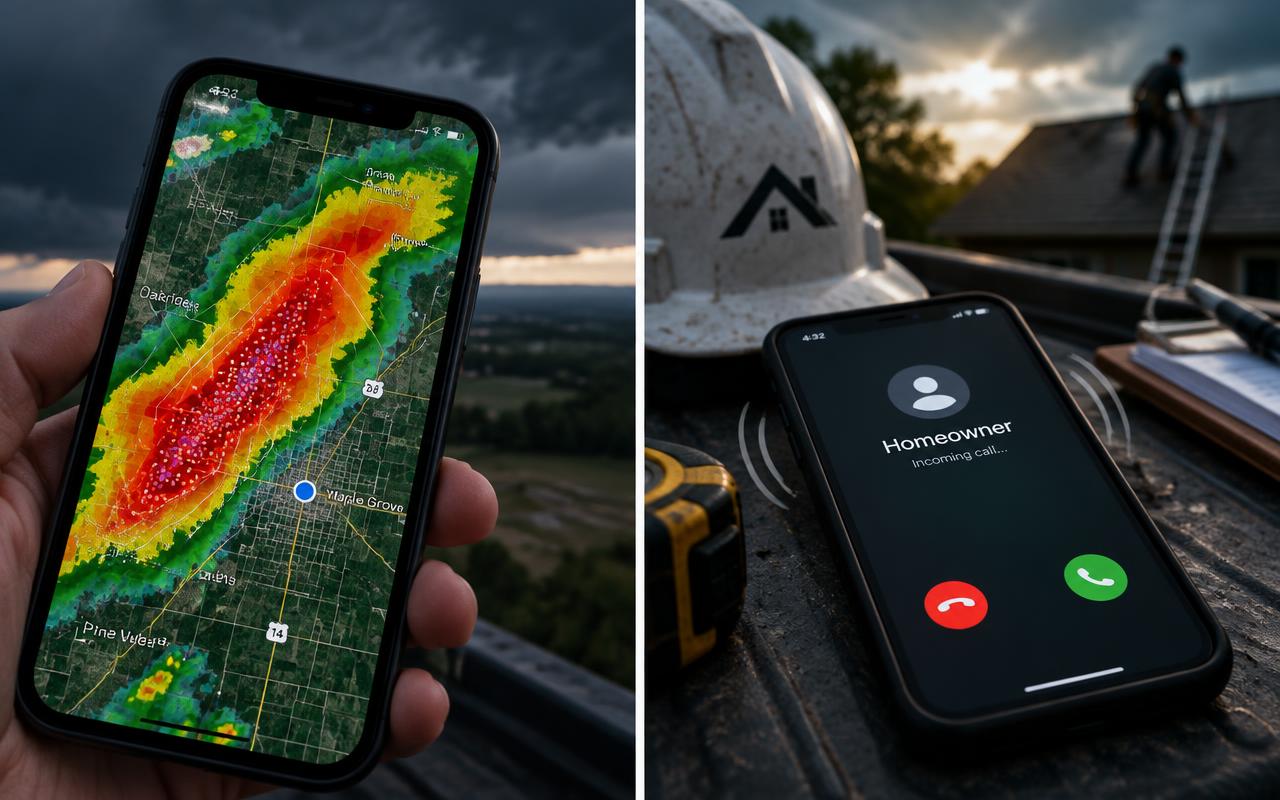
After a storm, many homeowners search before they call anyone: hail damage roof inspection, storm damage roof repair, roof insurance claim help, or roofer plus their town. They are looking for someone they can trust to tell them the truth about their roof.
Rent Roofing Sites builds and ranks local roofing websites for specific towns. Calls and requests route to one roofer, the company holding that territory. That homeowner is not sold to other claim companies.
When a homeowner calls you first, claim work can be done the right way. You inspect because they asked. You document honestly. You let them decide whether to file. If they do, you support the process within your state's rules. That is how claim jobs stay strong from start to finish.
01How an honest storm claim job usually flows
A homeowner notices possible damage or worries after a storm and asks a roofer to inspect. The roofer checks the roof and documents what they find with clear photos and notes. If there is real damage, the roofer explains it and the homeowner decides whether to contact their insurance company.
If the homeowner files, an adjuster inspects. At the homeowner's request, the roofer may meet the adjuster to point out documented damage. After the insurer makes its decision, the homeowner chooses how to proceed, and the roofer does the agreed work.
- Homeowner asks for an inspection.
- Roofer documents honestly.
- Homeowner decides whether to file.
- Roofer supports within state rules.
02Rules every claim roofer should know
Many states have laws about roofing contractors and insurance claims. Common examples include rules against offering to pay or waive a homeowner's deductible, cancellation rights for contracts signed after storm solicitation, and limits on contractors acting like public adjusters. Rules differ by state and change over time.
Check your state's current rules and follow them. An inbound model helps: when the homeowner reached out to you, there is less pressure to cut corners to win the job.
03Never promise what insurance will pay
Every policy is different, and only the insurer decides what is covered. A roofer who promises a free roof is setting up a disappointed homeowner and inviting legal trouble.
Honest claim roofers say something like: here is what I found, here are the photos, here is how the claim process usually works, and the decision is yours. That honesty is what earns referrals.
04Documentation wins claims, not pressure
Strong documentation helps everyone. Clear photos of hail hits on shingles, soft metals, vents and gutters, notes on roof age and condition, and a simple explanation the homeowner can understand all make the claim conversation smoother.
When you are not racing four other companies, you have time to document properly. That is one more reason inbound claim jobs tend to go better.
05How the exclusive territory works
We build a local roofing website for your town and work to rank it for searches like hail damage roof inspection and storm damage roof repair. It has a local number and a short form asking for name, phone, property ZIP and roofing problem.
Every lead is saved the moment it arrives, then routed to the roofer holding the town. You see it in your portal, with a recording when available, and we can deliver it to your CRM, email or text where supported. That homeowner is never sold to another roofer.
06Two claim roofers, one storm
Roofer A sends canvassers with a claim pitch. They sign several homeowners, but a few cancel within days after another company promises more. One homeowner complains to the state about pressure tactics, and Roofer A spends hours dealing with it.
Roofer B holds the territory. Homeowners who searched hail damage roof inspection in that town call her. She inspects, documents and explains. Some file claims, some do not. The ones who file stay with her because they trust her. No pressure, no complaints.
07The real math of claim chasing
Add canvasser pay, shared lead costs, storm tools, cancelled contracts, jobs lost mid-claim and time spent on complaints. Divide by completed claim jobs.
Compare that with claim jobs that started from a homeowner calling you. For most honest roofers, inbound wins on cost, retention and peace of mind.
08What the pilot does not promise
We do not promise a number of calls, claims or jobs. Rankings take time, storms vary, and insurance decisions belong to insurers. We promise exclusivity during the pilot, tracking of every routed lead, and written terms before any paid plan.
09Who should apply
Licensed and insured roofing companies that do honest inspections, document carefully, follow their state's claim-related rules, and want homeowners to come to them.
- Serves the town you want to hold.
- Never offers to waive or cover deductibles.
- Lets homeowners make their own claim decisions.
10Three storm claim myths
Myth one: claim jobs are won by the first knocker. They are often won by the roofer the homeowner trusts, and trust grows faster when the homeowner called you.
Myth two: you have to promise a free roof to compete. That promise creates disappointed homeowners and legal risk. Honest documentation wins more lasting jobs.
Myth three: claim work only exists right after big storms. Smaller storms, wind events and late-discovered damage create claim conversations for months, and homeowners search for help each time.
11Try this before you apply
Search hail damage roof inspection plus your town. Look at who answers and how many are lead sellers. Imagine every homeowner from that search calling only you. If that is worth testing, apply.
12Build claim work on trust
Claim work lasts weeks and depends on trust at every step. Start it the right way: with a homeowner who found you and asked for an honest opinion. That is what an exclusive territory is built to deliver.
13Meeting the adjuster the right way
When a homeowner asks you to be there for the adjuster's visit, come prepared and calm. Bring your photos and notes. Point out what you documented. Answer questions honestly. Let the adjuster do their job, and remember the decision belongs to the insurer and the homeowner.
Adjusters see many roofers. The ones who are organized, honest and respectful tend to have smoother visits. That reputation helps every future homeowner you serve.
14How a claim-related lead reaches you
A homeowner in your territory searches for a hail damage inspection or storm damage repair, finds our local site and calls or fills out the short form. The lead is saved the moment it arrives, then routed only to your company. You see it in your portal and, where supported, in your CRM, email or text.
15What happens at the end of the pilot
When the pilot ends, you look at every call and form routed to you from your local territory and decide whether it is worth keeping. If it is, any paid terms are written down for you to read before they start. If it is not, you walk away. There is no long contract to begin, and the leads you already received stay in your records.
16Your first call checklist
When a homeowner calls about storm damage, start with your name, license and local office. Ask what they noticed and when the storm hit. Ask whether they have already filed a claim or talked with other contractors. Book an inspection and explain that you will document what you find and walk them through it.
Do not talk about what insurance will pay on the first call. Promise only what you control: an honest inspection, clear photos and a straight explanation. That is the opening that keeps claim jobs strong all the way to the finished roof.
After the inspection, send a short written summary with photos so the homeowner has it ready if they decide to file.