THE PROBLEMThe problem nobody puts in the demo
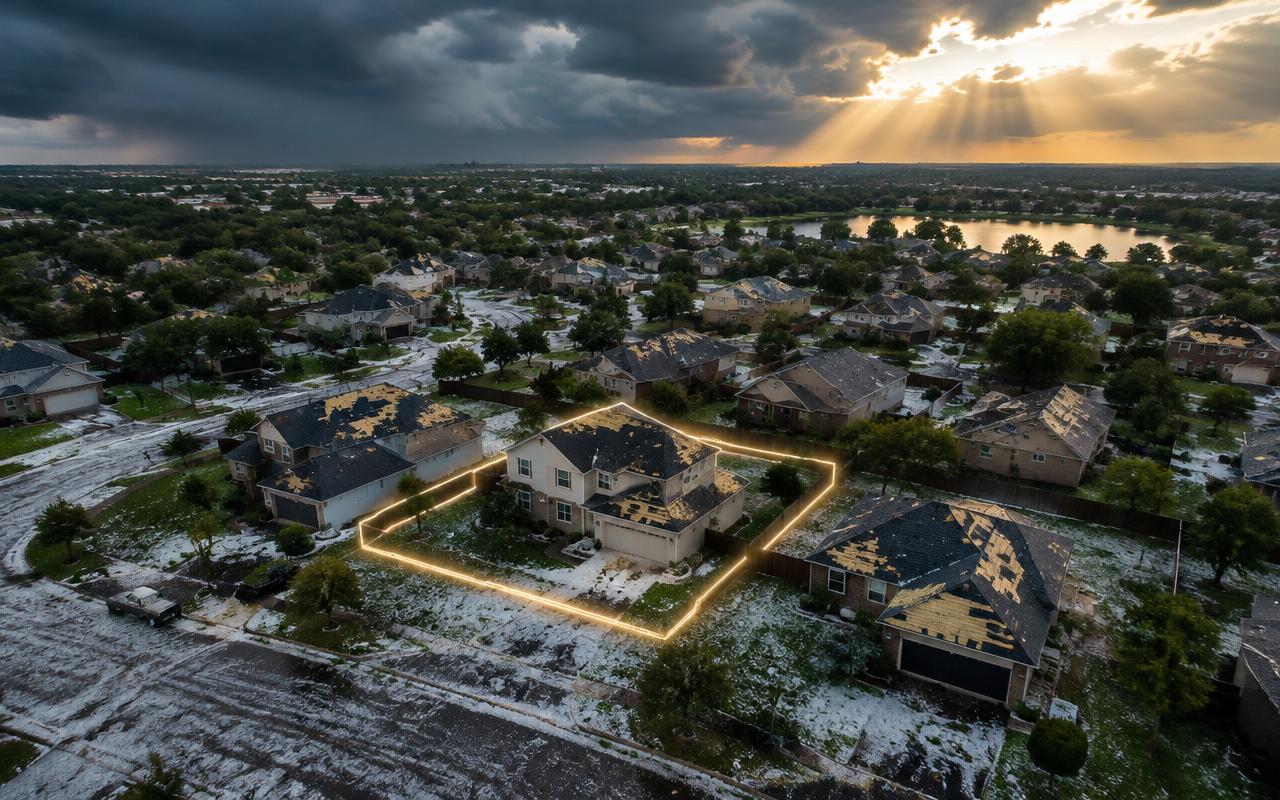
Kansas is hail country. Spring and early summer storms march across the plains, and a big one can drop ice along a path that runs for a hundred miles. On a Kansas hail map, that path looks like a long colored ribbon crossing wheat fields, small towns and, every so often, a city full of rooftops.
Here is the part the map does not show. When that ribbon crosses open farmland, very few roofers care. When it crosses Wichita, Overland Park, Olathe, Lenexa, Topeka or Lawrence, everybody cares. Those are the places with thousands of homes packed close together, and that is exactly where storm crews from Missouri, Oklahoma, Texas and Colorado head first.
So a Kansas roofer often faces two extremes. Rural storms are spread out and hard to work profitably. Suburban storms are dense but crowded within a day. Either way, the hail map does not tell you who wants a roofer. It only tells you where ice fell.
A swath is weather. A homeowner who asked for help is business. The gap between them is where Kansas roofers lose time, money and margin every storm season.
LET'S BE HONESTWhat it is really costing you
Think about the last time hail crossed Johnson County. Within a couple of days, cul-de-sacs were covered in yard signs from companies most homeowners had never heard of. Door knockers worked every street. HOA boards sent emails warning residents about storm chasers. Homeowners got cautious, and that caution landed on the honest local roofer too.
Now think about Wichita after a big storm. Same pattern. Crews drive in from neighboring states, set up in hotel parking lots and start canvassing. Some of them do fine work. Some disappear before the warranty matters. Homeowners cannot always tell the difference at the door, so they start saying no to everyone.
The local company pays the price. You have a real office, real staff and real insurance. You also have to compete on doorsteps against crews who can bid low because they will not be around next year. You either cut margin to match them or watch jobs walk away.
Then the storm market cools. The crews leave. Most of the swath is signed. Your pipeline drops until the next ribbon of hail crosses a city. That is a hard way to plan payroll.
THE FAILED FIXWhy more data never fixed it
Most roofers try to fix this with better storm data. Higher-resolution swaths. Faster alerts. Address lists inside the polygon. Canvassing apps that plan routes door by door.
These tools can save time. But they are sold to anyone who pays, and in a state as storm-prone as Kansas, plenty of competitors pay. When every crew sees the same swath across Olathe at the same moment, the swath stops being an edge. It becomes the start of a race.
Faster data makes the race faster. It does not make you the only runner. And it never tells you which homeowner actually wants your help.
THE REAL FIXOwn the call, not just the map
The better path is to be the roofer homeowners find on their own. After hail, many Kansas homeowners do not wait for a knock. They search for roof repair, hail damage roof inspection, or roofer plus their town. The company that shows up and answers gets the call.
Rent Roofing Sites builds and ranks local roofing websites for specific towns, such as Olathe, Derby, Andover, Shawnee or Manhattan. Calls and requests from that site route to one roofer, the company holding the territory. We do not sell that homeowner to anyone else.
When the homeowner calls you, they already chose you. You are not interrupting their evening. You are answering their question. That changes everything about the conversation that follows.
01Two Kansas markets in one state
Kansas roofing really splits into two worlds. The Kansas City suburbs on the east side behave like a big metro: dense subdivisions, HOAs, newer homes and lots of competition. Wichita, Topeka and Lawrence have their own busy neighborhoods. Then there is the rest of the state, where towns are smaller and farther apart.
Hail maps flatten those differences. A swath over Hutchinson and a swath over Overland Park look the same on screen. They are not the same business. One draws a crowd. The other might draw almost nobody. A territory model lets you focus on the town you actually serve, instead of reacting to wherever the ribbon of hail happened to land.
02What a Kansas hail map is built from
Most Kansas hail maps start with NOAA's NEXRAD radar network, which covers the state from several radar sites. Dual-polarization radar helps estimate where hail is likely and how large. Many maps add public storm reports from spotters and the National Weather Service.
That is real science, and it is useful for understanding a storm. It is still an estimate. In rural Kansas, fewer people means fewer ground reports, so some hail goes unconfirmed. In cities, a swath edge can split a neighborhood where some roofs were hit and some were not.
- Radar estimates where hail probably fell, not roof-by-roof damage.
- Ground reports are thinner in rural areas.
- No map shows who owns a home or wants help.
03The HOA factor in Johnson County
Many Johnson County neighborhoods have HOAs with rules about yard signs, roofing materials and contractors. After big storms, some HOAs send warnings about door-to-door crews. That makes cold canvassing harder for everyone.
Inbound calls sidestep that wall. The homeowner reached out to you. They often already know their HOA's rules and want a roofer who understands them. A local company that answers well has a real advantage over a crew that just drove in.
04The real math of a Kansas storm push
Add up everything a storm campaign costs: map tools, canvasser pay, fuel, hotel nights for crews working far from home, signs, door hangers and the discounts you gave to beat low bids. Divide by the jobs you actually signed.
Now compare that with jobs that started from a homeowner calling you. For most roofers, inbound jobs cost less, close faster and hold their price better. That gap is the reason to own your town's inbound channel.
05How the exclusive territory works in Kansas
We build a local roofing site for your town and work to rank it for the searches local homeowners use. It gets a local phone number and a short form asking for name, phone, property ZIP and roofing problem.
Every lead is saved in our system the moment it arrives, so it cannot be lost. Then it routes to the roofer holding the town. You see it in your portal, with a recording when available, and we can send it to your CRM, email or text where supported. We never sell that homeowner to other roofers.
06Two Kansas roofers, one May storm
A storm drops hail across Olathe and Lenexa. Roofer A sees the swath that night and sends reps out at dawn. By noon they are sharing every street with three other companies and dodging HOA warnings. A few inspections get booked, and several of those homeowners are also talking to competitors.
Roofer B holds the Olathe territory. That morning, homeowners who searched hail damage roof inspection Olathe find the local site and call. Each call goes to Roofer B. Her team books inspections with homeowners who asked for them. Same storm. Same town. Completely different week.
07Wind matters as much as hail
Kansas is famous for wind as well as hail. Straight-line winds can lift shingles, peel ridge caps and damage flashing even when there is no hail at all. Hail maps do not show wind damage well.
Homeowners with wind damage still search for help. A local site that answers roof repair and storm damage searches catches those calls too, so your territory brings in work even when the hail map is blank.
08What the pilot does not promise
We do not promise a number of calls. Rankings take time, storms vary, and every Kansas town is different. Anyone who promises a fixed number of roofing leads from search is guessing.
What we do promise is exclusivity in your territory during the pilot, honest tracking of every routed lead, and written terms before any paid plan begins. You see the calls. You decide.
09Who should apply
Licensed and insured Kansas roofing companies with a real local presence, a team that answers the phone, and a plan to be around for years. Companies that want to keep their own CRM and process and simply want more homeowners calling them directly.
- Serves the Kansas town you want to hold.
- Answers or returns calls quickly.
- Stands behind its work after storm season.
10Three Kansas storm myths
Myth one: rural hail is free money because nobody else goes there. Sometimes true, but the drive time, spread-out homes and thin demand often eat the profit. A local site in the town you serve catches homeowners without the windshield time.
Myth two: the bigger the suburb, the better the storm. Bigger suburbs draw bigger crowds. A storm that hits your territory and routes calls to you alone is worth more than a giant swath shared with everyone.
Myth three: you need storm data to stay busy. Repair, leak and replacement searches happen every week. A ranked local site keeps answering them.
11A simple test you can run today
Search roof repair plus your town on your phone. Count how many results are true local roofers and how many are lead sellers who pass one homeowner to several companies. Then imagine every caller from that search reaching only you. If that is worth testing, apply for the pilot.
12Keep the map, change its job
Keep your hail tracker if you like it. It is still useful for knowing when storms hit your area and for talking with homeowners and adjusters. Just stop making it your lead source. Let homeowners who searched and called become your pipeline.
13What happens at the end of the pilot
When the pilot ends, you look at every call and form routed to you from your Kansas territory and decide whether it is worth keeping. If it is, any paid terms are written down for you to read before they start. If it is not, you walk away. There is no long contract to begin, and the leads you already received stay in your records.