THE PROBLEMThe problem nobody puts in the demo
If you roof in Dallas, Fort Worth, Plano, Frisco, Arlington, McKinney or any town in between, you already know the routine. A spring line of storms rolls off the plains, the radar lights up, and by the next morning the Dallas hail map shows a bright swath cutting right across neighborhoods you have worked for years.
That swath feels like opportunity. It is real hail, on real roofs, owned by real homeowners who will need help. But the moment that map updates, it is not only your office looking at it. Every storm restoration company in Texas is looking. So are crews in Oklahoma, Kansas, Colorado, Missouri and states much farther away. In DFW, those trucks actually come.
So the Dallas roofer lives inside a strange paradox. You work in one of the best hail markets on earth, and you also work in one of the most crowded. The map that tells you where the jobs are tells everyone else too. Being first to the swath used to be an edge. Today it is just the entry fee.
The core problem is simple. A hail map is a picture of weather. It is not a list of homeowners who want a roofer. Between the swath and a signed contract sits a long, expensive gap: finding the right house, getting someone to open the door, earning trust, beating three competitors, and protecting your margin while you do it.
LET'S BE HONESTWhat it is really costing you
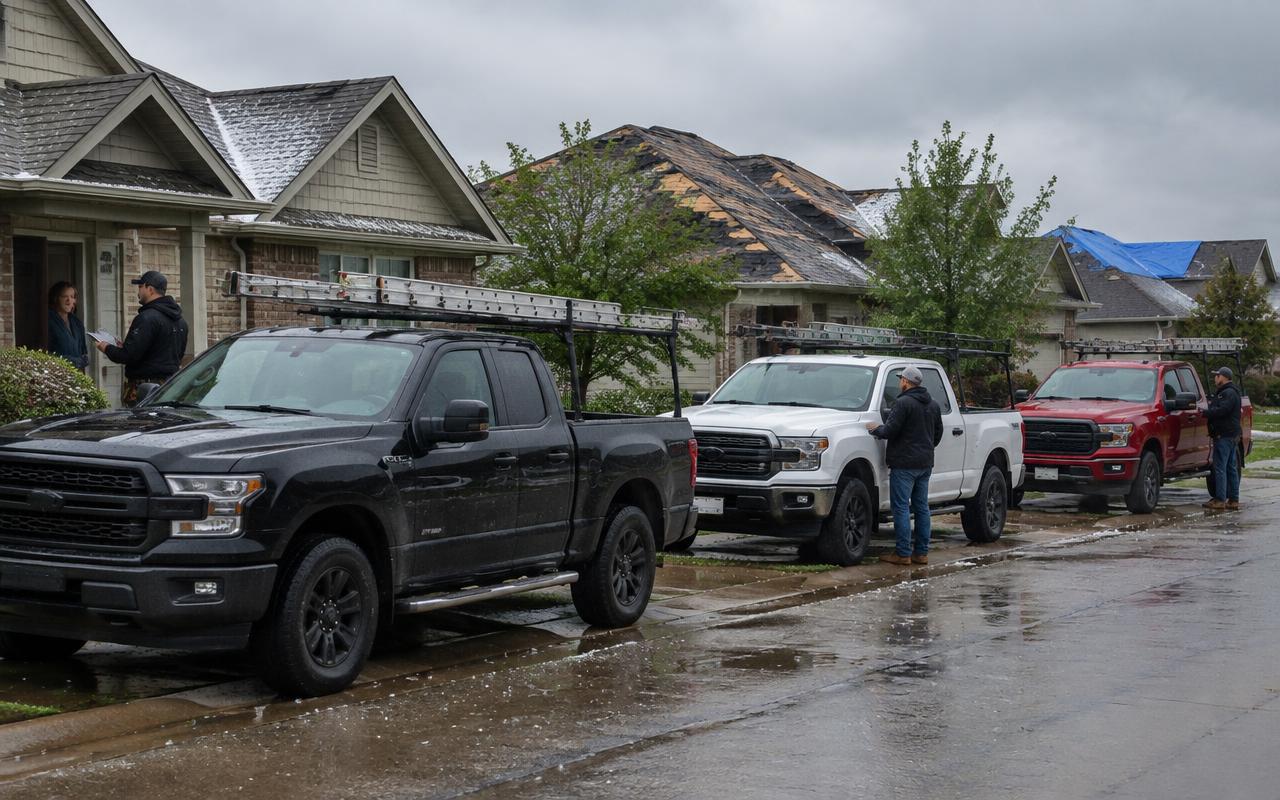
Think about the last big DFW hail event you worked. Within forty-eight hours the neighborhood was covered in door hangers, yard signs and strangers with clipboards. Homeowners got knocked on at dinner, on Saturday morning, and again on Sunday afternoon. Many of them stopped answering the door at all. The swarm trained them to distrust every roofer, including the local company that has been there for twenty years.
Then the price war starts. Out-of-state crews can quote low because they will be gone before the warranty call comes. You have a real office, real employees, real insurance and a reputation you have to protect. You cannot match a number that only works if nobody ever comes back. So you either cut your margin to the bone or you walk away from jobs you should have won.
Meanwhile the cost of chasing keeps climbing. Fuel. Canvasser pay. Truck wraps. Map subscriptions. Leaf-blowing through stacks of sales software. Long days for sales reps who knock a hundred doors to talk to a handful of people. Add it all up and many Dallas storm campaigns look busy but pay poorly. The hail map did not create that cost. Chasing the hail map did.
And the window is short. A DFW storm market stays hot for weeks, not months. If your plan depends on beating the swarm to every door, you are signing up for the hardest version of the roofing business, again and again, every time the sky turns green.
THE FAILED FIXWhy more data never fixed it
Most roofers respond to the Dallas swarm the same way: buy a better map. A paid hail tracker with finer swaths. A storm alert that fires faster. A canvassing app that plots every address in the swath. A data list of homeowners inside the polygon.
These tools are not useless. They are honest about what they do: they tell you where hail probably fell. But they cannot tell you who wants a roofer, who owns the house, who already signed with someone, or who is a renter with no say. And every serious competitor in DFW has the same tools. When everyone buys the same map, the map stops being an advantage.
Better data makes the race faster. It does not make you the only runner. That is the trap. You can spend more every season on storm data and still end up on the same doorsteps as everyone else, fighting over the same homeowners at the same shrinking margins.
THE REAL FIXOwn the call, not just the map
The fix is to stop chasing the storm and start owning the phone. When a homeowner in Plano or Frisco sees hail damage, the first thing many of them do is search. They type roof repair near me, hail damage roof, or roofer plus their town name. Whoever shows up and answers that search gets the call.
Rent Roofing Sites builds and ranks local roofing sites for specific towns. When a homeowner searches and calls, that call is routed to one roofer for that territory: the roofer who holds it. Not three. Not a shared list. One. The homeowner chose to call. You did not knock. That conversation starts with trust instead of suspicion.
Holding an exclusive town territory means the swarm can knock all they want. The homeowners who go looking for help, the ones who call instead of waiting for a knock, reach you. You stop racing the map and start answering homeowners who asked for help.
01Why DFW is different from almost every other hail market
Dallas–Fort Worth combines three things that make hail roofing intense: frequent spring hail, a huge number of homes, and fast-growing suburbs full of newer subdivisions with similar roofs. When a storm crosses Collin County or Tarrant County, it can touch thousands of roofs in an afternoon.
That density is a blessing and a curse. It means a single storm can create months of work. It also means a single storm is worth flying a crew across the country for. Smaller metros do not attract the same swarm, because the math does not justify the trip. DFW always justifies the trip.
So the question for a DFW roofer is not whether hail will come. It will. The question is whether you want to win the next storm the way everyone else does, by racing, or the way a few local companies do, by being the one homeowners already found.
02What a Dallas hail map actually measures
Most hail maps start from radar. NOAA's NEXRAD radars around DFW scan the sky every few minutes, and modern dual-polarization radar helps estimate where hail is likely and how large it may be. Many maps then add public storm reports from spotters and the National Weather Service.
That is useful science. It is also an estimate. A hail swath is a probability drawn over a map. Some roofs inside the swath have no real damage. Some roofs just outside it do. And none of the radar data tells you anything about the person living in the house.
Use the map as weather context. Do not mistake it for a lead list. A lead is a person who wants help. Radar cannot find that person for you. A search and a phone call can.
- Radar shows where hail was likely, not which roofs were damaged.
- Storm reports confirm hail somewhere, not on a specific house.
- No hail map shows ownership, intent, or whether a competitor already signed the job.
03The hidden cost of a DFW storm campaign
Most roofers never add up the full cost of a storm push, because the costs land in different places. The map subscription is on one card. Canvasser pay is in payroll. Fuel is in the truck budget. Yard signs and door hangers are in marketing. The lost margin from matching low quotes never shows up on any bill at all.
Put them together and divide by the number of signed jobs. That is your real cost per job from map chasing. Now compare it with any job that came from a homeowner who called you first. For most roofers, the inbound job costs less, closes faster, and holds a better price.
That gap is the whole argument for owning the inbound channel in your town. You are not paying to race. You are positioned where homeowners are already looking.
04How the exclusive territory model works in DFW
We build a local roofing website for a specific town, such as Frisco, Allen, Rockwall or Keller. We work to rank it for the searches local homeowners actually use. We give it a local tracking phone number and a simple request form.
When a homeowner calls or fills the form, the lead is saved in our system first, so it is never lost. Then it routes to the one roofer who holds that territory. You see the call, the recording when available, the address and the roofing need in your portal. If you use a CRM, we can deliver the lead there too.
No other roofer gets that lead. We do not sell the same homeowner to three companies. That single rule is what makes the model work. It protects your close rate and your price.
05What the pilot does not promise
We will not promise a number of calls. Search results move, storms come and go, and every town is different. Anyone who guarantees you a fixed number of roofing leads from organic search is guessing, or worse.
What we do promise is exclusivity during the pilot, honest tracking of every call and form we route to you, and clear written terms before any money changes hands after the pilot. You can see the calls yourself. You decide if it is worth keeping.
06Who this is for
This fits DFW roofers who have a real local office, can answer the phone during business hours, and want steady inbound work instead of a feast-or-famine storm cycle. It fits companies that do inspections, repairs and replacements, and that want to keep their own CRM and process.
It is not for crews who only want to fly in after storms, and it is not for companies that cannot respond quickly to a homeowner who calls. An inbound lead is only valuable if someone answers it.
- Licensed and insured roofing company serving the town you want.
- Able to answer or return calls quickly.
- Willing to treat homeowners like neighbors, not targets.
07Storm season and the quiet months
One quiet benefit of owning a town is what happens between storms. Hail maps go blank in late summer and winter. Homeowners do not stop having leaks, aging roofs, wind damage or insurance questions. They keep searching. A ranked local site keeps answering those searches all year.
That smooths out your pipeline. Instead of hiring up for a storm and laying off after, you get a steadier flow of repair and replacement calls in your own backyard.
08A simple test you can run this week
Pick the DFW town where you most want to work. Search roof repair plus the town name on your phone. Look at who shows up. Count how many are truly local and how many are lead-sellers passing homeowners to several roofers at once.
Now imagine that every homeowner who called from that search reached only you. That is the position the pilot is built to give you. If your town is open, apply and we will tell you plainly whether we can hold it.
09Keep using your hail map, just differently
You do not have to cancel your hail tracker to try this. Many roofers keep a map for context: to know when a storm hit their town, to plan crews and to talk smart with homeowners and adjusters. The difference is that the map stops being your lead source. It becomes background.
Your lead source becomes the homeowner who searched and called. That shift, from chasing weather to answering people, is the whole idea behind an exclusive territory.