THE PROBLEMThe problem nobody puts in the demo
Type an address into a hail tracker and you get a neat answer: hail of a certain estimated size on a certain date near that property. For roofers, that feels like a gold mine. If you know hail hit the house, surely that homeowner needs you.
Maybe. But an address report answers a weather question. It does not answer the business question. It cannot say whether the roof was actually damaged, whether the owner noticed, whether they care, whether they already filed a claim, or whether another roofer signed them last week.
So roofers who build their pipeline on address hail reports end up with long lists of houses where hail probably fell, and very few homeowners who actually want a conversation. The list is real. The demand is a guess.
And because many tools sell the same address-level data, your list overlaps heavily with your competitors' lists. The same houses get mailed, called and knocked by several companies.
LET'S BE HONESTWhat it is really costing you
Picture the workflow. Pull a hail report for a neighborhood. Export the addresses. Send mailers, buy skip-traced numbers, or send reps door to door. Wait. Most homeowners never respond. Some respond angry because they did not ask to be contacted. A few become real conversations.
Each step costs money: the report, the list, the postage, the phone data, the labor. And every competitor with the same tool is doing the same thing to the same houses. Homeowners get flooded and tune everyone out.
There is also a trust problem. When a stranger contacts a homeowner and says hail hit your address on this date, some homeowners find it helpful. Many find it creepy. That first impression is hard to undo.
So you spend more to reach people who did not ask, in a crowded field, starting from suspicion. That is a tough way to grow a roofing business.
THE FAILED FIXWhy more data never fixed it
The usual next step is to buy better data: more precise hail size, more history, richer property details, owner phone numbers. Each upgrade adds cost and makes the list look sharper.
None of it creates intent. A more detailed list of homeowners who did not ask for help is still a list of homeowners who did not ask for help. And your competitors can buy the same upgrades.
Address hail tools are excellent for documenting a storm, supporting a claim conversation, or checking history on a house you are already inspecting. As a primary lead source, they keep you on the outbound treadmill.
THE REAL FIXOwn the call, not just the map
The roofer who wins is the one homeowners contact first. When a homeowner suspects hail damage, many of them search: hail damage roof repair, roofer near me, roof inspection plus their town. They pick someone and call.
Rent Roofing Sites builds and ranks local roofing sites for specific towns. When a homeowner calls or fills out the form, the lead routes to one roofer: the company holding that territory. You get the homeowner's name, phone, property ZIP and roofing problem, with permission to follow up because they asked.
Then the address hail report becomes what it should be: supporting evidence during an inspection the homeowner requested, not a cold list you pay to work.
01How address hail trackers work
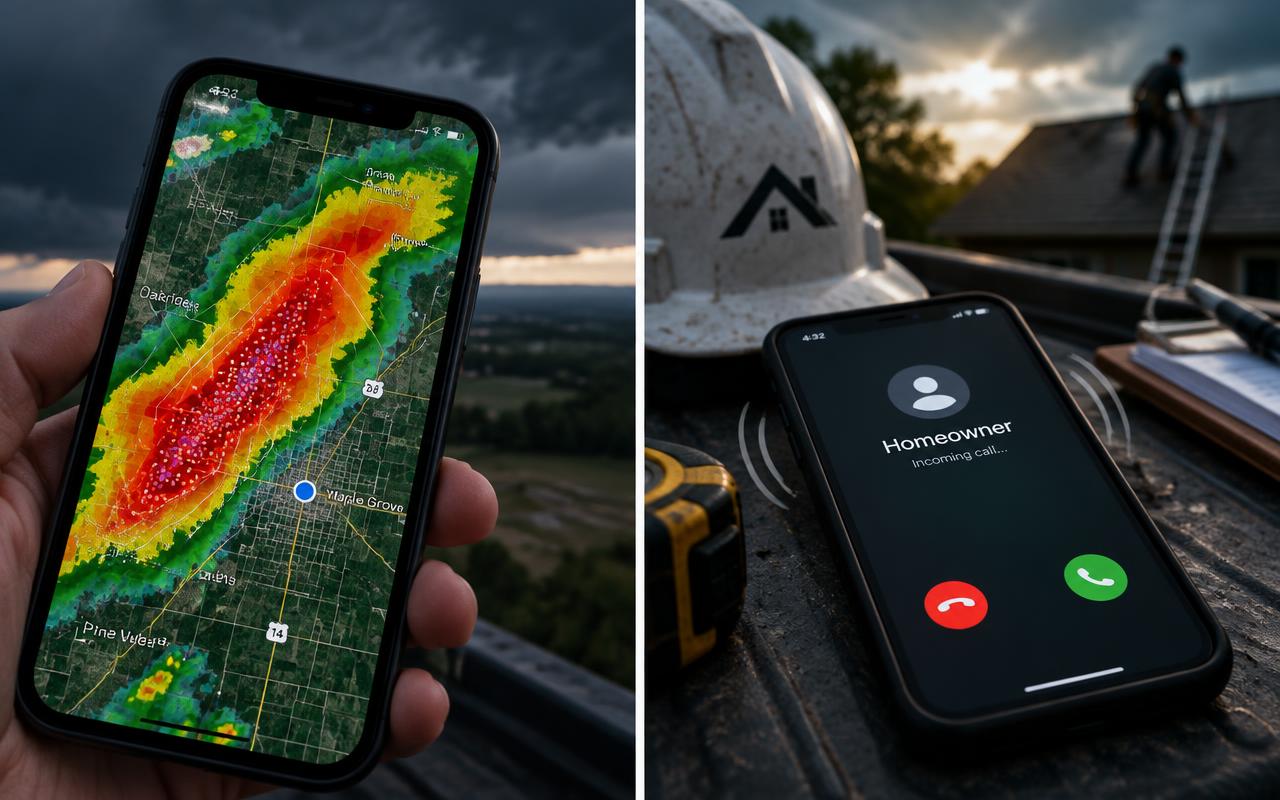
Most address hail tools start with radar. NOAA's NEXRAD radars measure storms, and algorithms estimate where hail likely fell and how large it may have been. Many tools also use public storm reports. The tool then checks how close a storm's estimated hail path came to your address and reports a likely size and date.
That is valuable for history. It is still an estimate. Radar sees the storm high in the air, not the shingles on one house. Wind, terrain and storm movement all affect what reached the ground. Some roofs in a reported area have no damage. Some outside it do.
- Good for: storm dates, rough hail size, claim timelines, inspection prep.
- Weak for: proving damage on a specific roof.
- Silent on: who owns the home and whether they want help.
02Why homeowners search hail history too
Homeowners use address hail lookups to check whether a storm may have hit their house before they call anyone. That search is a signal of interest. The homeowner is curious, maybe worried, and getting ready to act.
The best place to be is right after that moment: when they search for a local roofer to come look. That is exactly the search our territory sites are built to answer.
03The cost of working address lists
Add up a typical address campaign: the hail report, the list, skip tracing, postage or calling time, and rep hours. Divide by signed jobs. Now compare with jobs that started from a homeowner calling you.
Inbound usually wins because the hardest part of the sale, getting the homeowner to want a conversation, is already done.
04Privacy and respect matter
Homeowners are more aware than ever of who has their data. Cold outreach that starts with I know hail hit your address can feel invasive, and calling or texting people without proper consent can create legal risk too.
Inbound leads avoid that problem. The homeowner contacted you. You have a clear reason to follow up, and they expect to hear from you.
05How the exclusive territory works
We build a local roofing website for a town and work to rank it for real homeowner searches. Each site has a local number and a short form. Every lead is saved first so it is never lost, then routed to the one roofer holding that town.
You see every lead in your portal and can get them in your CRM. We do not sell that homeowner to other roofers.
06Using address hail history the right way
Once a homeowner calls and you schedule an inspection, an address hail report is a great tool. It helps you explain the storm timeline, set expectations, and prepare for an adjuster conversation if the homeowner decides to file a claim.
Just be honest with the homeowner: a hail report shows a storm likely passed nearby. Your inspection shows whether the roof was actually damaged.
07What the pilot promises and what it does not
We do not promise a number of calls. We promise exclusivity in your territory during the pilot, honest tracking for every routed lead, and written terms before any paid plan. You judge the results yourself.
08Who should apply
Licensed, insured roofing companies that answer their phones and want homeowners to come to them. Especially companies tired of paying for lists and mailers that rarely turn into conversations.
- Serves the town you want.
- Responds fast to inbound calls.
- Uses honest inspections, not scare tactics.
09Your next step
Pick the town you want to own. Apply for the Free Exclusive Territory Pilot. We will tell you plainly whether the town is open and how the pilot works. Keep your hail tracker for inspections. Let the calls come from homeowners who asked.
10Two ways to use the same address report
Roofer A buys an address hail report for a whole subdivision, exports the list and sends postcards and texts to every house. Most homeowners ignore them. A few complain. Several get the same postcard from two other companies that same week.
Roofer B receives a call from a homeowner in her territory who searched for a hail roof inspection. Before the visit, she pulls an address hail report for that one house. At the kitchen table, she shows the homeowner the storm date and estimated hail size, then walks them through her inspection photos. The report becomes proof that supports a conversation the homeowner asked for.
Same data. One roofer used it to interrupt strangers. The other used it to serve a homeowner who called. The second approach is cheaper, more respectful, and far more likely to end in a signed job.
11What homeowners really want after a storm
Most homeowners do not want a sales pitch after a hailstorm. They want answers. Did the storm hurt my roof? Do I need to do anything? Who can I trust to tell me the truth?
When a homeowner searches and calls, they are asking those questions out loud. A roofer who answers clearly, inspects carefully, and explains the evidence earns trust fast. That is why inbound calls close better than any list.
12Questions to ask before buying address data
Who else is buying this same list? Do I have consent to call or text these homeowners? How many of these homes are rentals? What will it cost me per signed job, after postage, phone data and labor?
If the honest answers make you uneasy, test inbound first. The pilot lets you see real calls from your territory without a setup charge.
13How a territory lead reaches you
A homeowner in your town wonders if last week's hail hurt the roof. They search, find our local site, and call or fill out the short form with their name, phone, property ZIP and problem. The lead is saved the moment it arrives, so it cannot be lost, and then it routes to your company alone.
You see it in your portal with a recording when available, and we can send it to your CRM where supported. Now you can pull an address hail report for that one house, show up prepared, and have an honest conversation with a homeowner who asked for it.
That is the right order: homeowner first, address data second. It costs less, it respects people's privacy, and it turns your hail tool into a strength instead of a cold-calling list.
14Three address-data myths
Myth one: if hail hit the address, the homeowner needs a roof. Many roofs come through storms fine. Only an inspection can tell, and only a willing homeowner will let you do one.
Myth two: more precise data means more sales. Precision tells you more about the storm. It tells you nothing new about the person inside the house.
Myth four: address tools and inbound calls compete. They work best together. The homeowner calls first, and then the address report helps you explain the storm at the kitchen table.
Myth three: everyone hates being contacted, so inbound cannot work. Homeowners do not hate roofers. They dislike being interrupted by strangers. When they search and call, they welcome the conversation.